-
Compose Key Sequences for Useful Unicode Characters
If you activate a Compose key on your keyboard:
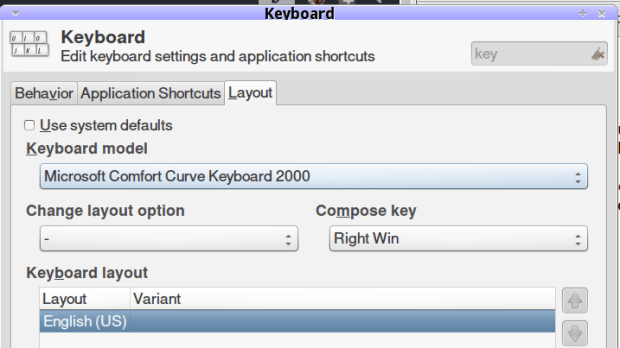
Compose key selection Then you can insert Unicode characters without memorizing their hex values. Of course, you must memorize the Compose key sequences. Fortunately, they’re more-or-less mnemonic for the ones I occasionally use, which are hereby cherrypicked from that list.
Press-and-release the Compose key (right-Win), then type the characters as shown to get the symbol in quotes:
- o c “©” copyright # COPYRIGHT SIGN
- o o “°” degree # DEGREE SIGN
- o r “®” registered # REGISTERED SIGN
- t m “™” U2122 # TRADE MARK SIGN
- s m “℠” U2120 # SERVICE MARK
- . . “…” ellipsis # HORIZONTAL ELLIPSIS
- . – “·” periodcentered # MIDDLE DOT
- . = “•” enfilledcircbullet # BULLET
- + – “±” plusminus # PLUS-MINUS SIGN (∓ MINUS-PLUS is U2213)
- x x “×” multiply # MULTIPLICATION SIGN
- < < “«” guillemotleft # LEFT-POINTING DOUBLE ANGLE QUOTATION MARK
- > > “»” guillemotright # RIGHT-POINTING DOUBLE ANGLE QUOTATION MARK
- c / “¢” cent # CENT SIGN
- – – . “–” U2013 # EN DASH
- – – – “—” U2014 # EM DASH
- < – “←” U2190 # LEFTWARDS ARROW
- | ^ “↑” U2191 # UPWARDS ARROW
- – > “→” U2192 # RIGHTWARDS ARROW
- | v “↓” U2193 # DOWNWARDS ARROW
- = > “⇒” U21D2 # RIGHTWARDS DOUBLE ARROW
- ? ! “‽” U203D # INTERROBANG
- p o o “💩” U1F4A9 # PILE OF POO
- m u “µ” mu # MICRO SIGN
- d i “⌀” U2300 # DIAMETER SIGN
- 1 4 “¼” onequarter # VULGAR FRACTION ONE QUARTER
- 1 2 “½” onehalf # VULGAR FRACTION ONE HALF
- 3 4 “¾” threequarters # VULGAR FRACTION THREE QUARTERS
- 1 1 0 “⅒” U2152 # VULGAR FRACTION ONE TENTH (and similar)
- ^ 1 “¹” onesuperior # SUPERSCRIPT ONE (also 0 2 3 + -…)
- _ 1 “₁” U2081 # SUBSCRIPT ONE (also 0 2 3 + -…)
- e ‘ “é” eacute # LATIN SMALL LETTER E WITH ACUTE
- e ` “è” egrave # LATIN SMALL LETTER E WITH GRAVE
Producing Greek letters requires a “dead_greek” key, so it’s easier to start with bare hex Unicode values at U0391 (Α) and U03b1 (α) and work upward until you find what you need:
- U03A3 Σ uppercase sigma
- U03a9 Ω uppercase omega
- U03C3 σ lowercase sigma
- U03c9 ω lowercase omega
- U03c4 τ lowercase tau
- U03c0 π lowercase pi
- U0394 Δ uppercase delta
- U03F4 ϴ uppercase theta
- U03B8 θ lowercase theta
- U03D5 ϕ phi math symbol
- U03A6 Φ uppercase phi
- U03C6 φ lowercase phi
Odds and ends:
- U00a0 | | non-breaking space
- U2007 | | figure space (invisible digit space)
- U202F | | narrow space
- U2011 ‑ non-breaking hyphen
- U2030 ′ prime (not quote)
- U2033 ″ double-prime (not double-quote)
- U2018 ‘ left single quote
- U2019 ’ right single quote
- U201C “ left double quote
- U201D ” right double quote
- U2245 ≅ approximately equal
- U2264 ≤ less-than or equal
- U2265 ≥ greater-than or equal
- U221A √ square root
- U221B ∛ cube root
- U221C ∜ fourth root (yeah, right)
- U221D ∝ proportional to
- U2300 ⌀ diameter
- U25CA ◊ lozenge
- U2E3A ⸺ 2-em dash
- U2E3B ⸻ 3-em dash
If you set the keyboard layout to US International With Dead Keys, maybe you (definitely not I) could remember all the dead keys.

-
Subscribe
Subscribed
Have a WordPress.com account? Log in now.

