-
Squidwrench Electronics Workshop Session 6: Capacitors
Capacitors as charge-storage devices with An introduction to Function Generators & Oscilloscopes
Capacitor show-and-tell
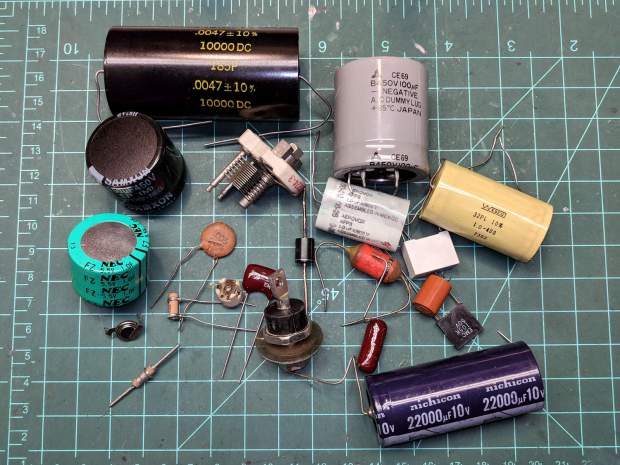
Capacitor show-n-tell Things to remember
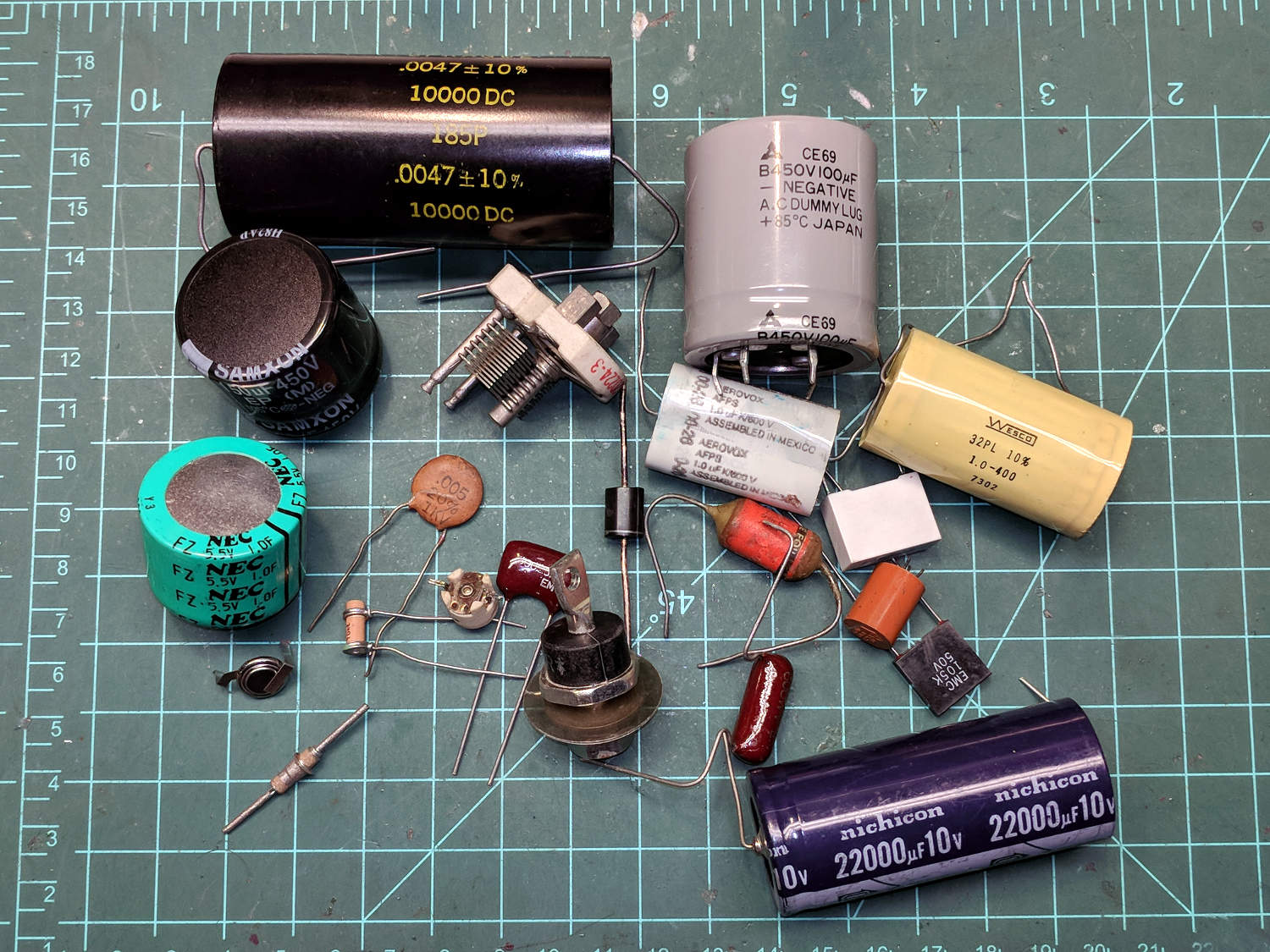
- The green one over on the left is the 1 farad cap my EE prof said I’d never see: “It would be as big as a house”
- The small disk in front of it is a 600 mF (milli, not micro) polyacene “battery” rated at 3.3 V
- Air-variable and wax-dielectric caps = ghosts from the past
- Reverse-biased diodes act as capacitors, due to charge separation
- Silver-mica caps are pretty things to behold
- Voltage rating vs size vs dielectric, a cap charged to 10 kV will get your attention
Warmup exercise: Measure the caps with a variety of meters, noting they do not reach 1 farad. General patter, Q&A, introducing equations as needed.
I will resolutely squash all discussion of capacitors as analog / small signal circuit elements.
Cap construction
- C = εA/d with ε = dielectric permittivity = ε0 × εR
- ε0 = vacuum permittivity = 8.84 × 10⁻¹² F/m
- εR = relative permittivity, air = 1.0006
- dielectrics: wax vs paper vs plastics vs whatever
- ignoring dissipation factor for now
- caution on dielectric absorption
- electrolytic caps vs capacitor plague
- brave / daring / foolish: aluminum foil with chair mat dielectric (εR ≈ 3)
Useful equations
- C = Q/V and (nonlinearly) C = Δq/ΔV
- thus Q = C × V, Δq = C × Δv = Δc × V
- by definition, i = Δq/Δt, so i = C × Δv/Δt
- “displacement current” vs “actual current”
- stored energy = 1/2 × C × V²
Quick demo
- charge 1 F cap to 3.7 V at 20 mA from constant current power supply
- estimate charge time
- plot V vs T
- disconnect power supply, connect white LED, observe light output for the next few hours
Capacitor applications in charge-storage mode
- Constant current → voltage ramp (scope horizontal)
- Large cap = no-corrosion (kinda sorta) small-ish battery
- Change plate d → microphone (need V)
- Trapped charge in dielectric → Electret mic (no V, but need amp)
- Change C (varactor) → parametric low noise amplifier (narrowband)
Parallel caps
- C = C1 + C2
- expanded plate area “A”
- capacitor paradox vs reality: never switch paralleled caps!
Series caps
- 1/C = 1/C1 + 1/C2
- increased separation “d”, sorta kinda
- floating voltage on center plates = Bad Idea
Now for some hands-on lab action
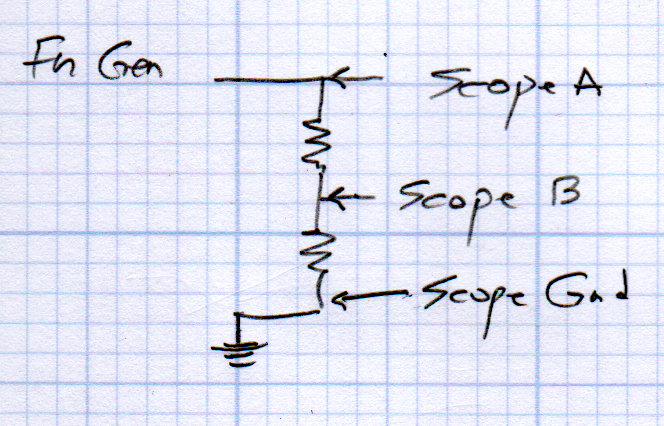
Connect function generator to resistor voltage divider
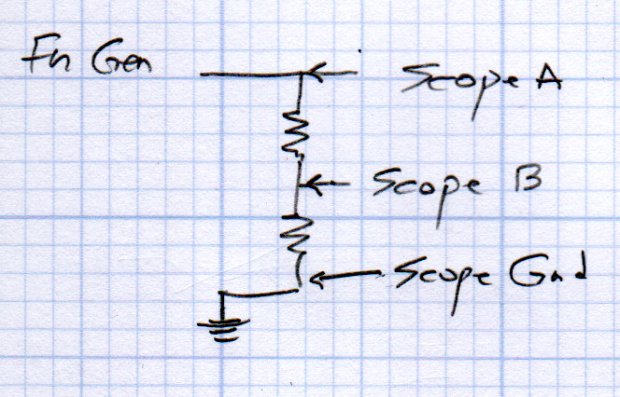
Resistor voltage divider – oscilloscope connections - calculate total resistance and series current
- calculate expected voltages from current
- show input & output waveforms on scope
- overview of oscilloscope controls / operations
Replace lower R with C, then measure V across cap
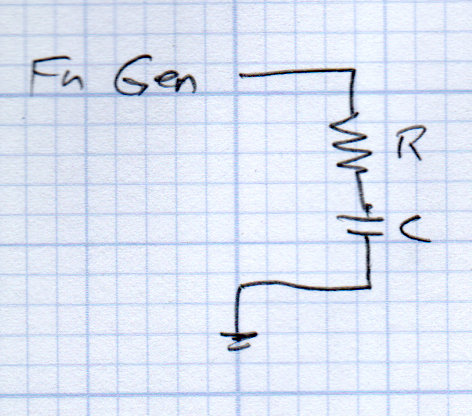
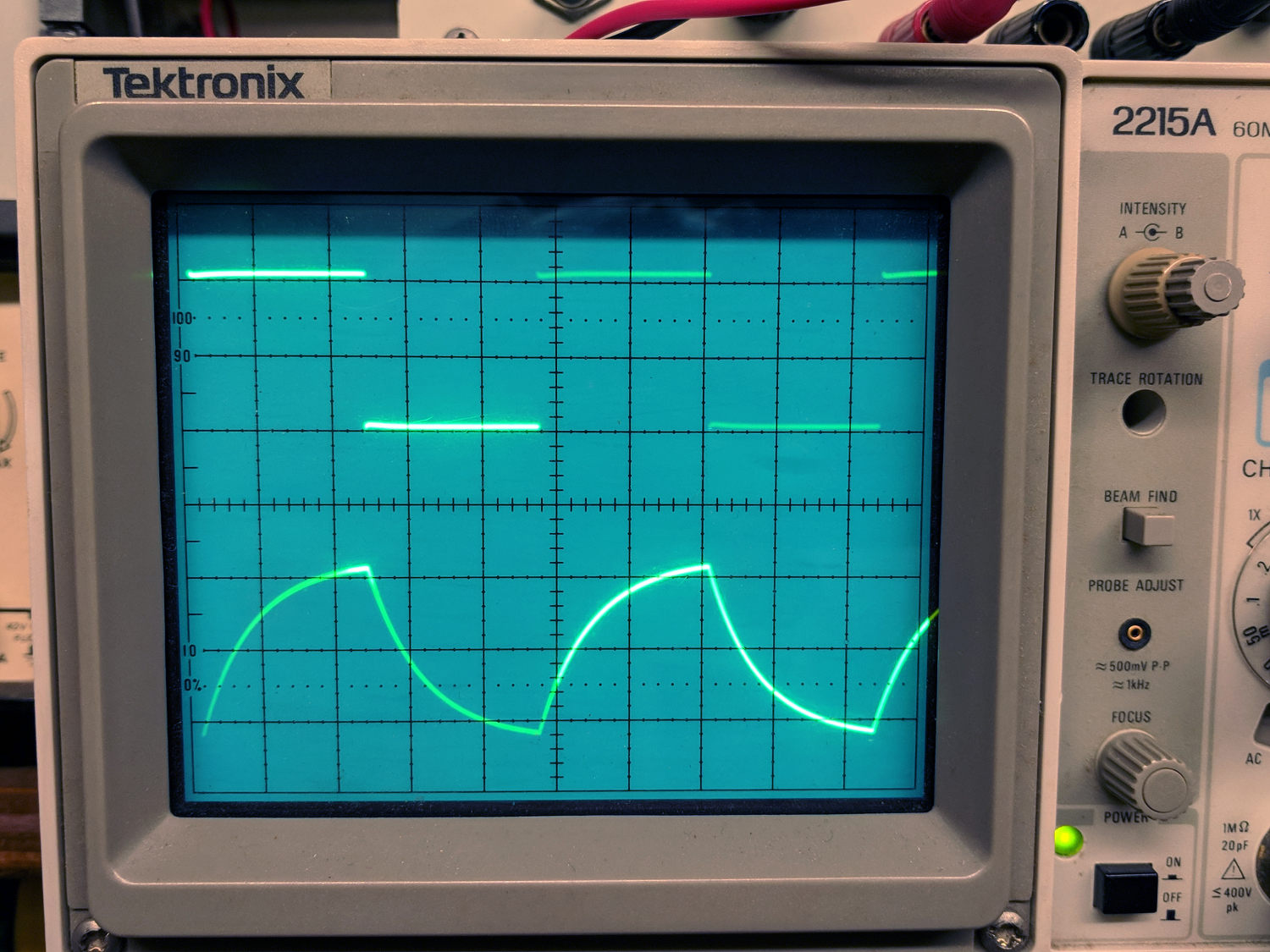
RC Circuit – integrator - series circuit: fn gen → R → C (C to common)
- scope exponential waveform across C
- not constant current → not linear voltage ramp
- except near start, where it’s pretty close
- e^-t/τ and (1 – exp(-t/τ))
- time constant τ = RC (megohm × microfarad = ohm × farad = second)
- show 3τ = 5% and 5τ < 1%
- integration (for t << τ)
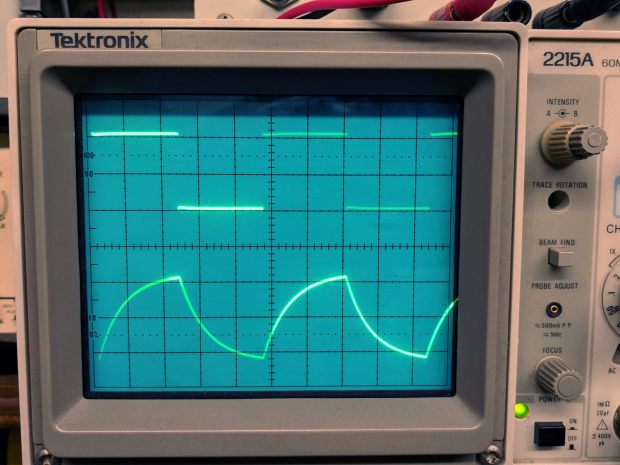
Tek 2215A oscilloscope – cap as integrator Flip R and C, measure V across resistor
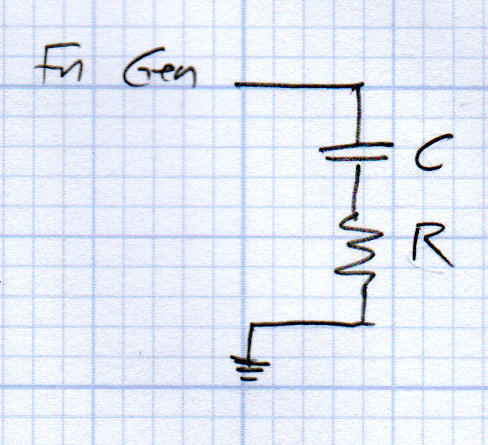
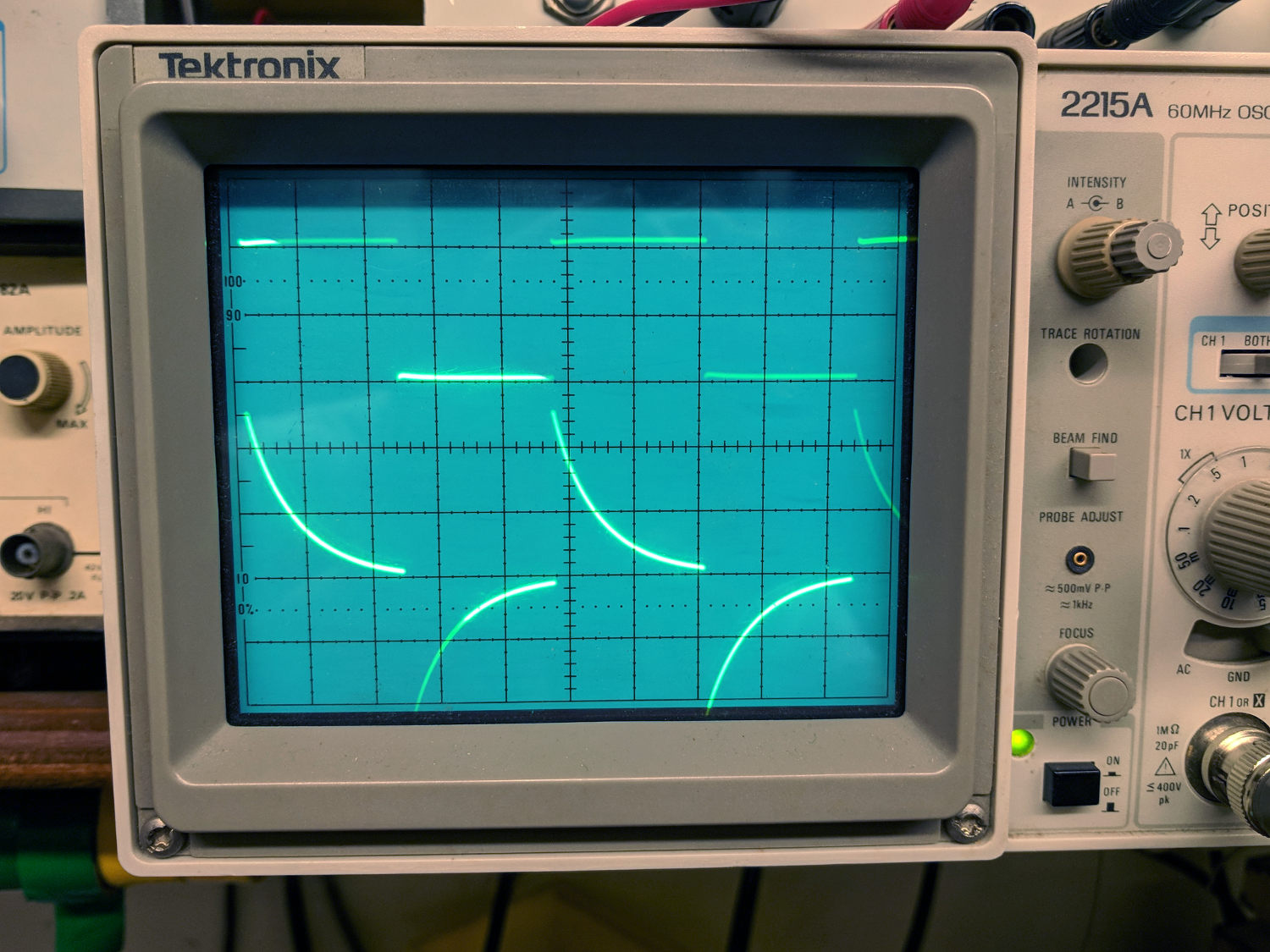
RC Circuit – differentiator - series circuit: fn gen → C → R (R to common)
- scope exponential waveform across R ∝ current through cap (!)
- same time constant as above
- differentiation (for t << τ)
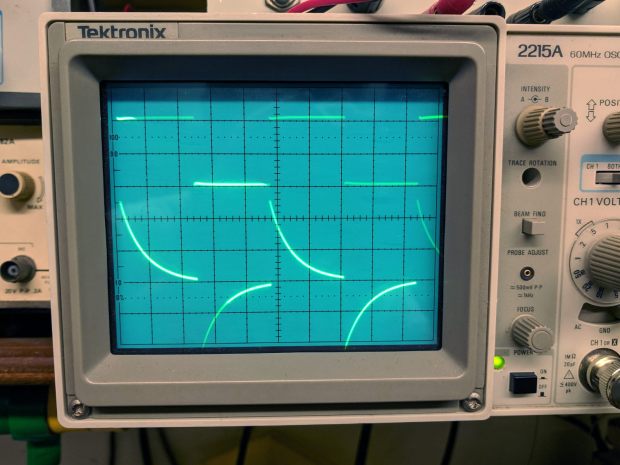
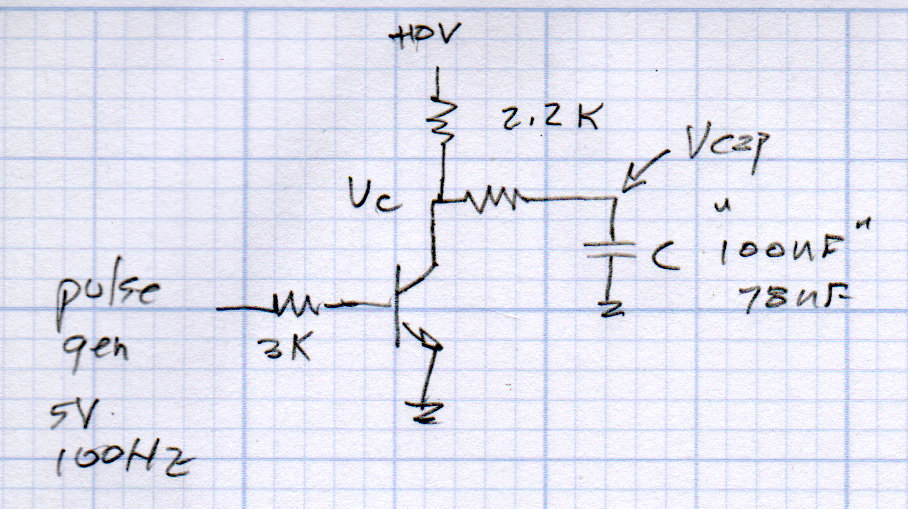
Tek 2215A oscilloscope – cap as differentiator If time permits, set up a transistor switch
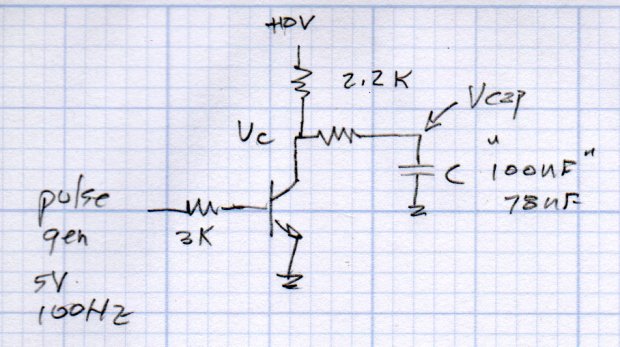
NPN switch – Cap charge-discharge - display voltage across cap
- measure time constants
- calculate actual capacitance
Other topics to explore
- measure 1 F cap time constant, being careful about resistor power
- different function generator waveforms vs RC circuits
- scope triggering
- analog vs digital scope vs frequency
All of which should keep us busy for the better part of a day …
-
Subscribe
Subscribed
Have a WordPress.com account? Log in now.

