-
Drag Knife Calibration: Downforce and Speed
The drag knife faceplant suggested I must pay a bit more attention to fundamentals, so, with a 60° drag knife blade sticking out a reasonable amount, the next step is to see what effect the cutting “depth” (a.k.a. downforce) and speed have on the outcome.
A smidge of GCMC code later:

Drag Knife Cal – depth – overview – Camotics sim It’s not obvious, but each pattern steps downward by 0.5 mm from left to right. With the spring force equal to 375 g + 57 g/mm, the downforce ranges from 400 to 520 g over the five patterns.
Laminated scrap, meet drag knife:
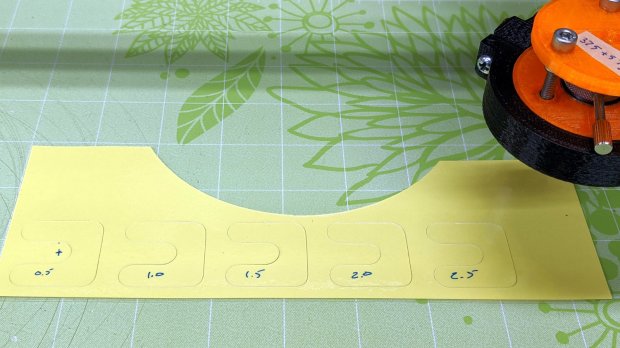
Drag Knife Cal – Depth – as cut Pulling up on the surrounding scrap left the patterns on the sticky mat:
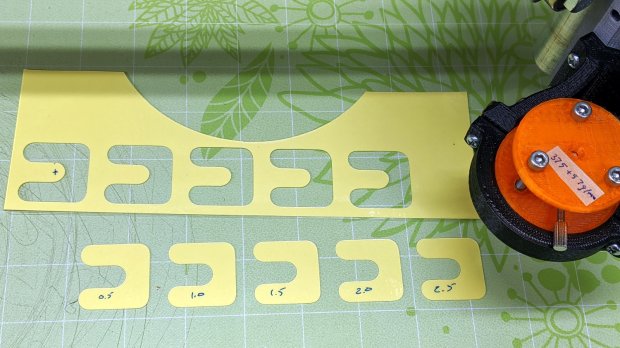
Drag Knife Cal – Depth – extracted Which suggested any cutting force would work just fine.
Flushed with success, I cut some speed variations at the minimum depth of Z=-0.5 mm = 400 g:

Drag Knife Cal – Speed – 0.5 mm – as cut The blade cut through the top laminating film, the paper, and some sections of the bottom film, but mostly just scored the latter.
Repeating at Z=-1.5 mm = 460 g didn’t look much different:
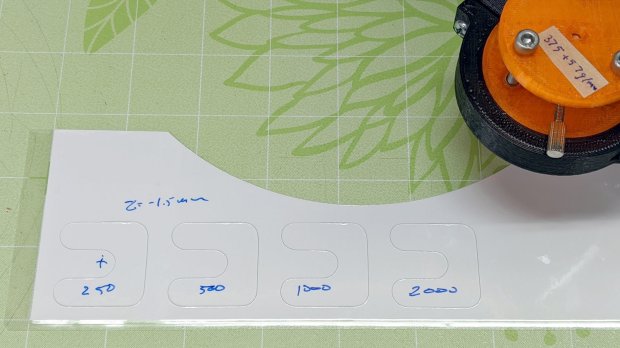
Drag Knife Cal – Speed – 1.5 mm – as cut However, the knife completely cut all the patterns:

Drag Knife Cal – Speed – 1.5 mm – extracted As far as I can tell, the cutting speed doesn’t make much difference, although the test pattern is (deliberately) smooth & flowy like the Tek CC deck outlines. I’d been using 1000 mm/min and 2000 mm/min seems scary-fast, so 1500 mm/min may be a good compromise.
The GCMC source code as a GitHub Gist:
This file contains hidden or bidirectional Unicode text that may be interpreted or compiled differently than what appears below. To review, open the file in an editor that reveals hidden Unicode characters. Learn more about bidirectional Unicode characters// Calibrate Drag Knife – speed & feed // Ed Nisley – KE4ZNU // 2020-03 values for MPCNC //—– // Dimensions CutIncr = -0.5mm; BottomCutZ = -2.5mm; SpeedRatio = 2.0; MaxSpeed = 2000mm; MinSpeed = MaxSpeed / 8; StripWidth = 10mm; CornerRadius = StripWidth/2; PatternSize = StripWidth * [3,3]; PatternSpace = 1.25; SafeZ = 10.0mm; // above all obstructions TravelZ = 2.0mm; // within engraving / milling area FALSE = 0; TRUE = !FALSE; if (!isdefined("TestSelect")) { TestSelect = "Depth"; } comment("Test Selection: ",TestSelect); //—– // One complete pattern // Centered at ctr, ctr.z=cut depth function Pattern(ctr) { local d1 = CornerRadius; // useful relative distances local d2 = 2*d1; local d3 = 3*d1; local d4 = 4*d1; goto([-,-,TravelZ]); // set up for entry move goto(head(ctr,2) + [-d2,d3]); move([ctr.x + d2,-,ctr.z]); // enter to cut depth arc_cw_r([d1,-d1],d1); move_r([0,-d4]); arc_cw_r([-d1,-d1],d1); move_r([-d4,0]); arc_cw_r([0,d2],d1); move_r([d2,0]); arc_ccw_r([0,d2],d1); move_r([-d2,0]); arc_cw_r([0,d2],d1); move_r([d4,0]); // re-cut entire entry path goto([-,-,TravelZ]); // exit to surface // goto(head(ctr,2)); } //—– // Start cutting! goto([-,-,SafeZ]); goto([0,0,-]); goto([-,-,TravelZ]); if (TestSelect == "Depth") { comment("Depth variations"); s = MaxSpeed / 2; feedrate(s); c = [0,0,-]; // initial center at origin for (c.z = CutIncr; c.z >= BottomCutZ; c.z += CutIncr) { comment("At: ",c," speed:",s); Pattern(c); c.x += PatternSpace * PatternSize.x; } } if (TestSelect == "Speed") { comment("Speed variations"); c = [0,0,-2mm]; // initial center at origin for (s = MinSpeed; s <= MaxSpeed; s *= SpeedRatio) { comment("At: ",c," speed: ",s); feedrate(s); Pattern(c); c.x += PatternSpace * PatternSize.x; } } goto([-,-,SafeZ]); goto([0,0,-]);
-
Subscribe
Subscribed
Have a WordPress.com account? Log in now.

