-
USB Testers vs. Reality
Set up a test harness with a USB tester between two amputated USB cables:
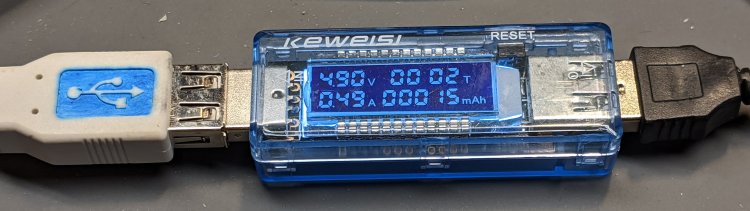
USB Testers – Keweisi plugged Input comes from a bench power supply:

USB Testers – 5 V input clips Output goes to an 8 Ω power resistor:

USB Testers – 8 ohm load Yes, it’s mounted on the isothermal block from back in the Thing-O-Matic days, disspating barely 2 W. Thermocouples FTW, but in this case I don’t care about the temperature.
Because these are random USB cables, they come with the usual caveats. Indeed, I measured a 9.8 Ω loop resistance (!) at the input end. The resistor is slightly under 8Ω, so the 1.8 Ω wire resistance suggests (at least) one of the USB cables contains very little copper. That’s measured without the USB tester in series, because it tries really hard to power up from the ohmmeter’s source voltage and basically shorts out the resistor.
Both testers accurately report the source voltage with no load, so I presume the voltage shown with current flowing through the resistor represents the actual voltage at the tester. The source cable drops a substantial voltage under load.
The 8 Ω resistor should draw 5 V / 8 Ω = 625 mA at 5 V. The voltmeter probes provide a non-intrusive way to measure the actual current by working backwards: current = volts / 8 Ω. As it turned out, the resistor sees less than 4 V with the bench supply set to 5.0 V.
So, we begin.
With the bench supply at 5.5 V, the Keweisi meter shows 4.9 V and 0.48 A with 4.0 V across the resistor for an actual 500 mA current. The source cable drops 600 mV, indicating a wire resistance of 1.2 Ω, about 2/3 of the total wire resistance.
The anonymous meter produces two different results for an actual 500 mA current, depending on nothing under my control:
- Supply 5.3 V, indicated 5.0 V and 0.5 A
- Supply 5.1 V, indicated 4.76 V and 0.5 A
Both results show about 300 mV source drop, half of the Keweisi meter’s 600 mV, suggesting a wire resistance of 0.6 Ω. The meter displays a blinking ▲, presumably indicating the input voltage is kinda high.
I have no explanation.
After the meters measured an actual 500 mA load for about an hour:
- Keweisi: 1.6 hr → 782 mA·h, should be 800 mA·h
- Anonymous: 1.0 hr → 515 mA·h, should be 500 mA·h
Which roughly agrees with the battery charge data:
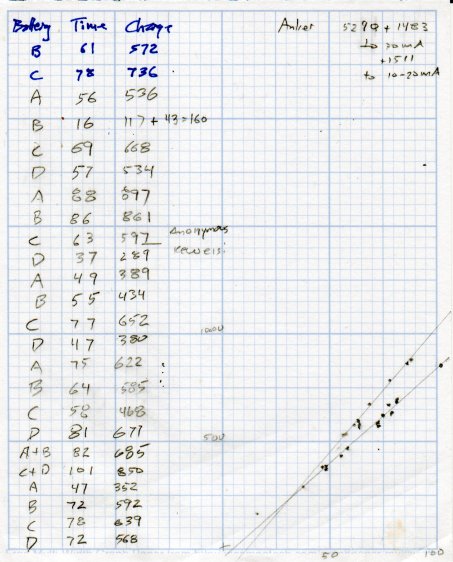
USB Testers – Charge vs Runtime The anonymous meter seems reasonably accurate, the Keweisi meter undershoots by 2.5%, and they’re both Close Enough for simple measurements.
There’s probably a duty cycle effect, too, because the battery charger presents a pulsed load, but I’m just not going to worry about it.
-
Subscribe
Subscribed
Have a WordPress.com account? Log in now.

