-
Tour Easy 1 W Amber Running Light: Firmware
Rather than conjure a domain specific language to blink an LED, it’s easier to use Morse code:
Herewith, Arduino source code using Mark Fickett’s Morse library to blink an amber running light:
// Tour Easy Running Light
// Ed Nisley - KE4ZNU
// September 2021

#include <morse.h>

#define PIN_OUTPUT	13

LEDMorseSender Morser(PIN_OUTPUT,(float)10.0);

void setup()
{
	Morser.setup();

    Morser.setMessage(String("qst de ke4znu "));
    Morser.sendBlocking();

//    Morser.setWPM((float)3.0);
    Morser.setSpeed(50);
	Morser.setMessage(String("s   "));
}

void loop()
{
	if (!Morser.continueSending())
		Morser.startSending();

}
Bonus: a trivially easy ID string.
A dit time of 50 ms produces a brief flash that’s probably about as fast as it can be, given that the regulator must ramp the LED current up from zero after its Enable input goes high. In round numbers, a 50ms dit corresponds to 24 WPM Morse.
Each of the three blanks after the “s” produces a seven element word space to keep the blinks from running together.
Sending “b ” (two blanks) with a 75 ms dit time may be more noticeable. You should tune for maximum conspicuity on your rides.
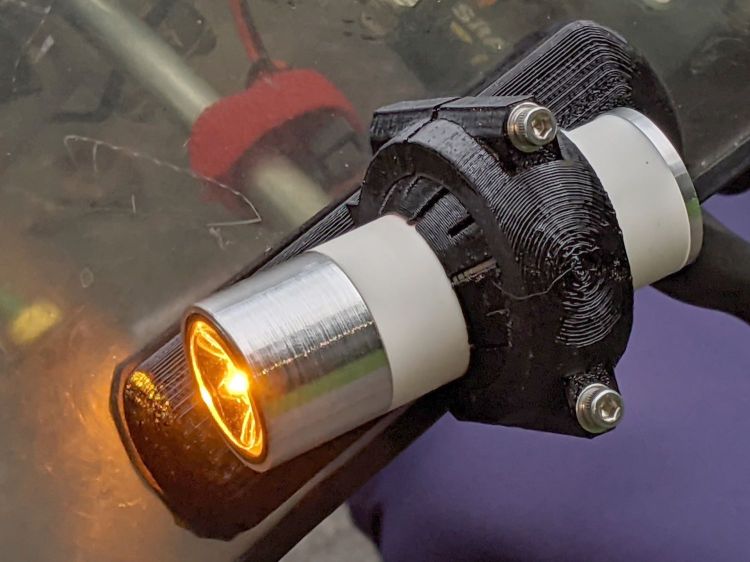
1 W Amber Running Light – installed front On our first ride, Mary got a friendly wave from a motorcyclist, an approving toot from a driver, and several “you go first” gestures at intersections.
Works for us …
-
Subscribe
Subscribed
Already have a WordPress.com account? Log in now.
 The Smell of Molten Projects in the Morning