Just to have something to work with, I cut a hex from a sheet of double-sided PCB stock and bonded the edges with copper foil:

Slightly wider tape on three edges will clear the board supports:
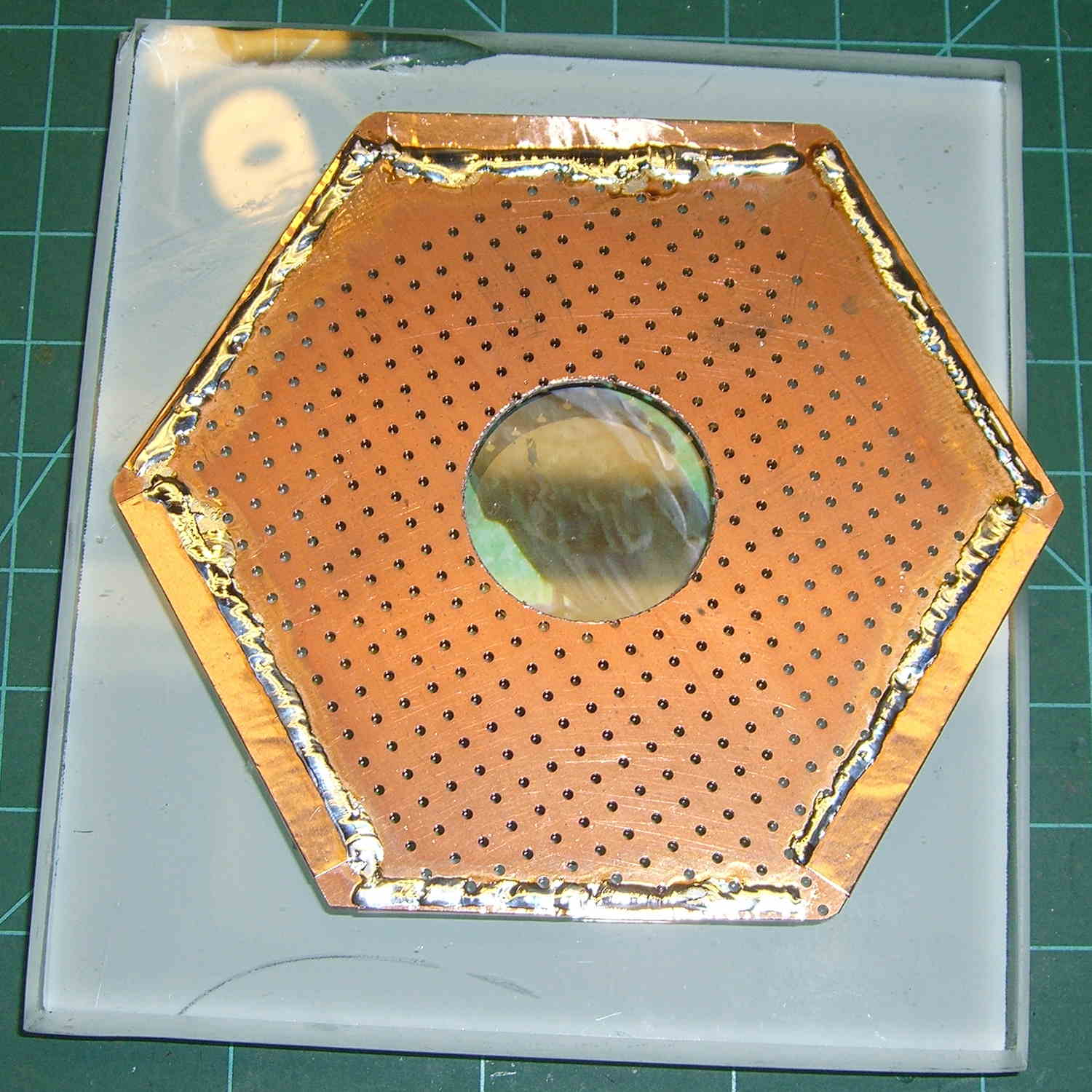
For unknown reasons, the PCB has arrays of plated-through holes firmly bonding the top and bottom copper, so that’s pretty much solid copper with a glass-epoxy core. I think somebody (else) harvested it from a locally important company many, many decades ago, but it arrived with no provenance.
The first pass at the electrometer circuitry will be air-wired for low leakage, which is pretty much the only way I have to actually get low leakage; the holes should help glue the parts to that copper plane.
I’m not at all convinced the big hole in the middle is strictly necessary. The chamber has 10 pF from pin to can that should swamp any stray capacitance unless I do something really stupid.
The copper foil stockpile remains hidden, so maybe I’ll build a shield from adhesive copper tape along the lines of the WWVB receiver shield in the Totally Featureless Clock:

Given my weak origami-fu and the need for hexagonality, I should print a 3D template.
It’s worth remembering that both the hex and the shield will be at the can’s +24 V potential, not “ground”. That makes no difference to the external circuitry, but will certainly cause me to blow a few junctions along the way.
 The Smell of Molten Projects in the Morning