Ed Nisley's Blog: Shop notes, electronics, firmware, machinery, 3D printing, laser cuttery, and curiosities. Contents: 100% human thinking, 0% AI slop.
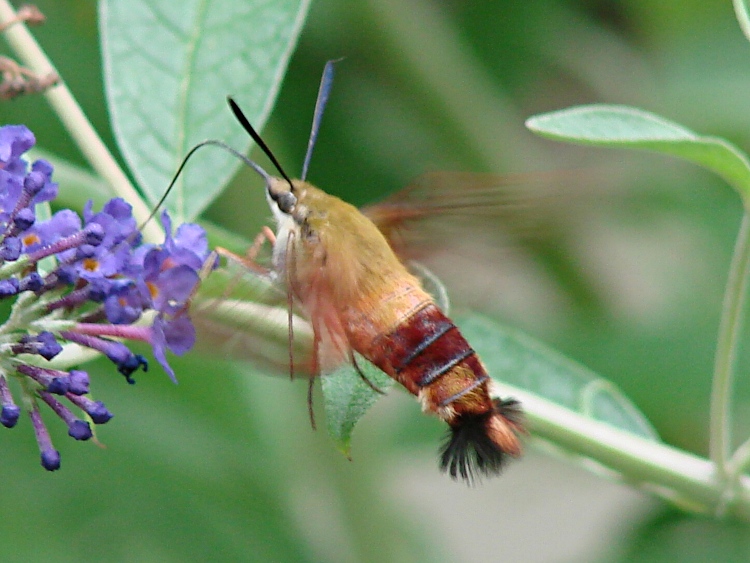
They’re heavy-bodied moths and, unlike those butterflies, never alight on the flowers to dine. Their wings are clear and never stop moving:
Hummingbird Moth – wing
It’s impossible to not see a face looking back at you, even though that’s a proboscis down the middle:
Hummingbird Moth – front
They don’t stay very long and are extremely flighty, so the picture are catch-as-catch-can: hand-held with the DSC-H5, roughly dot-for-dot crops, and only the last one got any color correction. I didn’t have time to set the usual one-stop underexposure, so the colors washed out a bit. I really like the first picture; almost all my mistakes canceled out.
The underwing shows four eye spots as distinguishing features:
Painted Lady – underwing
Painted Ladies have odd-looking “faces” on their front end:
Painted Lady – front
The proboscis works wonderfully well on deeper flowers than these, but they’re not passing anything up:
Painted Lady – proboscis
Another view:
Painted Lady – right side
The refueling tube stows neatly for flight:
Painted Lady – proboscis curled
One had a few notches taken from a wing:
Painted Lady – left rear
You can’t ask for prettier colors:
Painted Lady – right front
These are all hand-held with the DSC-H5 wearing the 1.7 teleadapter, underexposed by 1 stop to keep the dark background from burning out the butterfly colors. The images are very close to dot-for-dot crops from much larger pictures, with a touch of unsharp mask, and no color fiddling at all; bright daylight and a gorgeous subject come out beautifully!
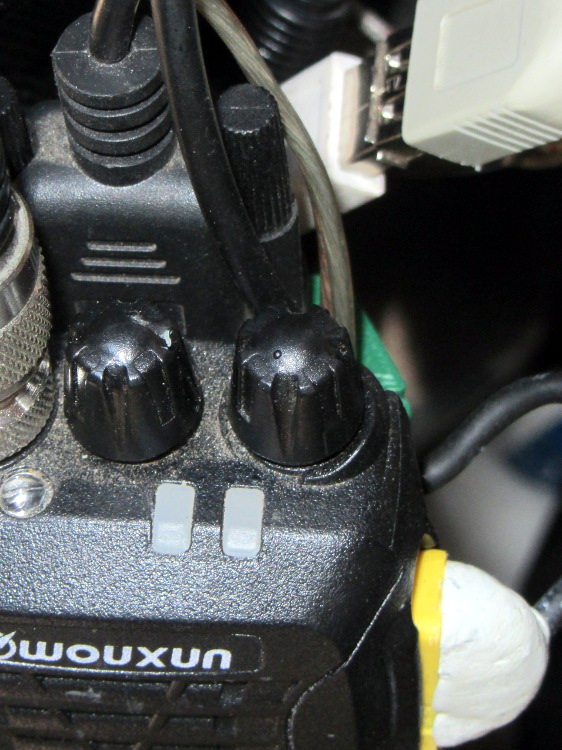
The volume / on-off control knob on our Wouxun KG-UV3D radios has the most minute raised dot you can imagine to mark its orientation. Yes, it’s another subtle black-on-black control! See if you can spot the dot:
Wouxun KG-UV3D – volume knob marking
The radio lives in a small pack attached to the back of the seat frame: we turn it with a fingertip and adjust the volume by touch; the dot is just barely perceptible to my finger. Nevertheless, WIBNI (Would It Be Nice If) you could look at the knob from a distance and determine whether the radio was turned on?
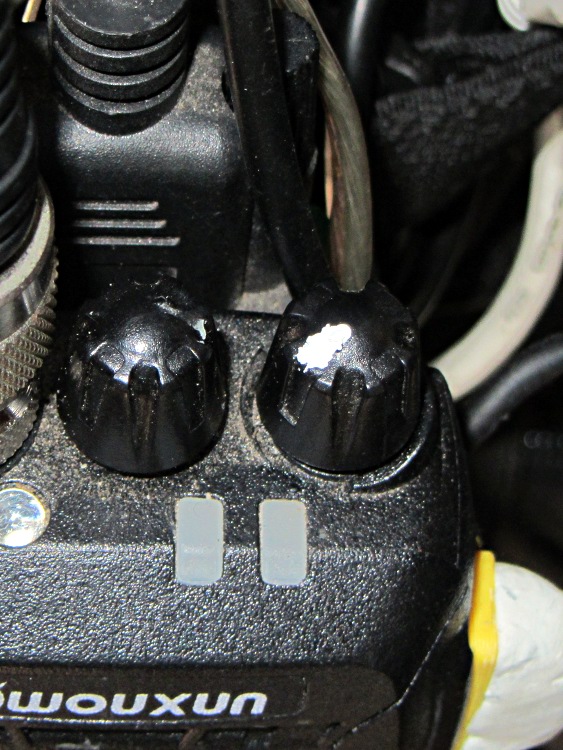
A dab of typewriter (remember typewriters?) correction fluid later:
Wouxun KG-UV3D – garish knob marking
Not elegant and sure to wear off after a while, but the smudge should remain visible forever.
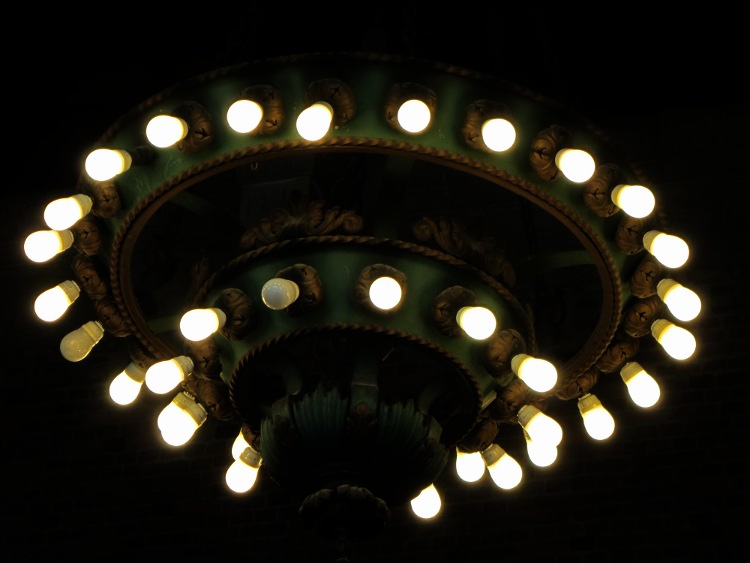
Each of the three chandeliers in the Poughkeepsie Train Station sports 36 bulbs in two rings. When the station opened in 1918 they installed those newfangled incandescent bulbs that were all the rage at the time. The color of the bulbs in this Wikipedia picture, dated October 2007, suggests that tungsten ruled for at least nine decades:
Poughkeepsie Train Station Interior
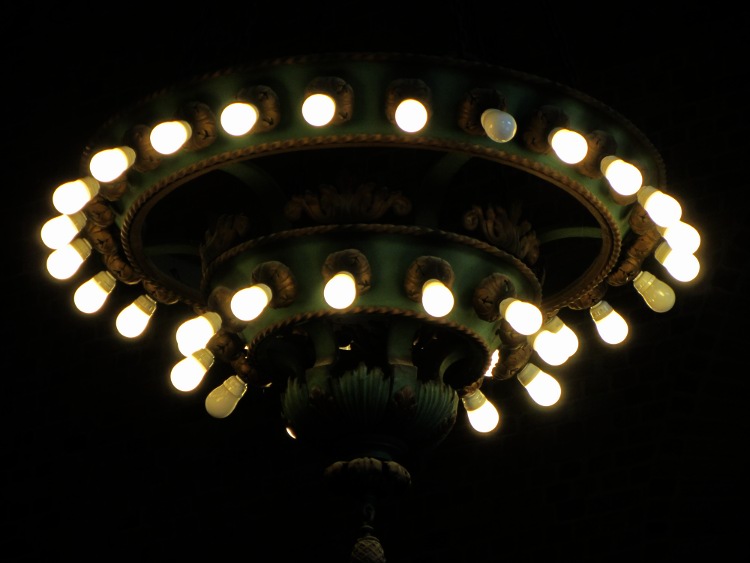
Since then, they installed chunky compact fluorescent bulbs that probably provide the same amount of light, minus the pinpoint highlights from tungsten filaments in clear bulbs. This view from below the central chandelier shows the layout and some detail of the carving & decorative sockets:
Pok RR Station Middle Chandelier – detail
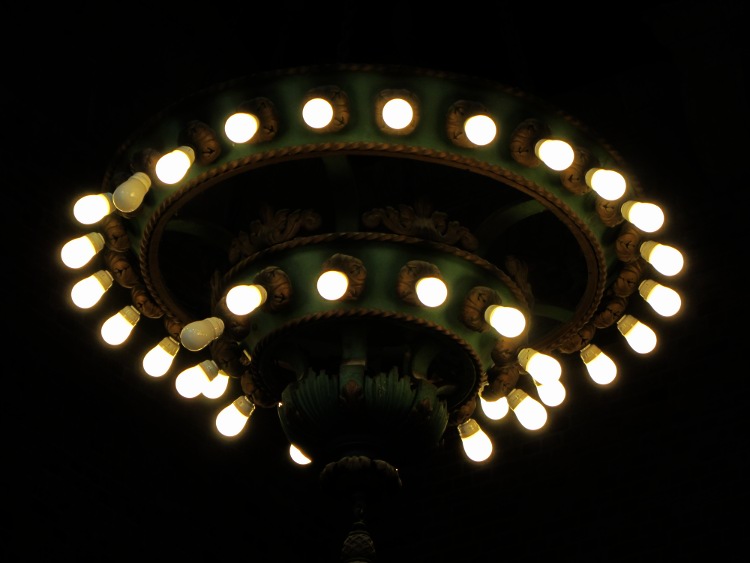
In addition to being decorative, those chandeliers also give useful data on the reliability of compact fluorescent bulbs. With the contrast stretched the other way to make the bulbs easier on the eye, count the number of deaders in …
Chandelier 1:
Pok RR Station Chandelier 1
Chandelier 2:
Pok RR Station Chandelier 2
Chandelier 3:
Pok RR Station Chandelier 3
I took each picture from a vantage point showing all the deaders; the bulbs hidden behind the central dingus work.
Let us assume all 108 bulbs were installed at the same time and, given the number of deaders, haven’t been touched since then (although they’re not covered in fuzz, which suggests that they’ve been dusted within living memory). I was there in mid-afternoon, so the bulbs probably burn 24 hours/day and aren’t subject to early failure from frequent starts.
So, in no more than five years, 108 CFL bulbs have a 4.6% failure rate, which works out to 0.9%/year, more or less, ignoring any infant mortality. If they’ve been up there for the last 2.5 years, then it’s 1.8%/year. Replacing deaders since installation, of course, makes it worse than that.
Over the course of a decade, a compounded 0.9% failure rate will kill 9.4% of the bulbs. After 20 years, 20% will be dead. A 1.8% annual failure rate kills 20% and 43%, respectively.
Now, I’ll grant you that tungsten bulbs burn far more energy over that time, but replacing a percent or two of those complex and somewhat eco-hostile CFL bulbs every year cuts away a big chunk of the rainbows-and-pink-unicorns delight involved in Saving The Planet.
The paving along Rt 376 just south of Raymond Avenue developed transverse ridges; evidently the old concrete roadway below the more recent asphalt cap is shifting. Bumps in the travel lane are not to be tolerated, so they milled off all the ridges. Problem solved!
Of course, the remaining asphalt isn’t thick enough to withstand any stress and promptly crumbles:
NYS DOT joint milling quality
Although the shoulder may appear to be wide enough for bicycle traffic, the debris strewn along it makes for a perilous journey: the larger chunks are bigger than my fist. Several of the milled joints along the unimproved section of Raymond and that stretch of 376 are disintegrating, so it’s not like they got just this one wrong.
Doesn’t bother the DOT one little bit, because their idea of a “shared use facility” is a sign with a picture of a bicycle, labeled Share The Road. As long as the travel lane seems mostly passable by automobiles, their job is done.
For reasons irrelevant to this discussion, I wound up looking at http://widestat.com/softsolder.com, which gave this view of my blog (typos in original, emphasis mine):
Softsolder.com has #12,773,578 traffic rank in world by Alexa. … Out of the 6 unique keywords found on softsolder.com, “chicken ark” was the most dense. … This site has Google PageRank™ 3 of 10.
OK, so it’s not a high-traffic site. I can live with that.
But … chicken ark?
If you search herein for chicken you’ll come up with zero hits (apart from this one) in the posts. Unleashing Google with site:softsolder.com chicken digs up some comments, none of which discuss arks. I have absolutely no idea where Widestat came up with that, which makes me distrust their conclusions even more.
Our Larval Engineer acquired a free bicycle to get around at school: a Rollfast “girl’s bike” dating back to 1972 with 105 miles on the odometer. She completely dismantled it, cleaned everything, reassembled it in reverse order, and added a rear rack & panniers. Having touched every part of the bike, she’s now in a much better position to fix whatever may go wrong in the future.
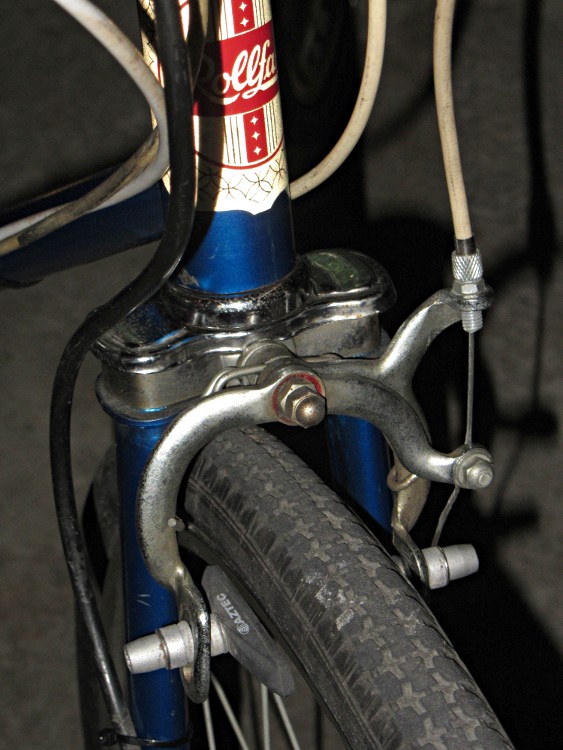
It was an inexpensive bike to start with and we left everything as-is, with the exception of the brake pads. You’re supposed to bend the brake arms to align the pads with the rims, a technique which I didn’t like even back in the day. So we swapped the OEM pads with worn-but-serviceable Aztek pads sporting spherical washers:
They’re way grippier than the old pads, even on those chromed-steel rims. I had a bike with steel rims and old pads; given the slightest hint of water, it didn’t stop for squat. With any luck, the Azteks will at least slow this one down.
Although she wanted to take the Tour Easy, the bike must live outside under the apartment stairs all year and, frankly, that’d kill the recumbent in short order. Forgive me for being a domineering parent; when she has a good place to store a spendy bike, it’s hers for the taking.
We haven’t figured out how to mount the GPS/APRS tracker + radio and antenna. The evidence suggests she prefers to travel incognito from now on…













 The Smell of Molten Projects in the Morning