The Smell of Molten Projects in the Morning

Ed Nisley's Blog: Shop notes, electronics, firmware, machinery, 3D printing, laser cuttery, and curiosities. Contents: 100% human thinking, 0% AI slop.

Month: June 2012

  • Quilting Pin Caps: Recycled O-Ring

    While doing something else, I rediscovered the fact that common 5 gallon plastic bucket lids have an O-ring gasket that seals against the top of the bucket. Some seals are hollow tubes, some are solid rods:
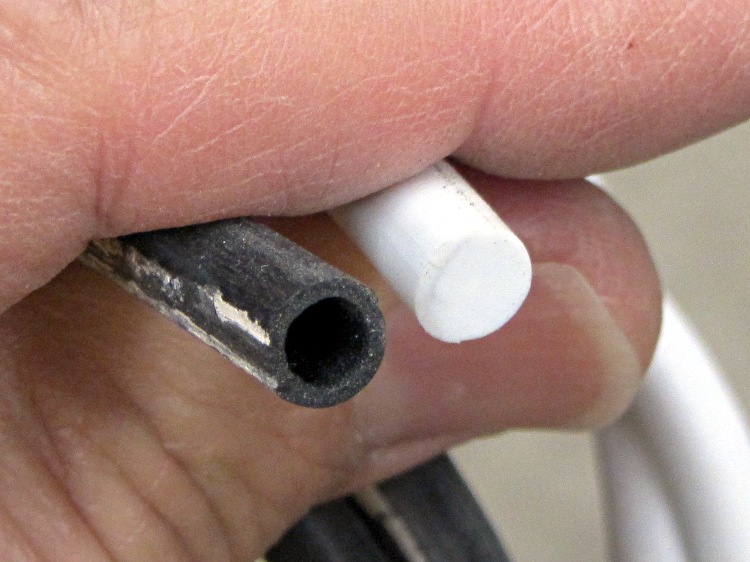
    5 gallon can lid gaskets
    5 gallon can lid gaskets

    The white O-ring has about the right consistency to serve as a quilting pin cap, along the lines of those 3D printed and silicone rubber filled cylinders. Although the rubber / plastic stuff isn’t quite as squishy as silicone snot, it holds the pin point firmly without much of a push.

    Chopping the O-ring into 10 mm sections produced another small box of prototypes:
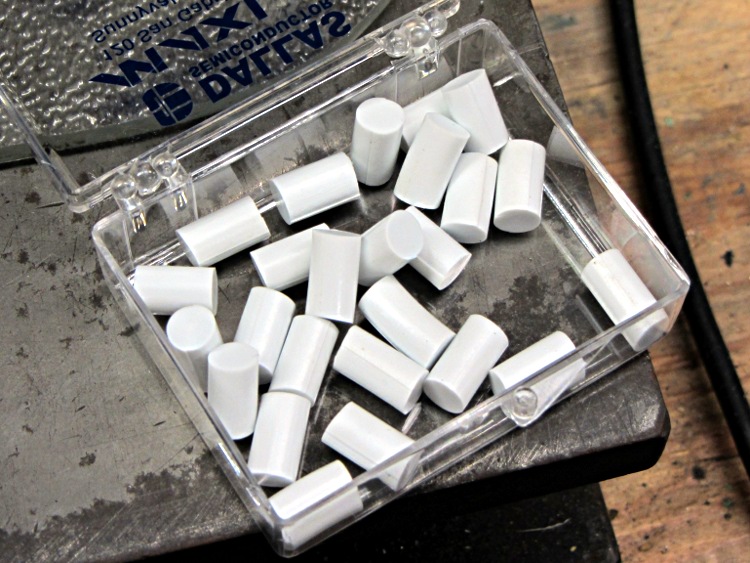
    Lid gaskets as pin caps
    Lid gaskets as pin caps

    Garden planting season remains in full effect, shoving all quilting projects to the back burner and delaying the evaluation phase of the project…
  • Arduino Survival Guide: First Pass

    I’ll be giving a short presentation for the Squidwrench meeting at /root in New Paltz this evening:

    Arduino Survival Guide for Squidwrench – 2012-06-12

    The general idea is to mention the things you need to know so you don’t kill your Arduino while fiddling around with the software side of the project.

    It’s a rather dense collection of facts & figures and I expect a whole bunch of Q&A activity… which should result in a better Survival Guide the next time around.

  • Powermonkey: Case Cracking

    Quite some time ago I got a Powermonkey Explorer set (the one with a solar panel charger) at a substantial closeout discount. After the marketspeak dissipates, it’s a single lithium-ion cell with a boost regulator and USB charger inside a screaming yellow case (the new ones seem more subdued) that’s somewhat water resistant, along with a kit of adapters for various widgets & phones. It stopped charging from the solar panel or a USB port, which suggested that I had little to lose by cracking it open.

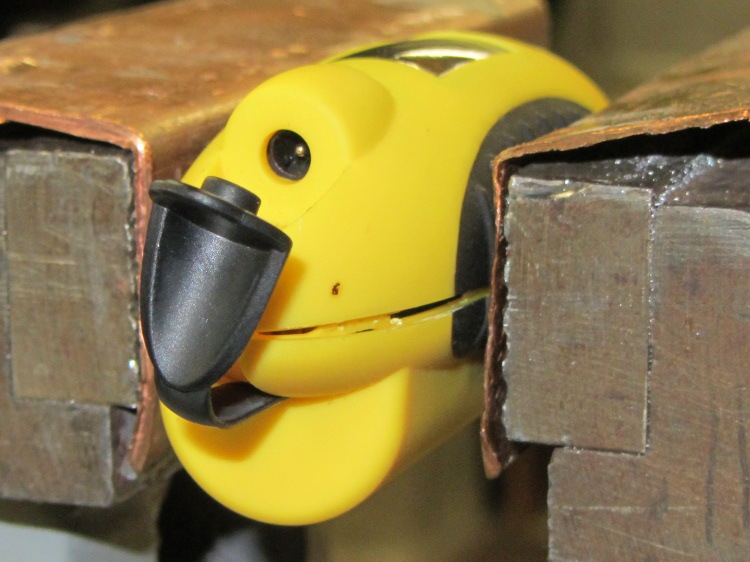
    It’s an odd shape, but grabbing it across the equator and applying gentle pressure cracked one side:

    Cracking Powermonkey case
    Cracking Powermonkey case

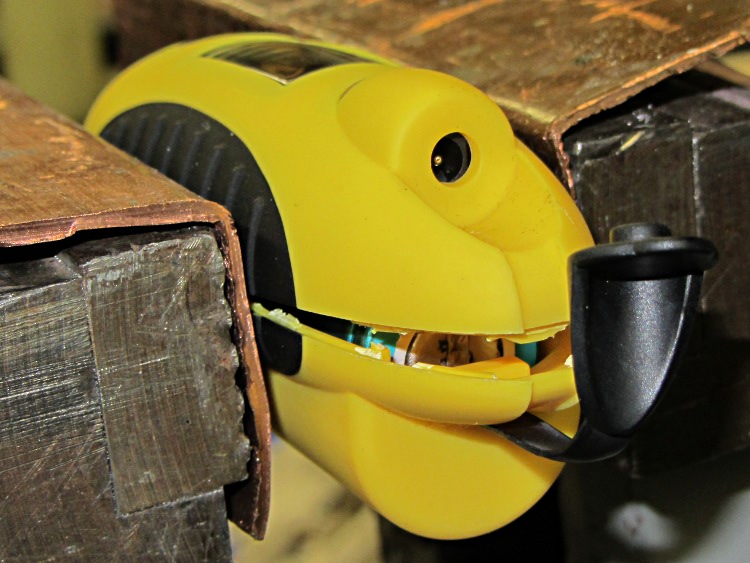
    Wedging a screwdriver in the opening and twisting a bit freed the other side:

    Enlarging Powermonkey case crack
    Enlarging Powermonkey case crack

    Then it was just a matter of pulling gently to expose the cell & circuitry within:

    Powermonkey interior
    Powermonkey interior

    That seems to be a standard 18650, presumably similar to that 2.2 A·h cell.

    I didn’t find anything obviously wrong, so I buttoned it up with screaming yellow silicone tape, put it on its wall-wart charger for a bit, and now it’s all good again: a shining example of a laying-on-of-hands repair.

    The single button has much more travel than it should, so I think the internal foam supports have lost their springiness.

  • Garden Knife Scabbard

    Mary uses an ancient paring knife (that, back in the day, my father had sharpened beyond all reason) to harvest garden veggies, which called for a scabbard to protect the blade, the bike pack, and the fingers.

    I snagged a random block of acrylic from the heap, straightened the long sides, milled a channel just wide and thick enough for the blade down the middle, then added small recesses at the right end for the knife’s haft:

    Garden knife scabbard - main block
    Garden knife scabbard – main block

    The cover is an acrylic sheet, solvent-glued and clamped in place:

    Garden knife scabbard - clamping cover
    Garden knife scabbard – clamping cover

    The cover exposes about 1/4 inch of channel so she can lay the point in place, rather than precisely aligning the point with the slot. I suppose I should have used gray acrylic to provide some contrast; maybe we’ll add a snippet of tape.

    Then mill four sides flat, break the edges & corners with a file, and it’s all good (in a blocky kind of way):

     Garden knife scabbard
    Garden knife scabbard

    The blade has become sufficiently bent over the years that simple friction holds it in the slot. It’s open on both ends so she can flush out the inevitable dirt.

    I was going to engrave her name on the back, but came to my senses just in time…


  • Norelco T770 Beard Trimmer: Battery Pack Rebuild

    The NiCd cells in my Norelco T770 beard trimmer finally gave out, for the obvious reason:

    Norelco T770 cells
    Norelco T770 cells

    They’re rated at 600 mA·h, as are the much shorter 2/3  AA NiMH cells I also used for those phone packs:

    Norelco T770 - rebuild
    Norelco T770 – rebuild

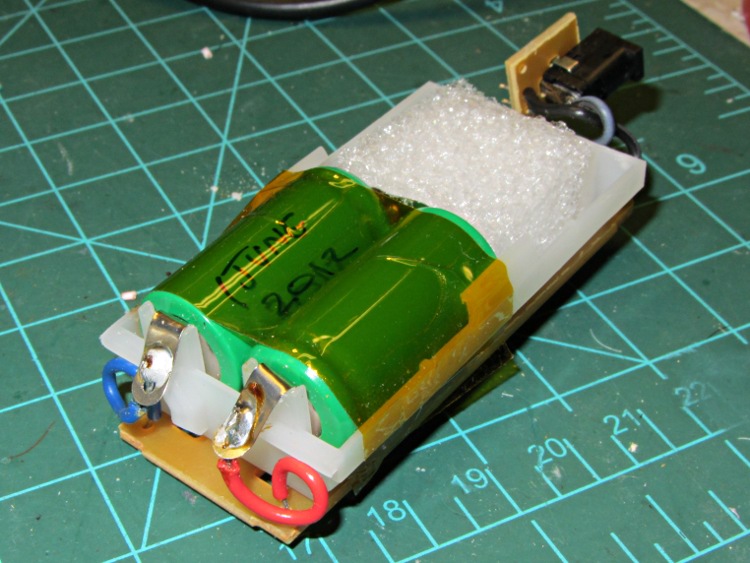
    That’s a wrap of Kapton tape around the cells, plus a block of closed-cell foam to fill the cell holder. It’s not a high-stress environment, so this hack-job repair should work fine.

    The trimmer’s charge / discharge cycle remains hostile to NiMH cells and I don’t expect a great lifetime from the new cells, either…

  • Dell 75UYF Battery Teardown: Part 1

    One of the batteries on the ancient Dell Inspiron 8100 laptop died completely and our Larval Engineer reports the other battery isn’t far behind; it gets her from outlet to outlet and not much more. Pursuant to that comment about harvesting reasonably good cells from dead batteries to build an extended-life external battery for the Canon SX230HS camera, I made a preliminary pack probe.

    The label says it’s a 14.8 V battery, so you’d expect four 3.7 V lithium cells in series. The 3.8 A·h capacity suggests parallel cells:

    Dell 75YUF battery - label
    Dell 75YUF battery – label

    Indeed, peeling off the label shows four cells pairs in series:

    Dell 75YUF battery - under label
    Dell 75YUF battery – under label

    The case joint seems firmly welded together and resisted simple attempts to crack it open. I might run a slitting saw around the edge, although I’ll probably just crunch it in the vise because the patient need not survive the operation.

    A single cell should have a 1.9 A·h capacity, although in an awkward cylindrical form factor. The 3.5 A charging current would drop to 1.7 A for a (string of) single cells.

    The Canon SX230HS uses a single 3.7 V, 1.1 A·h prismatic “battery”, which means replacing that with a single external cell wouldn’t be a major win; the size difference shows how much lithium energy storage tech has advanced in the last decade or so. A pair of cells in parallel would quadruple the runtime, which might be enough. Three in parallel would be fine, although that would require attention to matching their capacity; the nominal 5.2 A charging current (1.5 × 3.5 A) seems aggressive.

    Time to start mulling charging circuits…

  • Evapo-Rust vs. Battery Contact Corrosion

    A long-forgotten toy emerged from the heap bearing a trio of corroded NiMH cells between the usual plated-steel contacts:

    Corroded contacts - original
    Corroded contacts – original

    The toy wasn’t worth salvaging, but I extracted the contacts and applied Evapo-Rust to see what happened. After an overnight soak, some corrosion remained:

    Corroded contacts - after Evapo-Rust
    Corroded contacts – after Evapo-Rust

    Scrubbing with a stainless-steel detail brush removed the flakes and left reasonably clean metal behind:

    Corroded contacts - after brushing
    Corroded contacts – after brushing

    Although it’s not beautiful, I think the contacts came out as well as one could expect. The longer contact plate has holes, thinned sections, and some corrosion inside the spring; I’d be mildly tempted to rebuilt the whole thing with some nickel shim stock and a new spring.

    If I were salvaging the toy, I’d dab vinegar on the wiring to neutralize the creeping potassium hydroxide, rinse the whole thing with water, and clean out the case. Instead, it joined the consumer electronics recycling box with a thud…