Ed Nisley's Blog: Shop notes, electronics, firmware, machinery, 3D printing, laser cuttery, and curiosities. Contents: 100% human thinking, 0% AI slop.
That tag should ensure any TSA agent will sideline me for an enhanced inspection sufficient to reset breakfast to last Tuesday. Or I get to ride in the cockpit. Maybe both.
Aitch is one of the very few people in the world who can use a business trip to the Atacama Desert as a cover story for his real activities, about which I know absolutely nothing because I’m Still Alive™. The fact that he returns with a camera full of gorgeous pix merely demonstrates the cover team’s finesse. The NSA schwag came from another trip. So he says, anyway.
Oh, that tag originally hung from the drawstring of a very nice black velveteen pouch containing an NSA-logo sippy cup along with the matching coaster. All made in China, of course: if irony were energy, we could saw off the entire Middle East and be done with it…
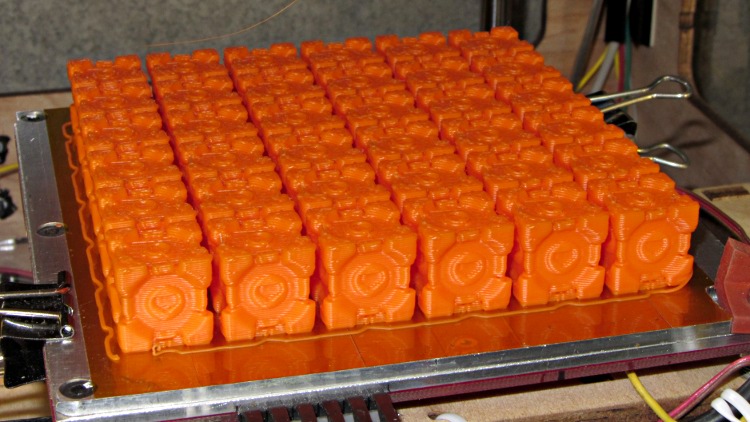
Scaling the cubes to about 15 mm on a side puts a 6×6 array neatly on the build plate. Takes nigh onto four hours to print all 36 of them at 30 mm/s print and 100 mm/s move… a bit over 6 minutes each.
The print quality is Good Enough. The bottom surface of the front cubes faces forward and reflects the scale markings:
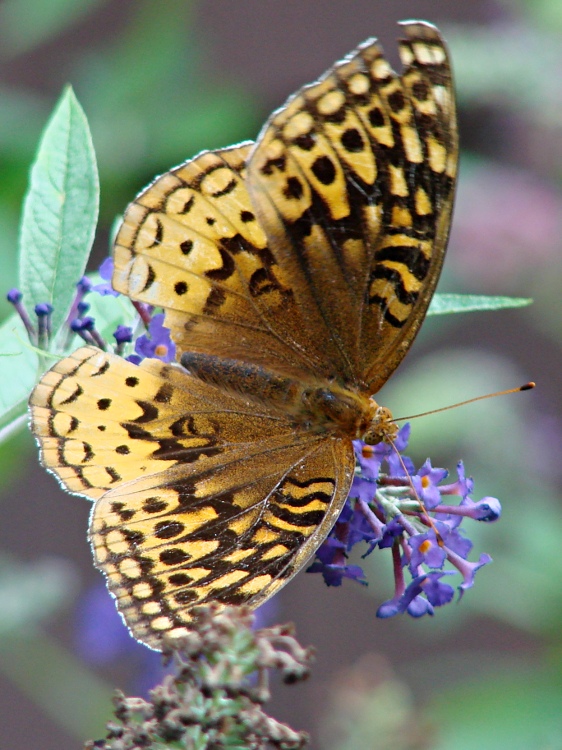
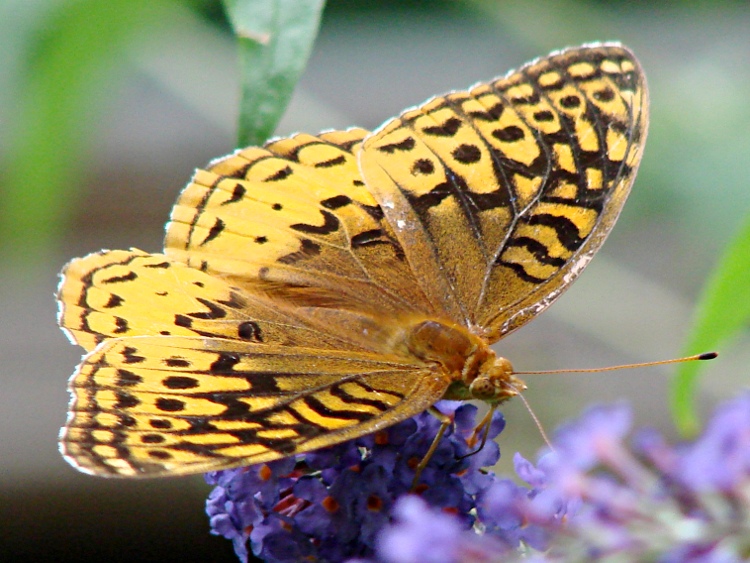
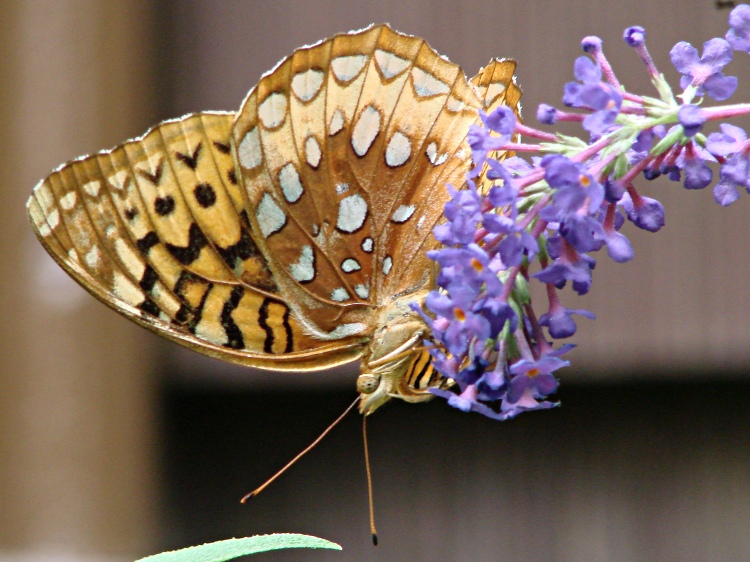
A pair of fritillary butterflies have been enjoying the butterfly bush at the living room window. The first one has a slightly tattered wing:
Fritillary butterfly – dorsal
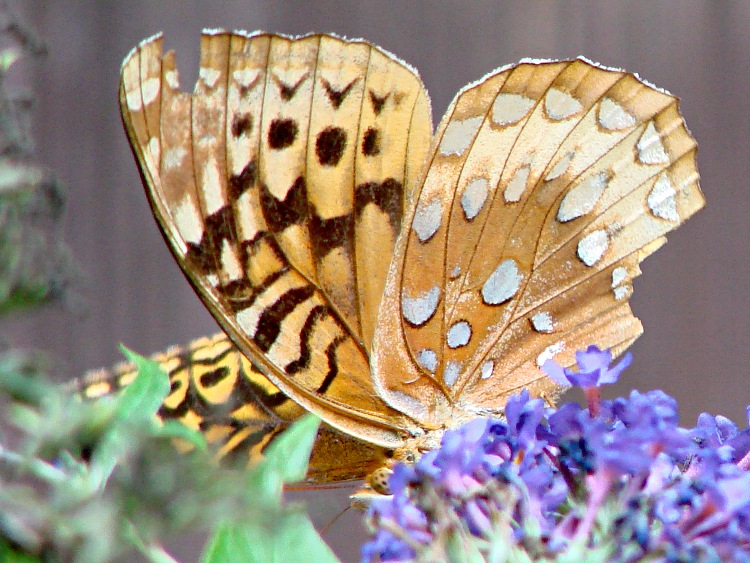
The camera can’t do justice to the silver patches on the bottom of the rear wing. They’re not reflective like a sheet of silver, but they shine like metal in the light:
When confronted with a zombie horde, though, nothing exceeds like excess:
Finned CO2 Cartridge Array
In real life, they’re 12 gram CO2 capsules, of the type used in tire inflators and air pistols. I knew I’d find something to do with the box of empties I’d been accumulating: they became (somewhat threatening) tchotchkes. This was inspired by that thing, although that STL file doesn’t render into anything and, as with many interesting Thingiverse things, there’s no source code.
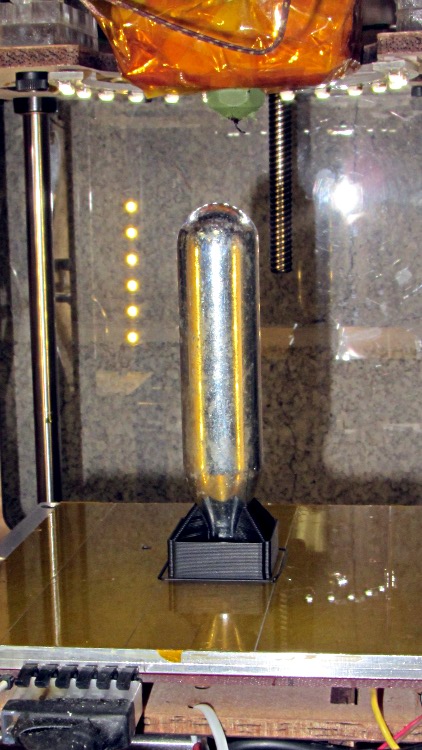
These fins were an exercise in thin-wall printing: the outer square is one thread thick, the diagonal struts are two threads, and the ring around the nozzle has just a touch of fill inside, with a one-thread-thick base below the cartridge nozzle:
Fin Array on build platform
The solid model looks about like you’d expect:
Fin Assembly- solid model
The teeny little quarter-cylinders in the corners encourage Skeinforge to do the right thing: build each quadrant in one pass, leaving the corners unfinished. The diagonals must be exactly two threads wide to make that possible: each strut thread connects to the corresponding single-thread outer edge.
It turns out that my box has several different types of CO2 cartridges and the nozzle ends are all different. To get it right, there’s a template for matching the curves:
Cartridge nozzle template
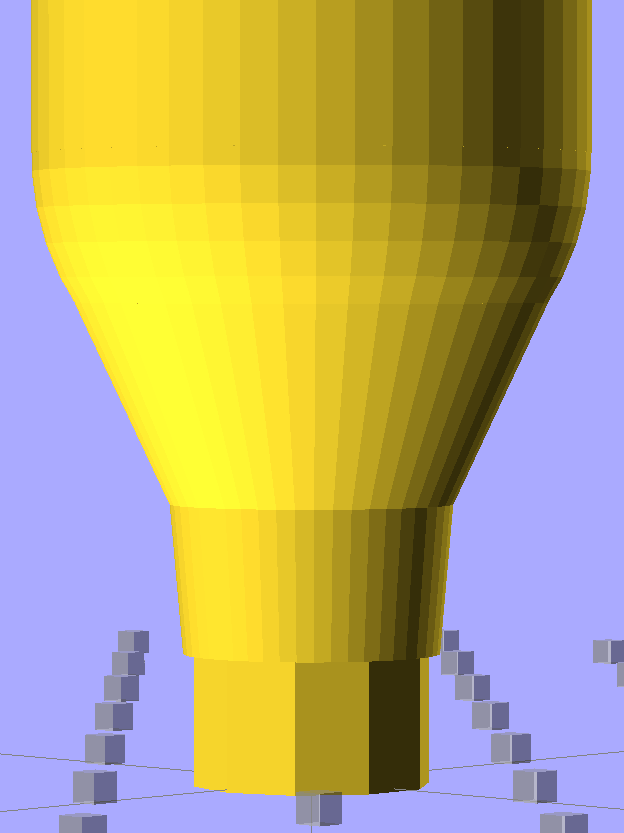
That end of the cartridge consists of a cylinder for the body, a sphere mated to a tangential conic section, another conic fillet, and then the cylindrical nozzle. Basically, you twiddle with the parameters until the template comes pretty close to fitting, then fire off a few trial fins until it comes out right.
CO2 Capsule Nozzle – solid model detail
They were a big hit at the Long Island Linux Users Group meeting…
The OpenSCAD source code:
// CO2 capsule tail fins
// Ed Nisley KE4ZNU - Oct 2011

Layout = "Show";			// Show Build FinBlock Cartridge Fit

include

//-------
//- Extrusion parameters must match reality!
//  Print with +0 shells and 3 solid layers

ThreadThick = 0.33;
ThreadWidth = 2.0 * ThreadThick;

HoleWindage = 0.2;

Protrusion = 0.1;			// make holes end cleanly

function IntegerMultiple(Size,Unit) = Unit * ceil(Size / Unit);

//-------
// Capsule dimensions

BodyDia = 18.70;
BodyRad = BodyDia/2;

BodyLength = 53.0;						// between hemispherical endcap centers
BodyBaseLength = 21;					// tip to endcap center

TipDia = 7.40;
TipRad = TipDia/2;
TipLength = IntegerMultiple(4.0,ThreadThick);

FilletLength = 5.0;						// fillet between tip and cone
FilletTop = TipLength + FilletLength;

FilletBaseDia = 8.60;
FilletBaseRad= FilletBaseDia/2;
FilletTopDia = 9.5;
FilletTopRad = FilletTopDia/2;

ConeTop = 16.0;							// tip to tangent with endcap
ConeLength = ConeTop - FilletTop;

echo(str("Cone Length: ",ConeLength));

IntersectZ = ConeTop;					// coordinates of intersect tangent
IntersectX = sqrt(pow(BodyRad,2) - pow(BodyBaseLength - ConeTop,2));

echo(str("IntersectZ: ",IntersectZ));
echo(str("IntersectX: ",IntersectX," dia: ",2*IntersectX));

//-------
// Fin dimensions

FinThick = 1*ThreadWidth;				// outer square
StrutThick = 2*FinThick;				// diagonal struts

FinSquare = 24.0;
FinTaperLength = sqrt(2)*FinSquare/2 - sqrt(2)*FinThick - ThreadWidth;

FinBaseLength = 2*TipLength;

//-------

module PolyCyl(Dia,Height,ForceSides=0) {			// based on nophead's polyholes

  Sides = (ForceSides != 0) ? ForceSides : (ceil(Dia) + 2);

  FixDia = Dia / cos(180/Sides);

  cylinder(r=(FixDia + HoleWindage)/2,h=Height,$fn=Sides);
}

module ShowPegGrid(Space = 10.0,Size = 1.0) {

  Range = floor(50 / Space);

	for (x=[-Range:Range])
	  for (y=[-Range:Range])
		translate([x*Space,y*Space,Size/2])
		  %cube(Size,center=true);

}

//-------
// CO2 cartridge outline

module Cartridge() {

$fn = 48;

  union() {
	translate([0,0,BodyBaseLength]) {
	  cylinder(r=BodyDia/2,h=BodyLength);
	  translate([0,0,BodyLength])
		sphere(r=BodyRad);
	}

	intersection() {
	  translate([0,0,BodyBaseLength])
		sphere(r=BodyRad);
	  union() {
		translate([0,0,(TipLength + FilletLength+ConeLength)])
		  cylinder(r=BodyRad,h=(BodyBaseLength - ConeLength));
		translate([0,0,(TipLength + FilletLength)])
		  cylinder(r1=FilletTopRad,r2=IntersectX,h=(ConeLength + Protrusion));
		translate([0,0,TipLength])
		  cylinder(r1=FilletBaseRad,r2=FilletTopRad,h=(FilletLength + Protrusion));
		}
	  }

	translate([0,0,FilletTop])
	  cylinder(r1=FilletTopRad,r2=IntersectX,h=ConeLength);

	translate([0,0,TipLength])
	  cylinder(r1=FilletBaseRad,r2=FilletTopRad,h=(FilletLength + Protrusion));

	translate([0,0,-Protrusion])
	  PolyCyl(TipDia,(TipLength + 2*Protrusion));

  }
}

//-------
// Diagonal fin strut

module FinStrut() {
  rotate([90,0,45])
	translate([0,0,-StrutThick/2])
	  linear_extrude(height=StrutThick)
		polygon(points=[
		  [0,0],
		  [FinTaperLength,0],
		  [FinTaperLength,FinBaseLength],
		  [0,(FinBaseLength + FinTaperLength)]
		]);
}

//-------
// Fin outline

module FinBlock() {
  union() {
	translate([0,0,FinBaseLength/2])
	  difference() {
		cube([FinSquare,FinSquare,FinBaseLength],center=true);
		difference() {
		  cube([(FinSquare - 2*FinThick),
			  (FinSquare - 2*FinThick),
			  (FinBaseLength + 2*Protrusion)],center=true);
		  for (Index = [0:3])
			rotate(Index*90)
			  translate([(FinSquare/2 - FinThick),(FinSquare/2 - FinThick),0])
				cylinder(r=StrutThick,h=(FinBaseLength + 2*Protrusion),center=true,$fn=16);
		}
	  }
	for (Index = [0:3])
	  rotate(Index*90)
		FinStrut();
	cylinder(r=IntegerMultiple((FilletBaseRad + StrutThick),ThreadWidth),h=TipLength);
  }
}

//-------
// Fins

module FinAssembly() {

  difference() {
	FinBlock();
	translate([0,0,ThreadThick])				// add one layer to close base cylinder
	  Cartridge();
  }

}

module FinFit() {

	translate([0,0.75*BodyBaseLength,2*ThreadThick])
	rotate([90,0,0])
	  difference() {
		translate([-FinSquare/2,-2*ThreadThick,0])
		  cube([IntegerMultiple(FinSquare,ThreadWidth),
			   4*ThreadThick,
			   1.5*BodyBaseLength]);
		translate([0,0,5*ThreadWidth])
		  Cartridge();
	  }

}

//-------
// Build it!

ShowPegGrid();

if (Layout == "FinBlock")
  FinBlock();

if (Layout == "Cartridge")
  Cartridge();

if (Layout == "Show") {
  FinAssembly();
  color(LG) Cartridge();
}

if (Layout == "Fit")
  FinFit();

if (Layout == "Build")
  FinAssembly();
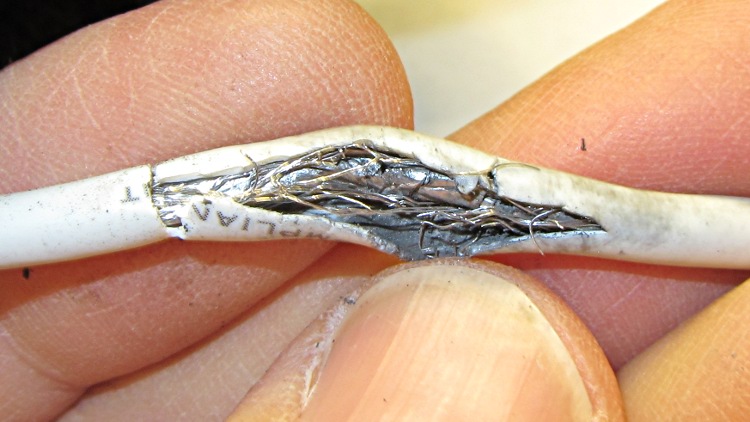
I cable-tied the mic/earphone cable on Mary’s bike helmet to a rib on the fancy air vents near the back end, hoping that would reduce the inevitable flexing. Alas, it didn’t work out that way and the cable lasted only two seasons. This cut-away view shows the pulverized shield braid inside the jacket:
Fatigue-failed helmet cable
The symptoms were totally baffling: the mic worked perfectly, but the earphones cut out for at most a few syllables. Of course, I can’t wear her helmet and it only failed occasionally while riding. I barked up several wrong trees, until it got so bad that I could make it fail in the garage while listening to the local NWS weather radio station.
I spliced in a new USB male-A connector and (re-)discovered that the braid seems to be aluminum, rather than tinned copper. In any event, the wire is completely unsolderable; I crimped the braid from the new connector to a clean section of the old braid. The braid serves only as an electrostatic shield, as it’s not connected to anything on the helmet end. That should suffice until I rebuild the headsets this winter.
After getting everything configured, I hauled the Atom to the Basement Laboratory Computational Center, set the IP address, brought it up as the new file server, backed up the changed files, and everything worked fine. Then I plugged in all three printers, lit up the CUPS configuration screen, and configured the, uh-oh, two printers it could find.
So I shut everything down, yanked out the Atom, plugged in the old AMD box, reconnected everything, restored the changed files from backup, and we’re back to where we were a few days ago. I’ll swap in the old drive and slide the Atom underneath the Thing-O-Matic again.
Come to find out that Ubuntu 11.10 uses NFS V4 by default, which means the various clients scattered around here, all of which use NFS V3 by default, report all files have user & group 232 – 2: an awkward and unforgettable unsigned 4294967294. That’s -2 in 2’s complement notation with 32 bit hex numbers, corresponding to the unsigned 16-bit 65534 = -2 for the nobody user & group.
Fix that by editing /etc/default/nfs-common to set NEED_IDMAPD=yes. Unmount the NFS share, do sudo start idmapd, remount, and it’s all good. The next time the client boots, the idmapd daemon starts automagically, and that’s all good, too.
Adding the -t nfs4 filetype in /etc/fstab seems to be not necssary.
How I got into this mess: the Intel Atom D525 that had been driving the Thing-O-Matic has a bog-standard Intel graphics chip that, despite (or perhaps because of) having an open-source video driver, reports doing only OpenGL 1.4. OpenSCAD, however, requires OpenGL 2.0 and those hacks don’t allow it to run properly, which makes it awkward for demos. The AMD that’s currently the file server has, IIRC, better graphics that might improve the situation; I think it sports a somewhat peppier processor, too. The fact that it’s running Ubuntu 8.10 says that it’s time for an update.
Soooo, I swapped in a new 1.5 TB SATA drive, installed hot-from-the-oven Ubuntu 11.10, replaced Unity with XFCE, inhaled all the current data from the file server’s external USB backup drive, configured ssh / nfs / etc, and I’m now doing some simpleminded tests before I swap the IP addresses.
Now, if the AMD has craptastic graphics hardware, it’s unhappy dance time…





 The Smell of Molten Projects in the Morning