The Smell of Molten Projects in the Morning

Ed Nisley's Blog: Shop notes, electronics, firmware, machinery, 3D printing, laser cuttery, and curiosities. Contents: 100% human thinking, 0% AI slop.

Month: September 2011

  • Mower Blade Hub Adapter

    Mower blade compatibility
    Mower blade compatibility

    So I picked up a new mower blade that sported a sticker claiming it probably fit my Craftsman mower. Got it home, took off the old blade, and it actually fit the mower; the holes matched the hub’s drive pins, although the bolt hole was oversized.

    The old blade was a replacement, too, with a square hub hole and an adapter to fit the bolt. The blade had slots for the drive pins, so the adapter was required.
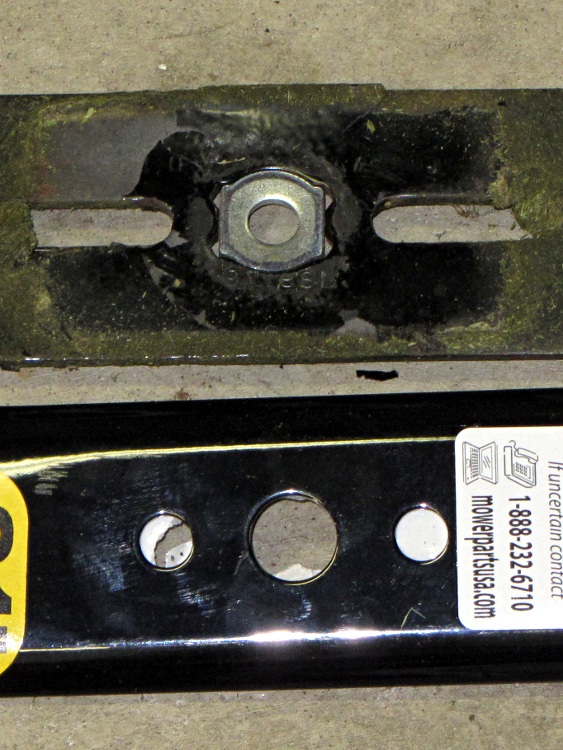
    Seeing as how nothing exceeds like excess, I rummaged around in the heap to find something that would serve as an adapter in the central hole. It’s not really necessary, but I’m that type of guy.

    As it turned out, an ordinary lockwasher for a 3/8 inch bolt was just about perfect. I crunched one in a short bolt with two nuts jammed in place …
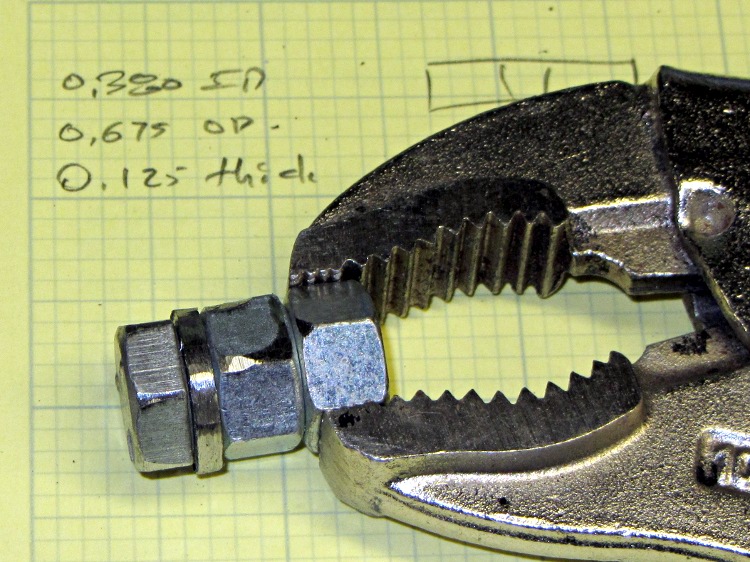
    Lockwasher ground for mower blade
    Lockwasher ground for mower blade

    … introduced it to the coarse side of Mr Grinding Wheel, and, after a few shots with a hammer, it became a perfect fit:
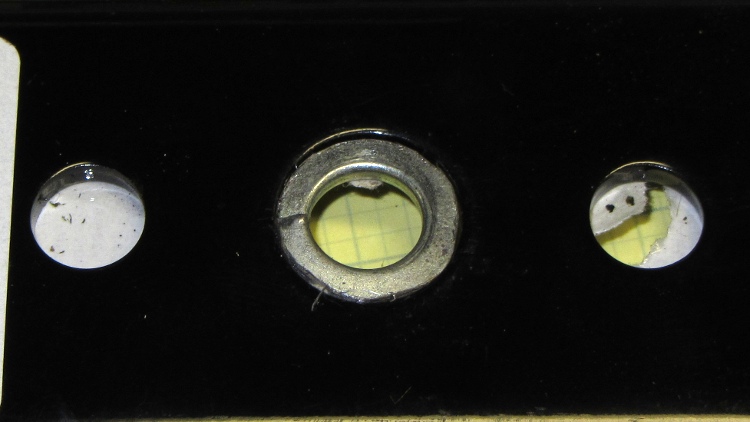
    Lockwasher in blade
    Lockwasher in blade

    Bolted it on the mower, put in two hours of yard aerobics, and it worked just fine. Sliced the top off a root that evaded the attention of the previous blade, too.

  • Ampeg B-12-XY Cap Autopsy

    Before trashing (*) all those caps from the Ampeg, I marched them past a capacitance meter that gives the dissipation factor D. As D = tan δ = ESR / ¦X¦, we know ESR =  D*¦X¦ at the meter’s 1 kHz test frequency. We don’t know the magnitude of the total reactance X (the meter doesn’t tell us that) and in this case we can’t assume the ESR will be small with respect to the capacitive reactance Xc = 1/2πfC.

    Ampeg capacitors
    Ampeg capacitors

    The smaller green 0.022 µF Cornell-Dubilier caps all came in with D=0.05, so they’re marginal.

    The larger green 0.15 µF Cornell-Dubilier caps had D=0.00 and the black 0.1 µF was D=0.01. Those are OK.

    The small black caps had D=0.14. Yikes! The larger one and the yellow cap had D= 0.01 or 0.02.

    The blue Ducati (!) electrolytics ranged from 0.06 to 0.48. That was without reforming, as the last time Phil turned it on, the finals about melted down: I wasn’t going to risk that again just to find out if you can reform all the electrolytic caps without the tubes in place.

    So, yeah, some of the coupling caps were exceedingly bad. If you’d like to rub the values & data against the schematic to find out which one(s) were killing the finals, go ahead.

    All of the measured capacitance values were within spitting distance of their nominal values.

    [Update: Eks points out that I really should measure the leakage at operating voltage, so as to find the current that would drive the grids off their normal bias points. That’s a project for another day… ]

    (*) They’re in the e-waste recycling box, of course.

    The raw data, not that anybody cares: