The Smell of Molten Projects in the Morning

Ed Nisley's Blog: Shop notes, electronics, firmware, machinery, 3D printing, laser cuttery, and curiosities. Contents: 100% human thinking, 0% AI slop.

Month: June 2011

  • Thing-O-Matic: Chainmail

    This worked out better than I expected: printable chainmail!
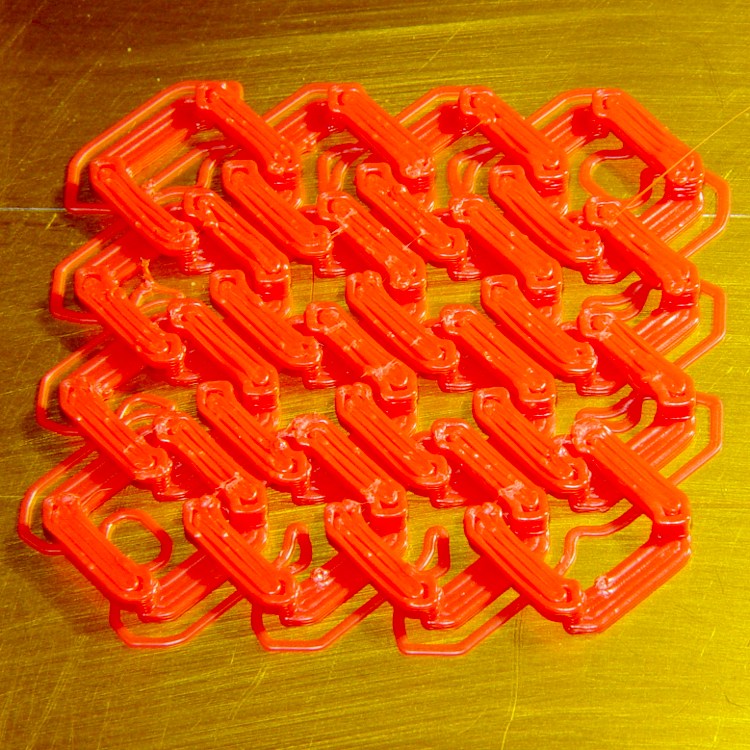
    ChainMail - top
    ChainMail – top

    The back view may be easier on the eyes:

    ChainMail - bottom
    ChainMail – bottom

    As the writing says, printed at 20 & 100 mm/s, 0.33 mm thickness, 0.66 mm width, and bridge speed at 1.0 to 1.3 times the usual.

    I tried a few variations and got decent results with the bars set to 3 threads wide (the pix show 4 × bars). Making it fairly tall (11 × thread thickness, IIRC) helps get enough clearance below the sagging bridges between the vertical pegs. I’m amazed it works as well as it does.

    Dropping to a width of 2 threads doesn’t work: the vertical pegs simply disappear from the G-Code! Turning the pegs into cylinders might help.

    A pair of flush-cutting wire nippers applied to the top of the pegs along one edge allows you to lace a pair of sheets together. Apply a micro-drop of plastic cement to each cut, put a roll of duct tape on the joint overnight, and it’s all good.

    My Shop Assistant has some interesting ideas for this, although I was mostly interested in its build-ability. It’s wonderful to see the printer lay down a sheet of tiny vertical pegs, five layers tall, and clear the top of every one, every time, on its way back and forth.

    I love it when a plan comes together…

  • Thing-O-Matic: Graduation Day

    OK, so I printed a Stanford Bunny to haul along to the 3rd Ward Make-A-Thon:

    Stanford Bunny on platform
    Stanford Bunny on platform

    It’s one of the few objects I’ve printed with enough interior to show the honeycomb fill pattern:

    Stanford Bunny - in progress
    Stanford Bunny – in progress

    Obviously, this was before I sawed three segments off the LED ring light.

    It had a bit of trouble with overhang under the ears, but I figure rabbits are soft and fluffy there anyway, so I’ll define this as a feature rather than a bug:

    Stanford Bunny - ear overhang
    Stanford Bunny – ear overhang

    What’s nice: all I did was slice the STL and build the rabbit. No muss, no fuss: It. Just. Works.

    Some parameters:

    • 0.33 mm thickness, w/t=2.0 -> 0.66 mm width
    • 50 mm/s print, 75 mm/s move
    • Reversal 25 rpm, 75 ms, early action

    An organic object like this eliminates any problems with waviness due to axis instability.

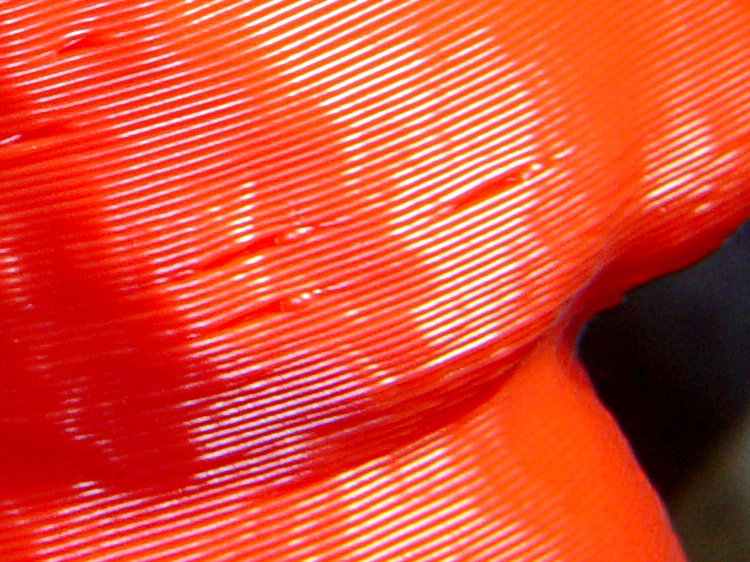
    If you look very closely, you can see early Reversal suckouts just to the left of the zit marking the start of the thread. This was the object that prompted me to turn off early Reversal action, but I still haven’t figured out how to get rid of the zits:

    Stanford Bunny - Reversal suckouts and zits
    Stanford Bunny – Reversal suckouts and zits

    (Is it just me or does that not look like part of a rabbit?)

    All in all, though, this bunny marks the end of the Intense Thing-O-Matic Hackage era. The printer now works dependably, prints parts accurately, and doesn’t require a lot of babysitting. I’ll present some test pieces over the next few days that explore some variations.

    While I didn’t quite jump & clap my hands, life is good…

  • Thing-O-Matic: Heart Gears FAIL

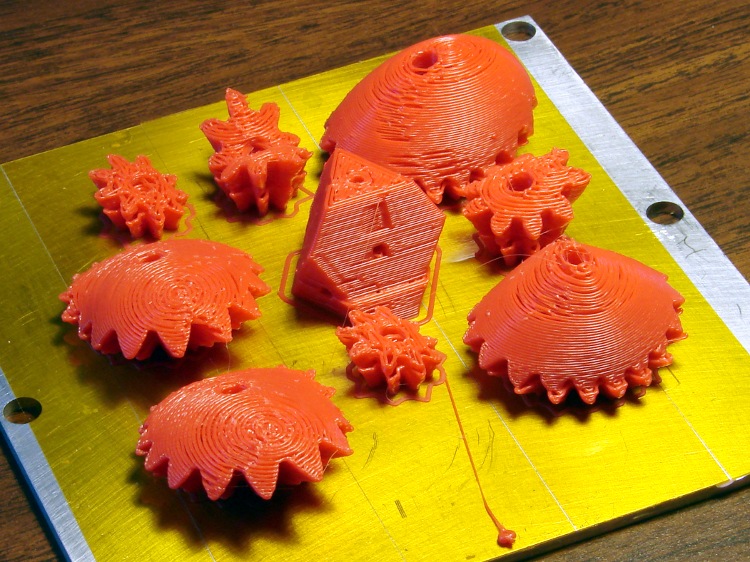
    This one didn’t work out at all and, after a few attempts, I gave up:

    Failed Heart Gears objects
    Failed Heart Gears objects

    It turns out that the myriad gear teeth curl up slightly as they cool. At some point, one of them will snag the nozzle and, even with good steppers in full effect, yank the XY stage to a dead stop. The missed steps cause that ledge a few millimeters up from the plate and, of course, the gears don’t mesh at all.

    I watched it happen and stopped the print as soon as I could, but I didn’t catch exactly which tooth did the damage. Then I extracted just the bottom few layers by importing the STL into OpenSCAD, subtracting a block from the top, exporting what’s left as another STL, then built just that chunk.

    Of course, that worked perfectly:

    Heart Gears - curling gear teeth
    Heart Gears – curling gear teeth

    Printing each object separately should eliminate the problem: the nozzle would remain within the outline at all times and, with a smaller part, the plastic would stay bendy.

    Maybe next year…