Ed Nisley's Blog: Shop notes, electronics, firmware, machinery, 3D printing, laser cuttery, and curiosities. Contents: 100% human thinking, 0% AI slop.
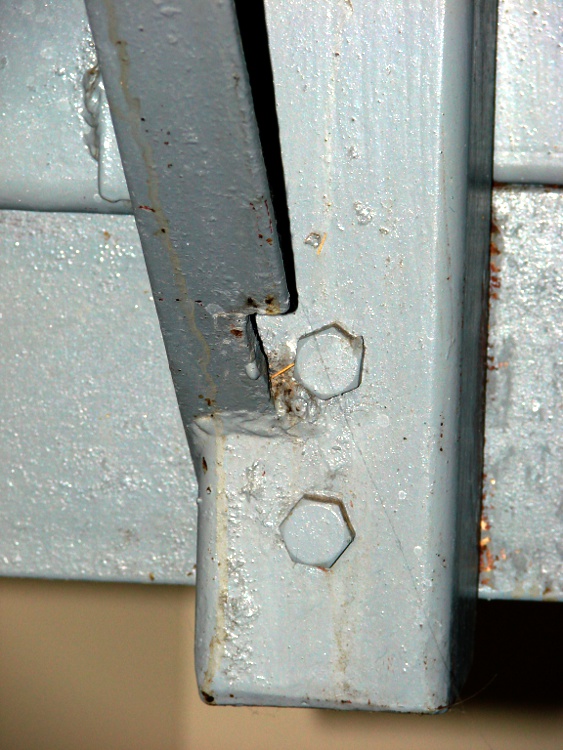
Saw this in the Syracuse Sheraton: every stringer in the stairwell had a torch-cut opening so they could bolt the flight to the landing.
I don’t know if the flights came pre-assembled (minus the concrete, I assume), but the cutouts definitely have that “WTF do we do now?” aspect about them, don’t they?
So I swapped in the snow tires and did the fall oil change a few days ago. Everything went smoothly, although the oil filter, as usual, blooshed oil over the front of the engine and, despite my padding the area with rags, onto the exhaust plumbing.
Digression: I don’t understand why the Toyota engineers felt they had to tuck the oil filter below the exhaust header, behind the front downpipe, and over the flexible coupling to the forward cat converter, with the mounting tube pointed upward. It might have something to do with their rotating the entire engine rearward to get a lower hoodline. It seems to me that angling the filter so it can’t drain and must dump its contents atop the exhaust system isn’t Good Design; I’ve been muttering about it for the last decade.
Anyway, the new filter screwed on easily, its seal ring (seemed to) seat against the block, and one final turn snugged it up just fine. The last fraction of that turn felt gritty, as though part the shell kissed the block, but I attributed that to the fact I was using a different filter style.
I added the usual 5 quarts of oil, wiped up the spills, cleaned off the exhaust pipes, declared victory, called it a day, and put away the tools. Later that evening, I checked for leaks, found nothing, and we drove to a meeting about 12 miles away. As you might expect, the van smelled strongly of hot oil: you cannot wipe all the oil off those pipes.
Oil trails on driveway
The next morning, Mary drove to an all-day class about 15 miles away and, about noon, I rolled out my bike to go grocery shopping… only to discover what you see in the picture (minus the sawdust patch) on the driveway.
This is what we call in the trade A Very Bad Sign.
There are three oil tracks:
Right-front track = outbound to evening trip
Rightmost heavy track = return
Leftmost track = outbound to morning trip
Now, the fact that there’s no huge oil slick means the drain plug is in place and properly sealed. The oil evidently leaks out only under pressure, so the filter isn’t sealed against the block. This can be due to a number of causes, the most common of which is leaving the rubber ring from the old filter stuck to the block. I checked the old filter, which was still in the trash: the seal was still in place, so that wasn’t contributing to the problem.
Regardless, the car was bleeding to death. I called Mary and she reported a dry dipstick.
So I loaded a 5-quart jug of oil into the right pannier, dumped all the tools that might possibly come in handy into the left pannier, topped both off with many rags, stopped at an auto parts store along the way for a new filter, and rode those 15 miles at a pretty good clip. When I got to the parking lot, it was easy to find the van: simply follow its trail. The van sat atop a disturbingly large slick, evidently caused by oil draining off every local minimum inside the engine compartment and under the forward half of the chassis.
The filter was still firmly screwed in place, but when I got it off and compared it with the new filter, they were different: the offending filter was slightly larger in diameter and the threaded hole was noticeable larger. Although it threaded on, the threads weren’t properly engaged, the larger diameter shell did hit the engine block, and it most certainly wasn’t sealed properly.
I installed the new filter, poured in 3 quarts to the get the oil level midway into the dipstick’s OK range, wiped off some of the oil that coated essentially every part of the engine compartment, and we drove home trailing a cloud of hot oil fumes.
As it turned out, the old filter was the same brand as the one that didn’t seal, but with different numbers and a different prefix: the correct filter is a 3614, the wrong one was 3593. Of course, the boxes and illustrations are identical, with slightly different contents. I’m sure they’re adjacent on the shelf and migrate into each other’s slot. It’s worth noting that the filter I bought while on the way to fix the problem was a different brand sporting a part number totally unrelated to 3614.
The butt end of the van was covered with oil, as though the droplets blew out under the chassis and got sucked up against the rear surface; the window was a mess. I sprayed on stout detergent and wiped it clean, but I think we must treat the poor thing to an all-over car wash with the special undercarriage scrub option.
No harm done, as nearly as I can tell, although it’s an exceedingly good thing we weren’t driving off to the grandparents!
Those of you following the blog comments by RSS probably noticed a frenzy of commentary on the bed bug posts last week. Turns out that hackaday.com posted an article mentioning my Hot Box Disinsector on the afternoon of 22 November, producing this blip in the traffic numbers:
Page Views – November 2010
I noticed the jump shortly before suppertime, at which point the WordPress counters weren’t keeping up with the hit rate: the statistics page produced essentially random numbers for the next day.
About 1/4 of the newcomers (welcome!) read all of the bed bug articles, punching the views up by an order of magnitude. Of course, for a real website, 16k hits per day rounds off to zero, but it’s still invigorating for a simple guy like me.
WordPress.com inserts ads on their blogs, over which I have no control. As nearly as I can tell, most of my articles have such esoteric topics that they attract no ads at all, but, wow, Google sure knows exactly what to do with bed bugs!
Now, I’ll return to my usual practice of fixing stuff and writing about how that goes down…


 The Smell of Molten Projects in the Morning