The Smell of Molten Projects in the Morning

Ed Nisley's Blog: Shop notes, electronics, firmware, machinery, 3D printing, laser cuttery, and curiosities. Contents: 100% human thinking, 0% AI slop.

Month: October 2010

  • LED Worklight: Innards Thereof

    So I added a cheap 72-LED worklight as a box-filler to a recent order. Popped in four AA alkaline cells, clicked the switch, and … huh, that thing looks dim.

    Took it apart and what do we find inside? Resistors!

    Over on the left lives a pair of 10-Ω resistors that limit the overall LED current. They’re in parallel, so it’s running with a 5-Ω ballast.
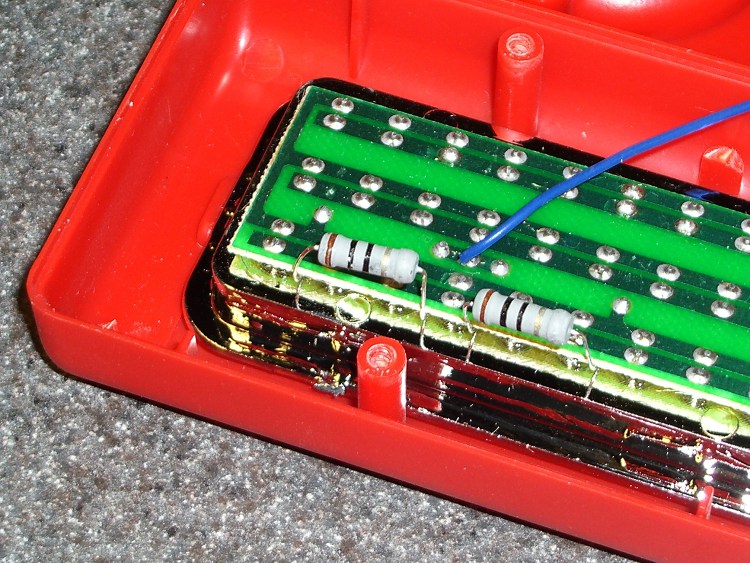
    LED ballast resistors
    LED ballast resistors

    Over on the right, each string of 24 parallel LEDs has a separate 10-Ω equalizing resistor.
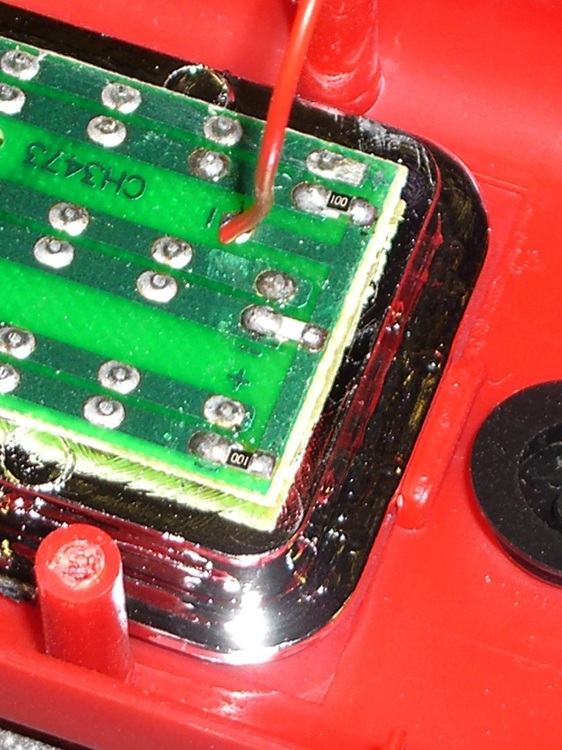
    LED equalizing resistors
    LED equalizing resistors

    A quick ammeter check gives the dismal news: total current is 220 mA = 73 mA per string of 24 LEDs = 3 mA per LED.

    Well, no wonder why it’s dim!

    The ballast resistors drop 0.22 x 5 = 1.1 V, each equalizing resistor is good for 0.073 x 10 = 0.73 V, and (as you’d expect) the LEDs run at about 4 V.

    Run it on rechargeables and it’s much worse.

    Given the low price, I’d expect these LEDs to fall over dead if I goosed them all to 20 mA… not to mention, 0.02 x 72 = 1.44 A is a pretty stiff load for alkalines and the housing wouldn’t stand up to nearly 9 W of power dissipation.

    Ah, well, it’ll come in useful here & there…
  • Door Stop Bumper Fix

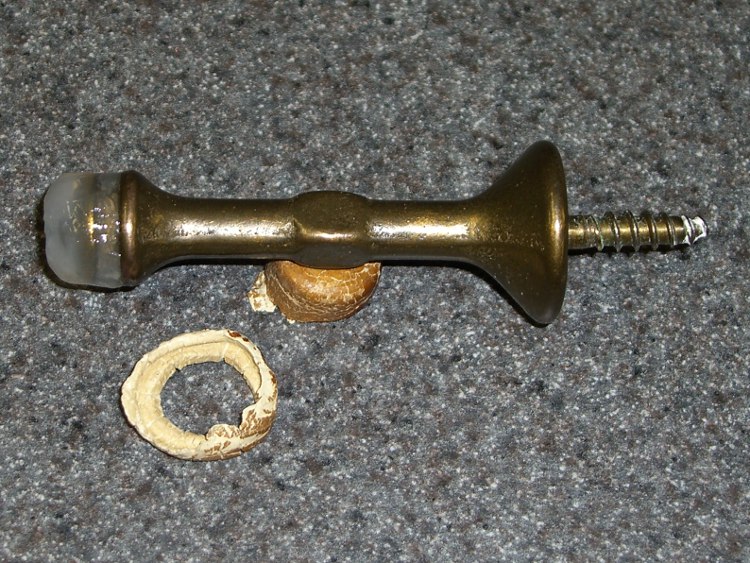
    After slightly over half a century, the rubber bumpers on the doorstops around the house have stiffened up and, occasionally, one falls off.

    Although I suppose I should just buy a new doorstop, molding a dab of silicone snot around the end of the nice brass post takes only a few minutes (plus an overnight cure). If what they tell us about silicone adhesives is true, this one is good until the sun goes dark…

    Re-bumpered door stop
    Re-bumpered door stop

    Another no-CNC repair!

  • Dual Displays vs Wacom Tablet vs xorg.conf

    So, as I wondered there, it turns out that the tablet cursor can fall into the crack between my landscape left monitor and portrait right monitor, with the distressing result that the X server jams with the pointer jittering between the two displays. Worse, the keyboard isn’t active, so I can’t switch to a console screen and shoot X in the head.

    I’m guessing this is a picket-fence error, where Something Bad Happens when the cursor hits the maximum possible value: X=16704, in this case.

    The solution seems to be telling the Wacom driver that the tablet is just slightly wider than it really is, so that the X value can’t ever reach the maximum. Having done this before, the line is already in my xorg.conf, just waiting to be un-commented:

    Section "InputDevice"
        Identifier      "Wacom - stylus"
        Driver          "wacom"
        Option          "Device" "/dev/input/wacom"
        Option          "USB" "on"
        Option          "Type" "stylus"
        Option          "Button2" "3"
        Option          "Button3" "2"
        Option          "MMonitor" "off"
        Option          "ScreenNo" "0"
        Option          "BottomX" "16710"
    #    Option          "BottomY" "11893"
    EndSection
    
    Section "InputDevice"
        Identifier      "Wacom - eraser"
        Option          "Device" "/dev/input/wacom"
        Driver          "wacom"
        Option          "USB" "on"
        Option          "Type" "eraser"
        Option          "MMonitor" "off"
        Option          "ScreenNo" "0"
        Option          "BottomX" "16710"
    #    Option          "BottomY" "11893"
    EndSection
    

    That seems to work, but the failure was intermittent. We shall see…