So I added a cheap 72-LED worklight as a box-filler to a recent order. Popped in four AA alkaline cells, clicked the switch, and … huh, that thing looks dim.
Took it apart and what do we find inside? Resistors!
Over on the left lives a pair of 10-Ω resistors that limit the overall LED current. They’re in parallel, so it’s running with a 5-Ω ballast.
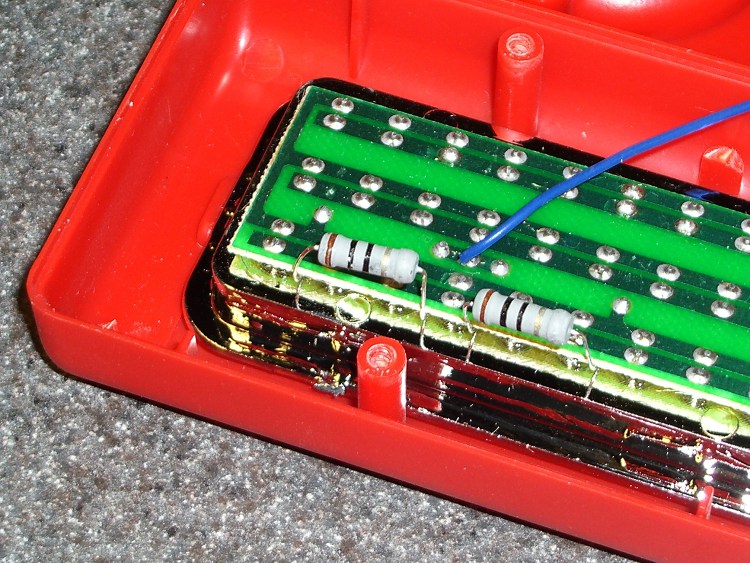
Over on the right, each string of 24 parallel LEDs has a separate 10-Ω equalizing resistor.
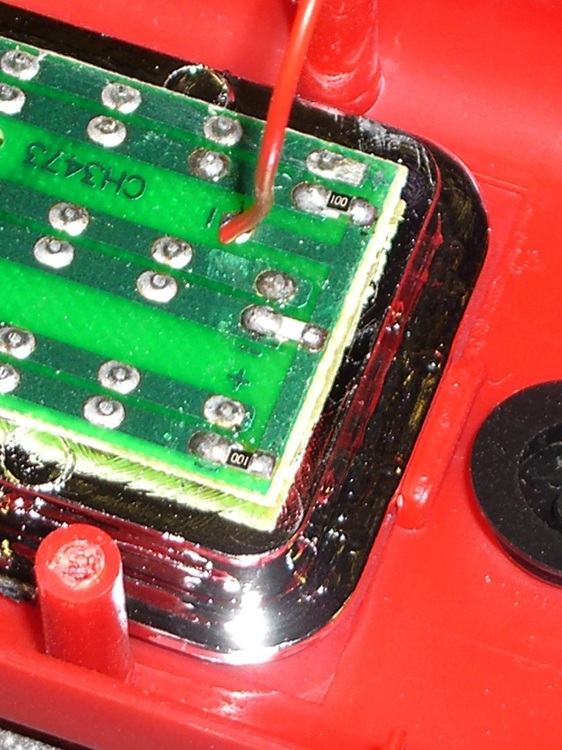
A quick ammeter check gives the dismal news: total current is 220 mA = 73 mA per string of 24 LEDs = 3 mA per LED.
Well, no wonder why it’s dim!
The ballast resistors drop 0.22 x 5 = 1.1 V, each equalizing resistor is good for 0.073 x 10 = 0.73 V, and (as you’d expect) the LEDs run at about 4 V.
Run it on rechargeables and it’s much worse.
Given the low price, I’d expect these LEDs to fall over dead if I goosed them all to 20 mA… not to mention, 0.02 x 72 = 1.44 A is a pretty stiff load for alkalines and the housing wouldn’t stand up to nearly 9 W of power dissipation.
Ah, well, it’ll come in useful here & there…
 The Smell of Molten Projects in the Morning
Comments
5 responses to “LED Worklight: Innards Thereof”
Through-hole? In 2010? Really?
How to get moderate wattage without spending money on an actual power resistor: parallel two fat through-hole resistors.
They’re really putting the screws to that trio of 10-ohm SMD balancing resistors, too: nigh onto half a watt apiece.Ooops. Decimal error.Worth every penny, purely for the amusement value…
Wait a minute, do I see LEDs in parallel? Is that even supposed to work that way at all? I’d have thought the canonical way of dealing with multiple LEDs is to run them in series, each string with its own ballast resistor or a dedicated power supply (usually a boost-mode supply in current source mode).
I’d think the paralleled strings would self-destruct in short order if the average current would anywhere near approach the rated current. At that point there’d be several LEDs, I bet, that are running way over their rated current, and you get a nice failure cascade.
Alas, that doesn’t explain why my baby monitor camera’s IR LEDs keep dying, and they are in series with a ballast resistor. Out of laziness I’ve replaced the failed one with two rectifier diodes in series, as I didn’t have a proper replacement handy. In a week another one died. Somewhat unilaterally I’ve decided we don’t really need the camera all that much.
Evidently, but not particularly well. It’s a clear-cut example of building to the lowest possible cost while ignoring all the other constraints.
Based on some teardowns I did a while ago, I think the manufacturers get specially binned LEDs with unnaturally high forward voltages: basically, high-Vf rejects from the usual manufacturing line. If you have enough volume for, say, 25 mV bins, then you can parallel them and they’ll all share current quite happily, even if you drive them directly from a battery without the formality (or cost) of ballast resistors.
The other saving grace is that the LEDs run far under maximum current. You get that for free by driving three dozen LEDs from a trio of AAA cells… or maybe a single CR2032. [wince]
But, because they’re using using rejects, those bins don’t get filled with reliability… which accounts for those early-failure LED strings.
[…] For what it’s worth, the 8 LEDs draw 130 mA (16 mA each), far more than the 3 mA each in that pathetic work light. […]