The Smell of Molten Projects in the Morning

Ed Nisley's Blog: Shop notes, electronics, firmware, machinery, 3D printing, laser cuttery, and curiosities. Contents: 100% human thinking, 0% AI slop.

Month: April 2010

  • Crystal Capacitance Measurement Fixture

    Crystal Capacitance Fixture
    Crystal Capacitance Fixture

    The trick to measuring small capacitance values is to get your body out of the loop: this fixture holds a crystal rigidly and makes solid contacts to both the case and leads while measuring the internal crystal-to-case capacitance. It’s sized for wire-terminated HC-49/U and HC-49/US cases, but you could obviously adapt it to other cases.

    The meter is an AADE L/C Meter IIB, with binding posts on 3/4″ centers. The post caps are plastic, so the only reliable connection is on the bottom surface. I used double-sided 62-mil PCB material for the fixture base plate, with copper-foil tape wrapped around the sides and soldered along the top edge; the adhesive is allegedly conductive, but I suspect that’s for static dissipation and shielding, rather than for actually conducting signal current. Kapton tape over the copper foil prevents gashes on the sharp edges.

    Notes:

    • Run a 1/8″ end mill across (both sides of!) the PCB and drill 1/4″ holes with a step drill at the appropriate spots.
    • A 25-mil brass shim stock rectangle soldered to the right half supports the crystal case to get the flange off the board.
    • Slice up an alligator clip with a Dremel cutoff wheel, drill a hole in the board to mount it with the screw that’s supposed to secure its wire, and it’ll hold crystal cans down with grim determination.
    • A snippet of phosphor bronze spring stock, bent in a slight arc with a tab soldered to the board at the far end, holds the crystal leads against the PCB. You could probably use brass shim stock.
    • The black strip on the far side of the binding posts is half of a wire-wrap IC socket, leads bent & clipped appropriately, then soldered to the underside foil. That’s where you stick crystals to measure their lead-to-lead capacitance (aka Co or C0). Works fine for through-hole caps, too.

    A detail view…
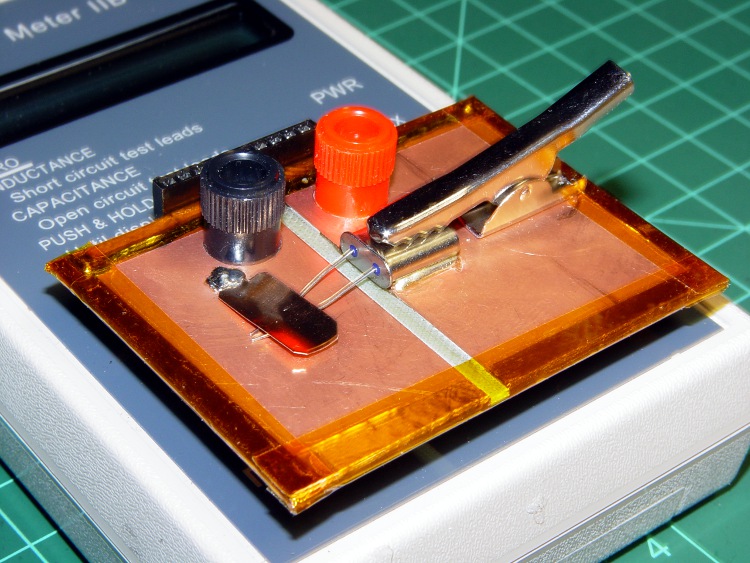
    Crystal Capacitance Fixture - Detail
    Crystal Capacitance Fixture – Detail

    Typical crystal case-to-lead capacitance is on the order of a few pF, so zeroing the fixture capacitance is important: (meter + fixture) weighs in at about 6 pF.

    There’s another half pF of crystal-lead-to-fixture capacitance that’s nullable by positioning the cap leads just over the spring contact when zeroing the meter.

    There’s essentially no stray capacitance due to a crystal in the socket strip along the back; zeroing the meter without the crystal seems to be adequate.

    I find that pressing the Zero button with a screwdriver while bracing the other side of the case with another screwdriver gives the best results; doing it with fingers produces about +0.5 pF offset.

    Done right, the meter reads within ±0.03 pF of zero and remains stable as long as you stay away while reading the digits!
  • Generic Sony NP-FS11 Lithium-Ion Packs: FAIL

    Somewhat to my surprise, the eBay vendor responsible for those curves sent three replacement NP-FS11 batteries, commenting:

    We’ve sent all your comments to the factory and ask them for a total quality inspection in this batch of batteries.

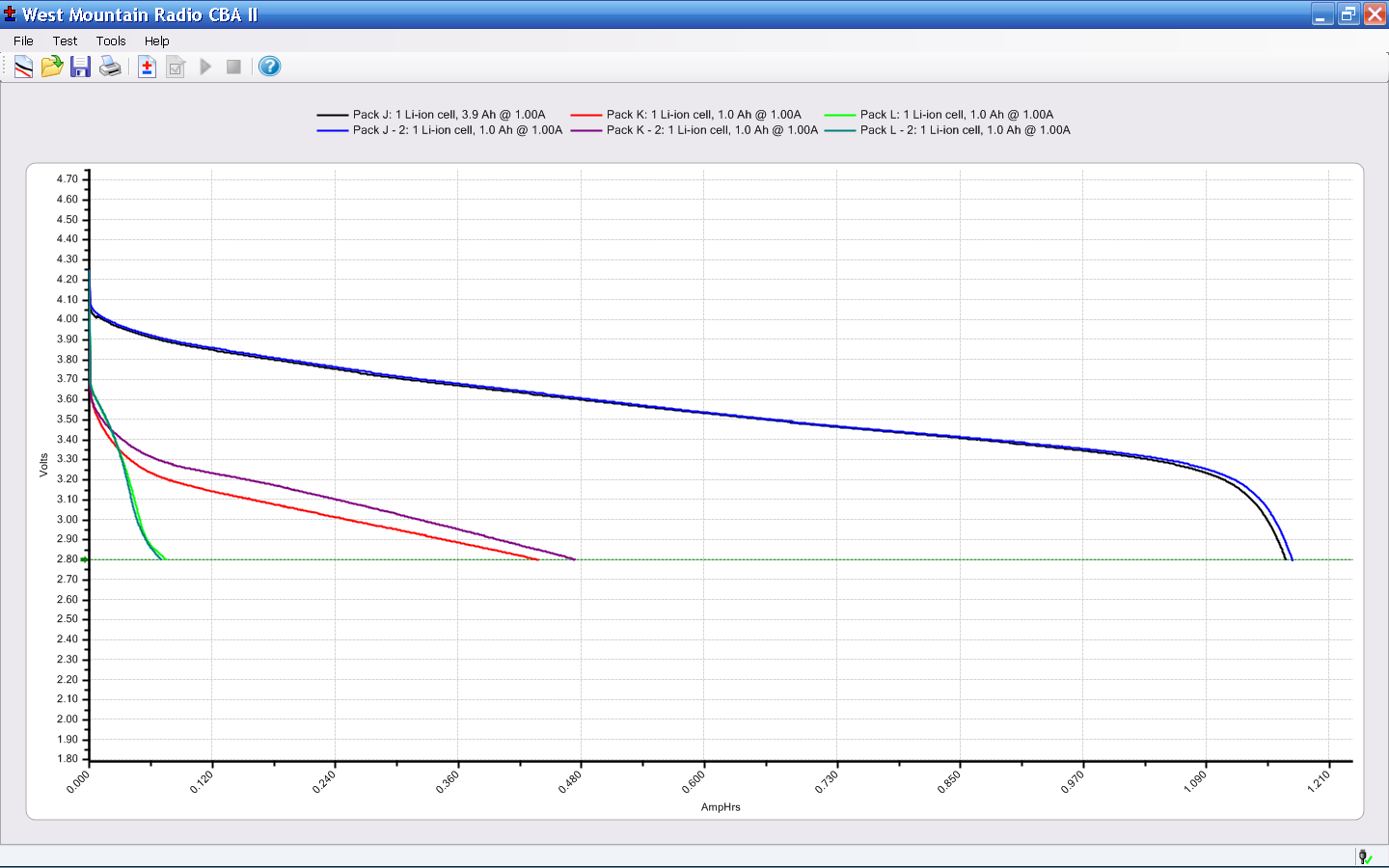
    Here are the capacity curves for an initial charge, a test, recharge, and another test on each pack. The curves match up reasonably well (the top & bottom traces are nearly exact overlays), so I believe the results are accurate.

    MaxPower NP-FS11 - Packs JKL
    MaxPower NP-FS11 – Packs JKL

    One pack is the best I’ve seen yet. The other two are junk, pure and simple.

    So, to summarize:

    • One of three batteries DOA in first batch, others weak
    • Two of three batteries DOA in replacement

    Overall, that’s a 50% failure rate even if you have relaxed standards…

    I decided that, despite their “customer service”, this level of quality deserves the dreaded Negative Feedback checkbox.

    Now, to saw the cases open and replace the cells. I cannot imagine any way to justify this on an economic basis, but we’ll certainly have enough batteries for that camera when I’m done.

    If I had any confidence that spending more on the batteries would get a higher quality product, I’d do it. The question is, would another order of magnitude make any difference?

  • Abusing a Leather Punch for Manhattan-Style Circuit Construction

    I’m building a crystal parameter measurement fixture and decided to use Manhattan wiring, rather than an etched circuit board, because I think this will be a rarely used gadget… and it’s RF, so air-wiring is a Good Thing.

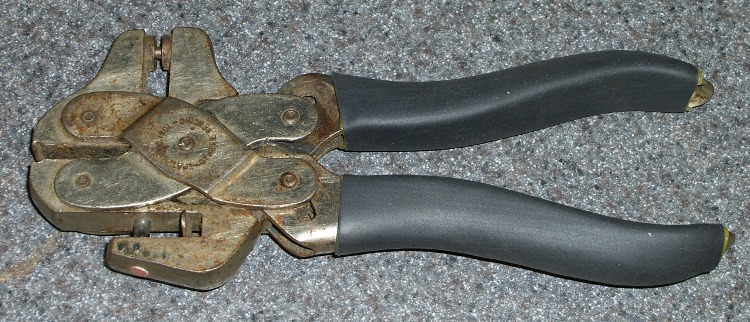
    The key to Manhattan construction is having a pile of little circuit-board pads that you glue to a ground plane, then solder component leads to the pads. A bit of rummaging turned up an old leather punch / snap crimping tool that’s probably older than I am. After punching a few pads, though, I realized that the die hole had a constant diameter: no relief behind the cutting edge.

    Aligning to the die
    Aligning to the die

    That meant the circuit board pads jammed tight in the hole. Extracting them required a pin punch and far more hammering than seemed reasonable, not to mention far more force to operate the punch than I was willing to apply.

    So I found the largest transfer punch that would fit in the die hole, chucked it in the drill press, and aligned the table so the vise grabbed the tool directly in line with the spindle.

    The tool is soft steel, intended for leather, so I could get away with the next step: chuck up a drill a few mils larger than the die hole and drill it out to within about 1/8 inch of the cutting edge.

    Worked like a champ: the pads no longer jammed in the hole and the tool operated with much less force.

    Nevertheless, I shrank some glue-lined heat stink shrink tubing around the handles to cushion the sharp inner edges. The handles are just folded steel, as nobody expected the retraction stroke to require much effort at all.

    Padded handles
    Padded handles

    That helped a lot, as did a few drops of oil in the obvious spots.

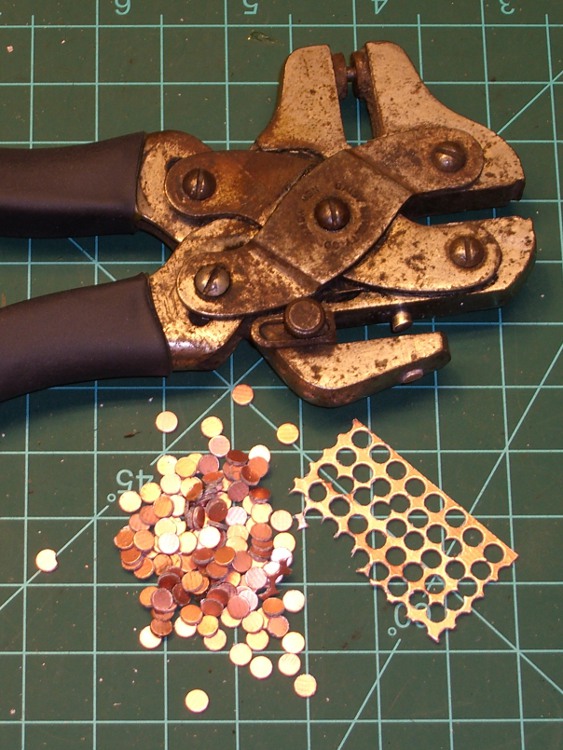
    The end result was a pile of punchies poked from a chunk of 32-mil double-sided circuit board.

    Punch with circuit-board punchies
    Punch with circuit-board punchies

    Now, to start soldering…

  • Zire 71 Flex Circuit Repair

    The classic failure mode for a Palm Zire 71 is to stop charging. This might happen when the lithium-ion battery craps out and needs replacing, but the flex circuit between the cradle connector and the main board seem to go bad around that time, too. That’s what eventually killed my first Zire, so after I stuffed a new battery in the second, I tried fixing the first.

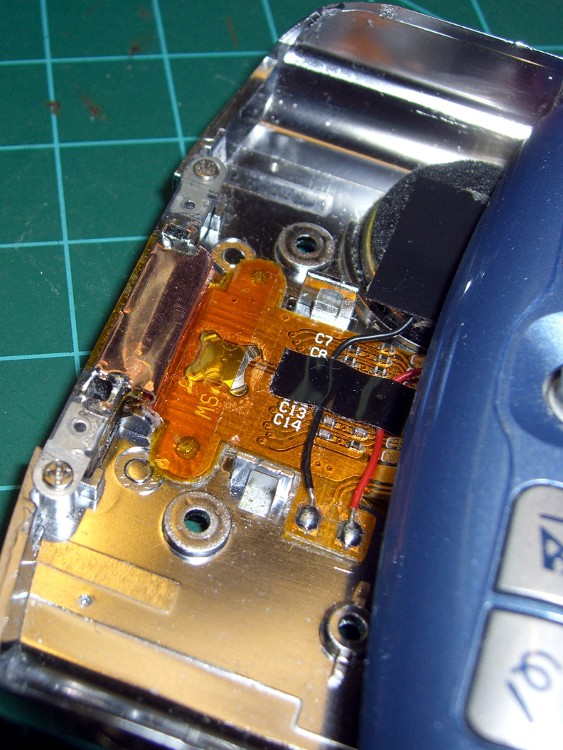
    Here’s the flex circuit in its natural habitat (photo from the second Zire).

    Flex Circuit and Components
    Flex Circuit and Components

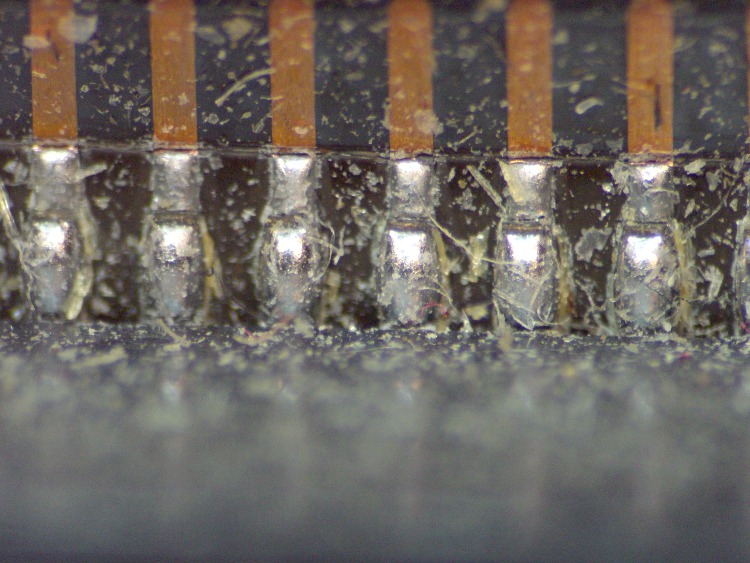
    Here’s a picture looking down along the inside edge of the connector at the the flex circuit in the photo above. Notice the cracks at the junction of the soldered terminals and the copper flex traces. Click the pic for more detail…

    Cracked Flex Traces
    Cracked Flex Traces

    I suspect some of those cracks came from my ham-fisted repairs over the years of owning the thing, but the fact of the matter is that many other owners who didn’t take their Zire apart have much the same charging / USB problems. I think the connector moves slightly when it’s jammed into the charging cradle and that’s enough to fracture those joints over the course of a few years.

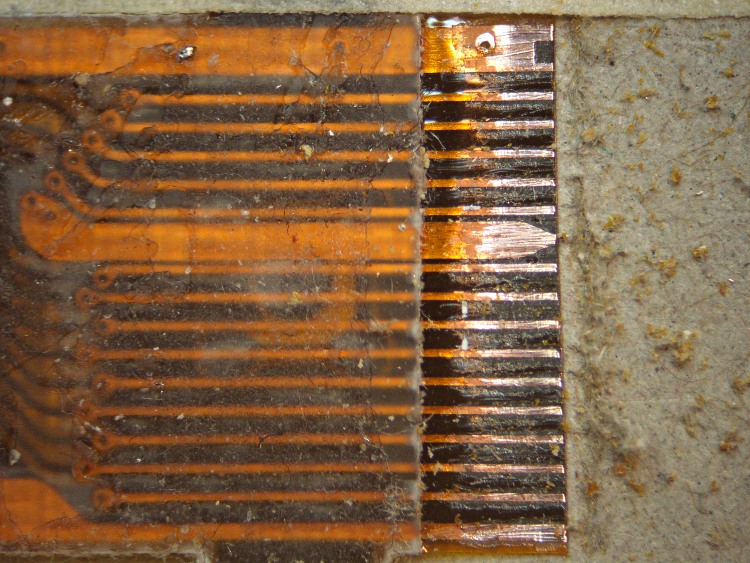
    Anyhow, cutting the flex just beyond the connector pins and scraping off the insulating layer with a sharp razor knife reveals the traces.

    Flex Traces Exposed
    Flex Traces Exposed

    This end of the flex circuit has two additional ground traces bracketing the 16 traces leading to the exposed connector pins. As a result, the connector body is firmly grounded. The fat trace on the top is a paired ground conductor. The fat trace in the middle is another ground.

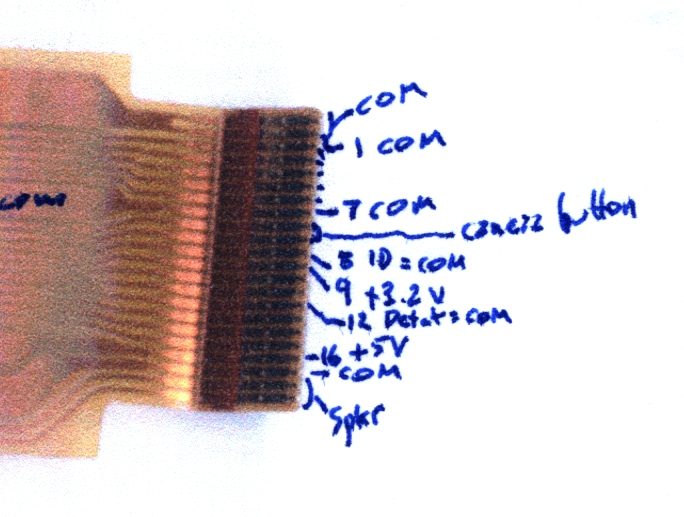
    Here are some of the connections at the other end of the circuit, where it plugs into the Zire PCB. Note that the shutter button traces wind up in the midst of all the traces with numbers corresponding to the external connector pinout found there. The speaker traces lie outside the ground at the bottom edge of the picture above.

    Flex connector pinout at main PCB
    Flex connector pinout at main PCB

    With that in hand, I untwisted a hunk of stranded hookup wire to get some fine copper wires and soldered them to the flex circuit traces. Note that the two outermost traces are soldered directly to the metal shell around the alignment / latch holes. The red stuff at the very end of the flex circuit is orange nail polish that will, in theory, keep the new wires from shorting to the copper shield layer in the flex. The silvery shape at the lower middle is the shutter button.

    New Leads in Place
    New Leads in Place

    The wires turned out to be just slightly too long; were I to do it again, I’d pay more attention to getting the edge of the flex exactly where it was when I cut it off.

    A layer of Kapton tape insulates and stabilizes the wires. A layer of copper foil tape atop the Kapton gets soldered to the connector shell for static dissipation, but I’m not convinced it was necessary. This view is from the other side of the flex, with more nail polish along the edge to glue things down.

    Flex with Nail Polish on Kapton
    Flex with Nail Polish on Kapton

    A layer of Kapton on that side pretty well finished it off; I took some pains to press the two adhesive layers together around each of the wires.

    Solder the speaker back in place and reinstall in reverse order, folding the new wires gently into position. That’s when I found out they were a few millimeters too long. I left ’em be.

    Here’s the final result, minus the shutter button and bezel.

    Repaired Flex in Place
    Repaired Flex in Place

    From this point, all the bits fit back together the way they used to.

    While all this was going on, I won a pair of Zire 71s on eBay, plus a wireless keyboard (which solves a problem I don’t have), plus a known-bad Z22 (dead digitizer), plus a bunch of other odds and ends, for a whopping $25 delivered. I was so hot to get the pair that I even upped my bid to $45… there were no other bidders.

    Now I have a cold backup for the hot backup for my PDA!

    Amazingly enough, the (presumably OEM) batteries in the new-to-me Zires charged up and work fine, so I need not meddle with them for a year or two.

  • City Raccoon

    Raccoon in tree
    Raccoon in tree
    I met this fellow on my way out of a recent MHV LUG meeting; he was up a tree between the library parking lot and the adjacent (and rather busy) gas station / convenience store, minding his own business while performing body maintenance.

    That’s pretty much in the midst of the City of Poughkeepsie, but raccoons have figured out that the livin’ is easy around people. I’m sure he’s also figured out dumpster diving, although he’s likely not looking for discarded electronics…

    Love those eyes!

    Reflective eyes
    Reflective eyes

  • LED Beam Patterns

    Red LED Beam Pattern
    Red LED Beam Pattern

    For some reason, everybody thinks LEDs put out nice Gaussian beams. Unless the specs say so, it just ain’t so. Some pix from the Trinity Robotics Contest show the situation.

    This is the table used in the RobotWaiter contest. It has a visible red LED on each face to aid in locating and aligning, but you better not depend on the actual beam intensity as a function of angle!

    The same picture in pure IR shows the situation with a bit more contrast. Although it’s a visible red LED and I have a visible-cut filter on the lens, there’s enough energy for an image.

    Red LED Beam Pattern in IR
    Red LED Beam Pattern in IR

    These IR LEDs have the same general pattern.

    IR Distance Sensor Emitters
    IR Distance Sensor Emitters

    Pix with my ancient Sony DSC-F717 in NightShot mode with a Hoya R72 IR filter.

  • New Tires For the Van

    So I bought 530 bucks worth of new tires for the van; it’s ten years old with 66k on the clock. Picked the most suitable ones:

    • Near the top of the Consumer Reports list
    • Best constellation of features for our use
    • Available at the local tire shop

    CR is essentially the only place that does actual across-the-board tests; you can disagree with their methodology, but it’s pretty much the only game in town.

    I wound up at the local tire shop after bouncing off one of the online sources. In this case, tire + shipping + installation costs more online; the local shop was one of the online source’s installers.

    So I went direct. They’re aboveboard: the balance + installation charge is the same no matter where the tires come from.

    Had a 10:00 appointment and it took 90 minutes to get out of the shop. Not impressed.

    The tire pressure monitor light came on halfway home. Well, OK, maybe it’s noticed the tires are bigger? But it’s a differential rotation counter, sooo… that’s not the problem.

    Checked the pressure after letting the tires cool off for a few hours.

    • 37 – Left rear
    • 32 – Right rear
    • 40 – Left front
    • 34 – Right front

    The pressure monitor was definitely doing its job!

    Adjusted them all to 36 psi (hard, but we’ll see how it rides), reset the monitor, and it’s all good.

    Factory trained and certified mechanics, my obscene-gerund deleted-noun.

    Oh, and the lug nuts were evidently tightened by Andre the Giant… gotta break those suckers free before we do much more driving!