The Smell of Molten Projects in the Morning

Ed Nisley's Blog: Shop notes, electronics, firmware, machinery, 3D printing, laser cuttery, and curiosities. Contents: 100% human thinking, 0% AI slop.

Month: March 2010

  • X10 Controller: End of Life

    X10 Controller Circuit Board
    X10 Controller Circuit Board

    After 30-some-odd years, the X10 controller we’ve been using to turn off all the lights at bedtime finally stopped working. For the last few months it had been occasionally jamming ON, even when nobody pushed any keys, and the only way to reset it was pulling the plug.

    The big silver can on the white cable is an ultrasonic mic, so perhaps the circuitry around that was getting cranky: the ultrasonic cleaner in the bathroom (which we use for eyeglasses) would reliably jam it. I think the controller was responding to the third harmonic of the 40-ish kHz cleaner power, delivered through the power line.

    As you’d expect, all the electrolytic caps were shot; ESR for the big one was “open”, the smaller ones around 5 Ω. The capacitance values were entirely within spec, of course. I replaced all three.
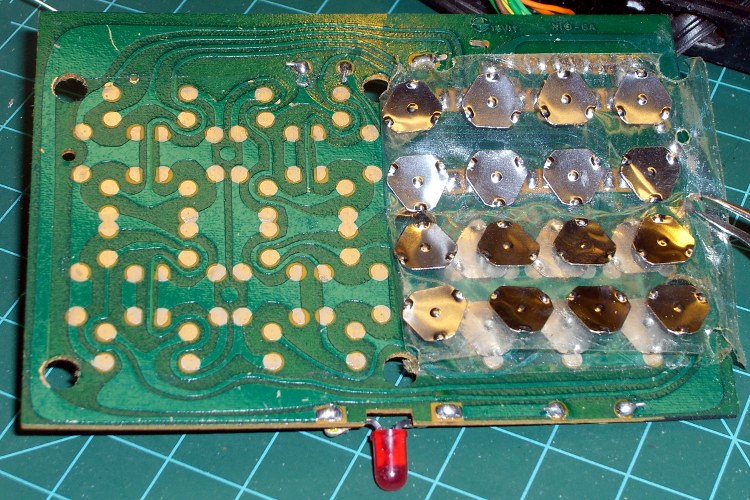
    X10 Controller keyboard
    X10 Controller keyboard

    While I had the hood up, I cleaned the switch contacts, even though that probably had nothing to do with the problem. Back in the day, they used actual metal deformable domes, stuck under an adhesive layer that did a fine job of keeping the crud and dust out.

    Put everything back together, fired it up, and it misbehaved the same way. I’d say we got our money’s worth out of it, though.

    A replacement is on the order of $15 from the usual eBay suppliers, so it’s not the end of the world.

    The new one probably doesn’t have the ultrasonic receiver, so it shouldn’t respond to the ultrasonic cleaner with the same enthusiasm.


  • Braille Signage

    I passed a few minutes in the high school lobby (while waiting for the Fencing team to return from a competition) trying to decipher the Braille signs. I’ve always had my doubts about the utility of these things, but I suppose if you’re going to have signs, they may as well have tactile lettering, too.

    Anyhow, what little I knew about Braille (six dots, um, 64 symbols, um, tapers off after that) didn’t extend to actually knowing any of the letters, but how hard could a substitution cipher be? I figured out most of the letters in Stairway quickly, but some were obviously missing. Perhaps Braille includes symbols for common digraphs?

    Stairway
    Stairway

    The Library across the lobby provided more letters, with obvious mismatches that showed I wasn’t anywhere near as clever as I thought (a distressingly common situation these days). Perhaps the two leading dots indicate “Here be there text”?

    Library
    Library

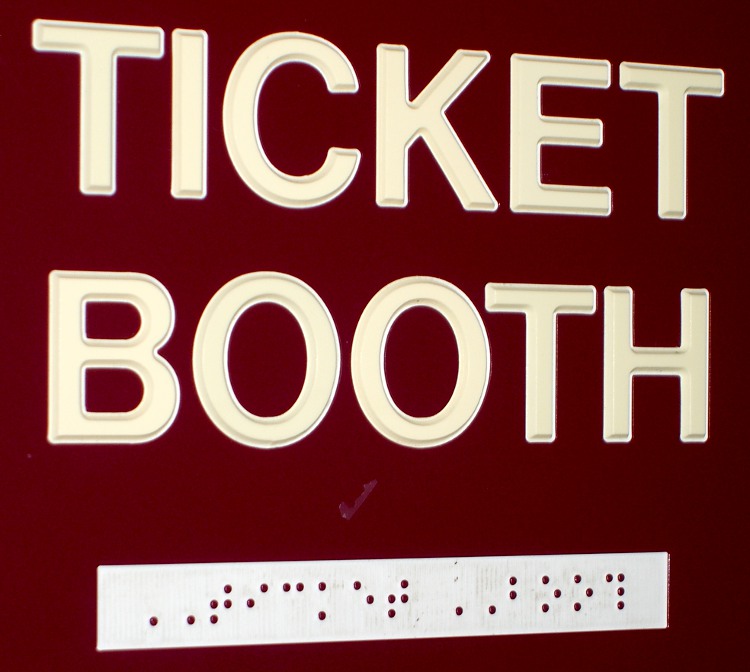
    Then I found the Ticket Booth, which strongly suggested digraph symbols.

    Ticket Booth
    Ticket Booth

    Upon returning home, I did the obvious search and eventually wound up at the Library of Congress Instruction Manual for Braille Transcribing: a short introduction to a very complex subject. Poring through Appendix B provided all the correspondences I needed:

    • The basic alphabet is sorta-kinda decimal
    • Yup, digraphs have their own encoding
    • The two leading dots are a sticky uppercase shift marker
    • Fortunately, I didn’t encounter real contractions
    • There’s an 8-dot variant coming into play

    Some years ago we took an introductory course in American Sign Language when one of my not-quite-a-nephew (son of a cousin, whatever that is) went deaf. Without anyone for day-to-day practice we never achieved fluency, but that was a window into another world, too. We still pass a few basic signs to each other across a noisy room …

    Photography note: photograph signs from far enough off-axis that the flash hotspot on the surface is out of the image. If you must get a rectangular sign out of it, apply a perspective transformation to the image.

  • “Clear Seal” Sealant Removal

    I attempted to assemble the Totally Featureless Clock’s case using Liquid Nails Clear Seal, figuring that it’d be easier to fixture than runny epoxy. I hoped that the joints would have enough surface area to allow curing, but was dead wrong.

    Hope is not a strategy and proper fixturing is your friend.

    Anyhow, I was left with eight surfaces on four dislocated panels covered with more-or-less cured sealant. I left ’em sit for a few days, then had to choose between:

    • Remove enough of the sealant to make the joints fit or
    • Machine new panels

    Turns out that xylene (from my can of Goof-Off) removes cured Liquid Nails Clear Seal just fine, without affecting the surface of the acrylic panel. Soak the corner of a rag, rub vigorously, and the gunk comes right off.

    Note, however, that Goof-Off comes in many different formulations. The one I have is mostly xylene, but the California “VOC Compliant” version is mostly acetone… which, I think, eats acrylic plastic for lunch.

    All of that stuff eats your liver for lunch, too.

    Don’t do like I did and use your bare finger in the rag. Alas, any solvent that actually works also eats any protective glove in my inventory for lunch.

  • Refrigerated Semitrailer Warning

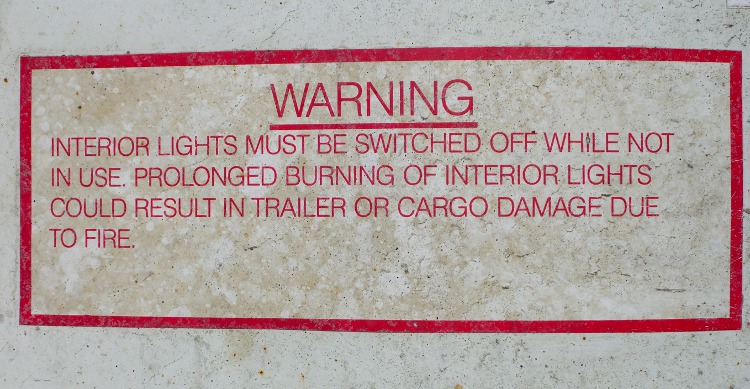
    Saw this one parked behind a local Hannaford grocery store.

    Must be some kind of king-hell bulbs in those fixtures. If there was ever an application for LED retrofit bulbs, this is it…

    Turn lights off to prevent fire
    Turn lights off to prevent fire
  • Why Friends Don’t Let Friends Run Windows: Mystery Banking DLL

    So I signed into the credit union’s online banking site, did the multi-factor authentication dance, and was confronted with this dialog box…

    HVFCU Mystery DLL Download
    HVFCU Mystery DLL Download

    No, as a matter of fact, I did not choose to open ibank.dll, thank you very much for asking.

    Well, what would you do?

    Got this response from the credit union’s email help desk:

    Upon speaking to out Information Technology department, I have been advised that this is a known problem for FireFox, Mac, and Linux users.

    Hmmm, well now, Internet Explorer is conspicuous by its absence on that list, isn’t it?

    A bit more prodding produced this response:

    HVFCU uses a third party vendor to provide the Internet Banking software used on our servers.  On November 22 we installed the equivalent of their year end release (which is mandatory due to regulatory changes contained in the release).  Subsequent to that upgrade we discovered that errors had been introduced for Mac and/or Linux users of Safari and FireFox (and also for a small subset of Windows Internet Explorer users).  These same errors do not occur on Safari nor FireFox running on Windows.  We reported these problems to our vendor within 24 hours of the installation.

    My guess is that the “small subset of Windows Internet Explorer users” corresponds to the few who actually armored-up their IE security settings enough that it doesn’t automatically download and execute anything offered to it from any website.

    The rest, well, those PCs are most likely part of a zombie botnet.

    He assured me:

    The “ibank.dll” program cannot run on a Mac nor a PC.  It is solely a server side application which generates HTML pages.

    Just guessing here, but if the “misconfiguration” had extended to actually serving the file, well, it probably would have run just fine (or, at least, attempted to run) on any Windows PC. They are, after all, using DLLs on the server, so it’s not like they’re a Unix-based shop.

    And it’s pretty obvious that their vendor’s testing extended only far enough to verify that the code worked with security settings dialed to “Root me!” Maybe they didn’t actually do any testing at all; this was, after all, just an end-of-year update. What could possibly go wrong?

    If you’re wondering why your Windows-based PC has been behaving oddly, maybe you’ve gotten a drive-by download from a trustworthy site with all the appropriate icons on their home page.

    Makes you really trust the banking system, doesn’t it?

    Or maybe it’s just another reason to stop using Windows…

  • Ambient Room Light Intensity

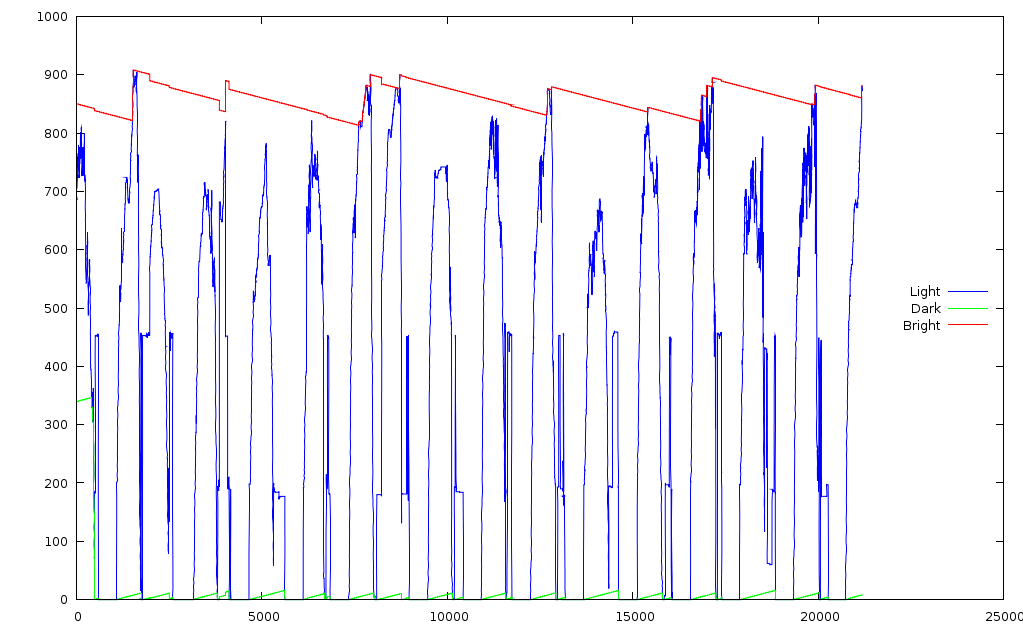
    The Totally Featureless Clock has been running continuously for the last few months, with a laptop dutifully recording its trace output. Occasionally the USB link will disconnect, but on the whole it works pretty well; the clock continues to run even when the USB link fails.

    Here’s about three weeks of light intensity record. The red trace is the max value, green is minimum, and blue the current intensity. The min and max tend toward the middle, one count per hour, so they don’t stick at the extremes.

    Light Intensity
    Light Intensity

    The peaks represent daylight hours, zeros are overnight, and the overall scale is roughly logarithmic, more or less, kinda-sorta.

    The general idea is that the LED brightness matches the room illumination, with the min & max values tracking the actual ambient light range to get the most benefit out of the TLC5916’s limited dynamic range.

    You can spot the data dropouts where the red trace steps abruptly; it should decline smoothly from each peak and the peaks should be evenly spaced about 24 hours (1440 minutes) apart. Each minute generates three lines with the exact time, so it would be possible to futz around and timestamp each record, but …

    The clock dumps the ADC values in hexadecimal, which gnuplot can’t handle, so a bit of preprocessing is in order.

    cat *log > 0.txt
    grep Light 0.txt > 1.txt
    sed 's/Light: /0x/g;s/Min=/0x/g;s/Max=/0x/g' 1.txt > 2.txt
    gnuplot
    set key on right center
    plot "2.txt" using 1 with lines lt 3 title "Light", (and so forth)
    

    All in all, it seems to be working as intended. When I put it inside the case, I’ll probably have to increase the resistor to account for the dark-gray faceplate.

  • Little Brown Bat

    Brown Bat in Skinner Hall - Vassar
    Brown Bat in Skinner Hall – Vassar

    We attended a concert at Vassar College and found this fellow flitting about an upstairs hallway in Skinner Hall. He eventually settled down atop a door frame and I took this picture from across the hall; it’s a tiny crop from a much larger image because I didn’t want to spook him.

    He’s most likely a Little Brown Bat and perfectly harmless. Anybody who can eat that many insects gets a free pass from me!

    He was at least as scared of us as some of the students were of him. Flying in a hallway full of running people must be bewildering…

    Somebody called Campus Security and I suppose they wiped the little guy out during the second part of the concert.