The Smell of Molten Projects in the Morning

Ed Nisley's Blog: Shop notes, electronics, firmware, machinery, 3D printing, laser cuttery, and curiosities. Contents: 100% human thinking, 0% AI slop.

Year: 2009

  • Fairing Arcs

    In CNC machining, at least the kind I do on my Sherline CNC mill, you can’t mill around acute inside corners: a round milling bit doesn’t fit into a straight-sided angle. You must add a fairing arc that smoothly connects the two sides; the catch is that “smooth” means it’s tangent to the sides. And EMC2 is really, really fussy about smooth, to the point where you can’t just wing it with a calculator and type in the numbers.
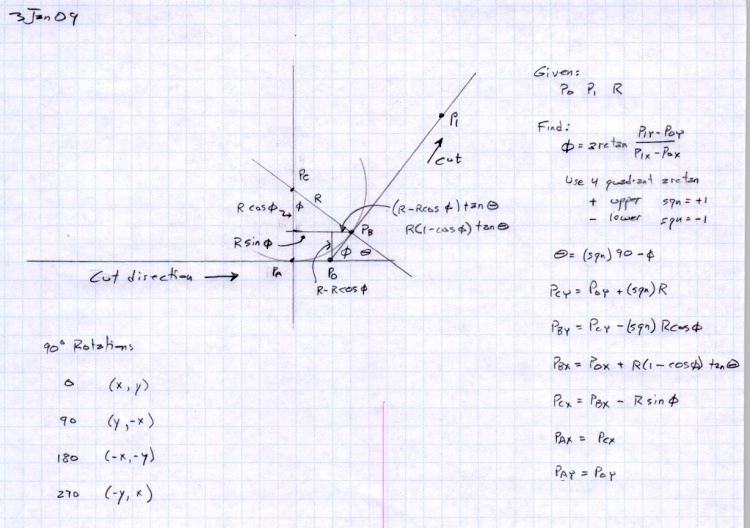
    Fairing arc doodles
    Fairing arc doodles

    There are nice analytic geometry methods for finding the intersection of two line segments, then laying in the arc that connects them, but this example weighs in at over two pages of G-Code. Mostly, what I need is an arc that connects a vertical or horizontal edge to an angled edge, so some simplification is in order.

    Herewith, the quick-and-dirty…

    The cutter enters from the left side, moving horizontally to the right, and will depart along the line toward P1, which might be the next corner of the part. The two material edges meet at P0, the vertex of the angle. The fairing arc is tangent to the two edges at PA and PB, centered at PC, and with a radius R.

    We know the coordinates of P0 and P1 and the arc radius. That radius must be larger than the cutter radius, as you can’t tuck a fat cutter into a narrow corner.

    The problem is to find PA, PB, and PC, so that we can write the G-code commands that travel along the sides & the arc.

    The first step is finding Φ (Phi), the angle between the outgoing edge and the X axis:

    Φ = arctan Δy/Δx = arctan (P1y – P0y) / (P1x – P0x)

    I’m pretty sure if you use a 4-quadrant arctan, as shown in the doodle, all the angles will work out perfectly on either side of the axis, but it’s easy enough to fake the signs to get the right answer in any specific case. If you wanted a general solution, you’d have a two-page subroutine, right?

    You’ll need the complement of that angle, hereinafter known as Theta:

    Θ = 90 – Φ

    Find the distances between various points using good old trig and right triangles:

    • CBx = R · sin Φ
    • CBy = R · cos Φ
    • P0PBy = R · (1 – cos Φ)
    • P0PBx = P0PBy · tan Θ

    Then the coordinates fall out thusly:
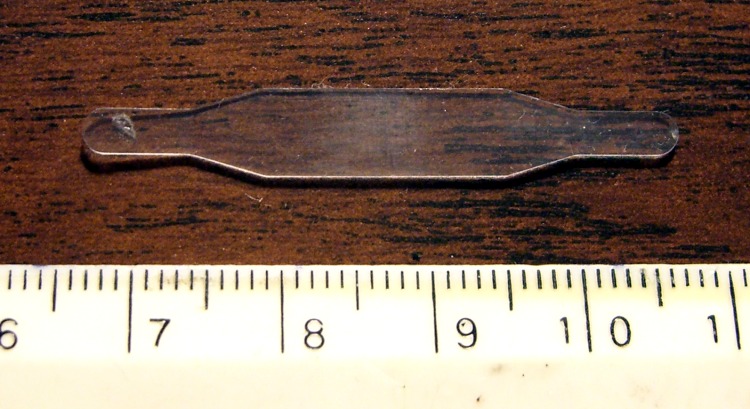
    Plastic Spring with Faired Corners
    Plastic Spring with Faired Corners
    • PCy = P0y + R
    • PBy = PCy – CBy
    • PBx = P0x + P0PBx
    • PCx = PBx – CBx
    • PAx = PCx
    • PAy = P0y

    Remember, you do not figure all this out with your calculator and plug the numbers into the G-code, not if you have any sense. If you have just a few corners, write the commands directly, otherwise gimmick up a little subroutine. Earlier versions of EMC2 used numbered parameters (#100), but now that you can have named parameters (#<_Fairing_Radius>), what’s holding you back?

    For example:

    #<_CBy>	= [#<_Fairing_Radius> * COS [#<_Phi>]]	(Y distance PC to PB)

    If your edge doesn’t come in from the left, then manual 90 degree rotations apply.

    0: (x,y) -> (x,y)
    90: (x,y) -> (y,-x)
    180: (x,y) -> (-x,-y)
    270: (x,y) -> (-y,x)

    If you’re using a CAD program to lay out your parts, all this is largely irrelevant. I hammer out the G-code for the simple 2-1/2-D parts I make by hand, so rounding off a few corners comes in handy.

    Because the lines & arc define the material edge contour, you can mill on either side of it and use cutter radius compensation to make the answer come out right. Works like a champ!

    For what it’s worth, the arc is tangent at PA and PB, making the line from PC to the corner (a.k.a. vertex) P0 the bisector of angle Φ. That’s not directly useful here, but keep it in mind when you solve similar problems.

    Update: As of mid-January, the newest trunk version of EMC2 can automagically insert fillets when cutter comp is turned on. That’ll be in the stable version in a while, after which I’ll need this math only for decorative fillets. That’s fine with me!
  • Fluorescent Shop Lights, Early Failures Thereof

    A decade ago I installed a few dozen two-tube fluorescent fixtures (a.k.a. “shop lights”) throughout the basement. Visitors always say something like “Wow, I can actually see what I’m doing!” That was the whole point, of course.

    Being that sort of bear, I write the date on one end of a fluorescent tube when I replace it. Tubes seem to last 3-5 years, which is short compared to the 20k power-on hours touted on the carton: 5 years * 300 days/yr * 6 hr/day = 9 k hours. That’s an overestimate, as I don’t spend all my time crouched in my basement laboratory, honest.

    It turns out that there’s also a spec for the number of lamp turn-ons (“starts”) hidden deep in the lamp datasheets. For example, if you manage to browse the current Lamp and Ballast catalog at http://www.sylvania.com/ProductCatalogs/, you’ll find that a 20k hour rated life comes at “3 hr/start”, which works out to a mere 6.7k starts over the expected life.

    More starts = shorter life.

    I tend to turn the lights off if I think I’ll be upstairs for a few hours, which happens a lot during the winter.  My back of the envelope says that the tubes fail right around the expected value: 5 years * 300 days/yr * 4 starts/day = 6 k starts.

    Lately I’ve had a rash of early lamp failures and it seems the fixtures are failing after a decade; nothing lasts any more. I’m now installing electronic-ballast fixtures that fire right up in the winter and don’t have that annoying subliminal flicker. At a cost of $20 each, I’m not replacing all of them at once, I assure you.

    The only real problem with fluorescent lamps is that they make white people look dead. I managed to buy a contractor pack of warm-white tubes at the local Lowe’s, but they’re hard to find around here. Go for the lowest color temperature bulbs you can find.

  • Sunglass Repair

    Making the fixture
    Making the fixture

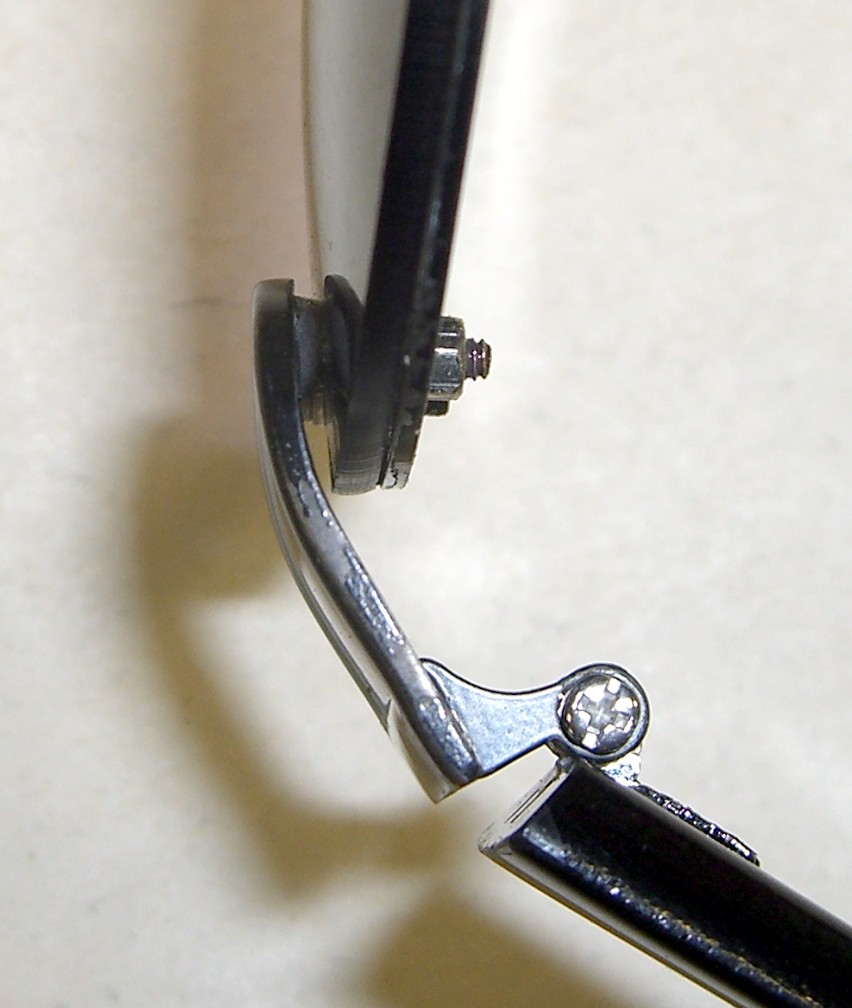
    One of the screws on Mary’s sunglasses came apart. Wonder of wonders, the nut fell off in the kitchen, made a click when it hit the floor, and we managed to collect all the pieces.

    The temples attach to the lens frame with two tiny screws apiece. The screw heads are slightly embedded in the temples, but you can see why this didn’t work nearly as well in practice as it did in the design studio.

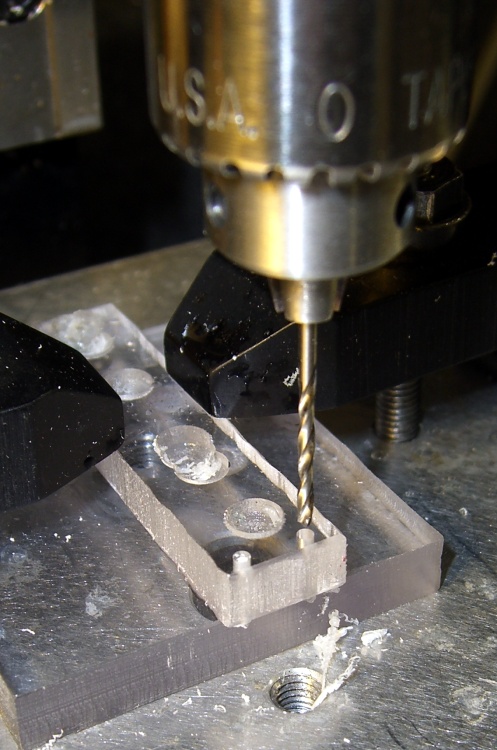
    The trick is to align the screw properly so it fits through the lens and frame after the adhesive sets up. The holes are 6 mm on center and more-or-less 55 mils in diameter (obviously, they’re metric screws, but this is the US and we do the best we can with antique units).

    Clamping and curing
    Clamping and curing

    That’s what CNC is all about: making it trivial to poke holes exactly 6 mm apart on center. I drilled two holes in some scrap acrylic sheet using Manual mode on my Sherline / EMC2 mill:

    g83 z-7 r1 q0.5 f100
    g0 x6
    g83 z-7 r1 q0.5 f100
    g0 z100

    I have it set to start up in metric units, which still seems to be legal here.

    cimg2858-sunglass-repair-success
    Success!

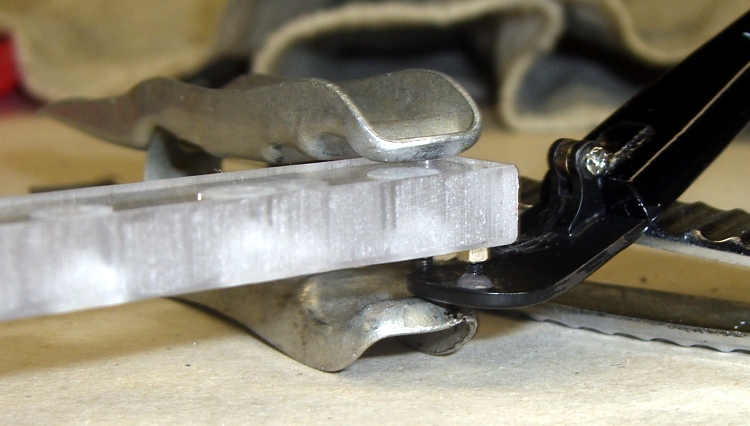
    Add a teeny dab of JB Weld, hold everything together overnight with a clothespin, and it’s all good in the morning.

    The trick is to check the leftover epoxy first to see if it’s fully cured before you move the actual piece.

    Memo to self: epoxy takes forever to cure at 55 F.

    Update: Pretty much as expected, that little dot of epoxy didn’t hold nearly as well as the original brazing. I tried a somewhat larger dot, but Mary was unhappy with the glasses anyway and we finally tossed ’em out.

    Of course I salvaged the screws & nuts & suchlike: you gotta have stuff!

  • Geek Scratch Paper

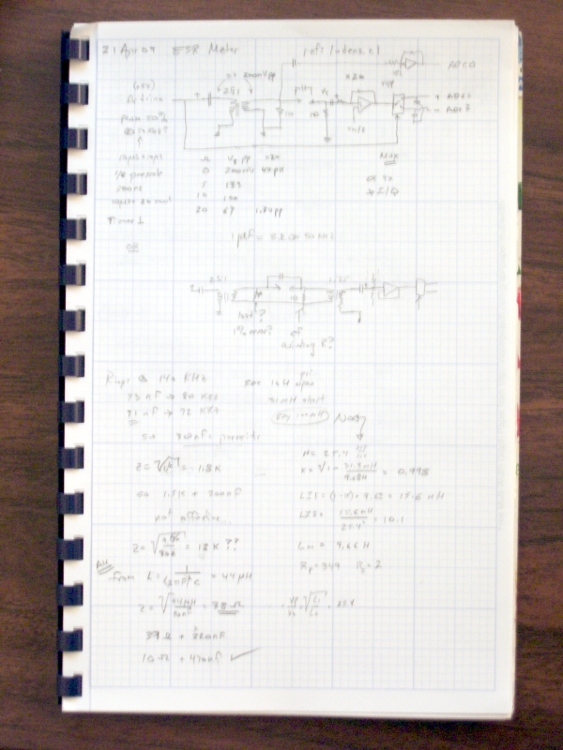
    Grid scratch paper pad
    Grid scratch paper pad

    Everybody needs doodle paper, but geeks need graph paper. What to do?

    Go to http://incompetech.com/graphpaper/ and set up a half-page grid with 5×8 1-inch divisions, 0.5-inch mid divisions, and 0.1-inch minor divisions (I think 1 / 0.6 / 0.3 pt line widths look nice). The obvious metric divisions are a bit too fine for my taste, but 2 cm – 1 cm – 2 mm might work.

    Fetch the PDF, load it into The GIMP at 300 dpi, expand the canvas to a full-page sheet (8.5×11 inches), duplicate the grid so you have two on one sheet, save it as a PNG for later use.

    If you don’t have a full-bleed printer, pick a full-page size that’ll print within whatever margins your printer enforces. You really want those one-inch grids to remain one inch, right?

    Print a few dozen copies, whack ’em in half, and bind ’em on the long edge. Add a thin cardboard backing sheet (Mr Breakfast Cereal Box, meet Mr Paper Cutter) so the bottom sheet stays neat.

    I have an old IBICO (since absorbed by GBC) plastic comb binding machine, but it’s easy enough to line the sheets up and coat the edge with white paper glue, rubber cement, or, for the true geek, liquid electrical tape.

    Pre-position pads wherever you’re ordinarily at a loss for scratch paper: neat doodles!

    PS: Put some money in his tip jar when you use his graph paper. It’s a nice gesture.

    [Update: Inexplicably, I didn’t have a picture of a pad. Here you go… low res, but you get the general idea. Great for off-the-cuff graphing, too.]