Ed Nisley's Blog: Shop notes, electronics, firmware, machinery, 3D printing, laser cuttery, and curiosities. Contents: 100% human thinking, 0% AI slop.
When you make a plumbing joint with screwed compression fittings, there’s always a question of whether you’ve tightened the nut enough to make a good seal. The fittings come with copious warnings to not overtighten the nuts, which means I tend to undertighten them.
It’s easy to spot a major leak or a trickle, but what about a very slow ooze on a hot water line where the drip will evaporate before you notice?
Fold up a piece of tissue paper and secure it around the joint with a wire tie. Come back a few minutes / hours / days later: it’s easy to tell if the tissue has ever been wet, because its texture will be dramatically different.
Having just replaced a water heater, the subject of leakage is a hot topic around here…
So our 6-year-old Whirlpool electric water heater tank failed and dribbled water on the floor. Fortunately, I spotted the leak before it flooded the basement: I look at the heater just about every time I venture into the Basement Laboratory Electronics Wing. Judging from the mildew & fungus growing on the wooden base I built for it, though, I haven’t been doing a good job of walk-by inspecting. In my defense, the visible wooden edge is 3/8″ thick below the dark rim of the heater.
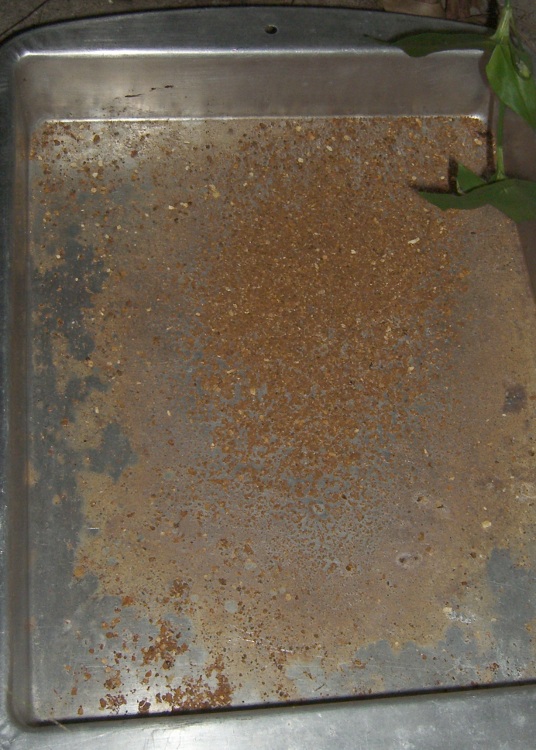
Grit drained from tank
I turned off the inlet & outlet ball valves, flipped the breaker off, routed a garden hose out the door, laid the end in an old cake pan, and drained the tank. The pan collected a fair amount of rusty grit (and more washed down the driveway), which means the glass-lined tank was suffering from internal rust.
A call to the Warranty Hotline produced an Indian-subcontinent accented voice, who told me that I had to get a licensed plumber to tell them that it was, in fact, rusted out. “Any plumber in the phone book will do”, he said, “Just have them call this number and we will verify the situation with them.”
My back of the envelope, confirmed by friends, is that it’d cost about $150 for a plumber to drop in. Oh, and this was on a Saturday morning, which means it might be a while later and bit more expensive than that. Paying somebody $75/hour to wait on hold didn’t seem attractive.
A new heater of the same general nature is $400, give or take.
Soooo, in round numbers, I’d be spending half the cost of the “free” replacement just to find out if Whirlpool would honor the warranty.
I was ready to just cut my losses and buy another heater when my friend Aitch suggested two simple alternatives:
Call the warranty line again, point out that this is the Internet Age, and offer to send them pictures of the problem, along with a statement that I was being truthful.
Spend the $150 to ship the dead heater to the office of the Whirlpool CEO with a note describing the situation
I picked the first option and had a brief conversation along these general lines:
paying nearly half the price of a new heater for an “evaluation” is absurd
the leak was near the top; even the caps over the heating elements were rusted
the grit shows that tank has internal rust, so it’s not external corrosion
I’ll send pictures anywhere you want
Much to my astonishment, the pleasant voice gave me a replacement authorization! No pictures needed.
Knock me over with a feather…
So I hauled the corpse back to Lowe’s, swapped it out for a new one, and away I went.
Now, it’s worth noting that the new heater has a 12-year tank warranty, not the lifetime one that came with the original purchase. Given my experience with the first one, we’ll see what happens; I suppose they learned how expensive a lifetime warranty can be.
Overall, a pleasant surprise, although the initial presentation wasn’t encouraging in the least.
The top bearing, the one nearest the impeller (on the left in the pic), developed detents, which says at least one of the balls has failed.
Both bearing housings are rusty; water has no trouble getting past the flexible seals at each end. As they’re not immersion-proof, I assume the water has little trouble getting past the shield rings on either side of the balls.
I replaced both of them, squeezed some silicone stopcock grease above the top bearing in the vain hope of excluding liquids, and we’ll see what transpires.
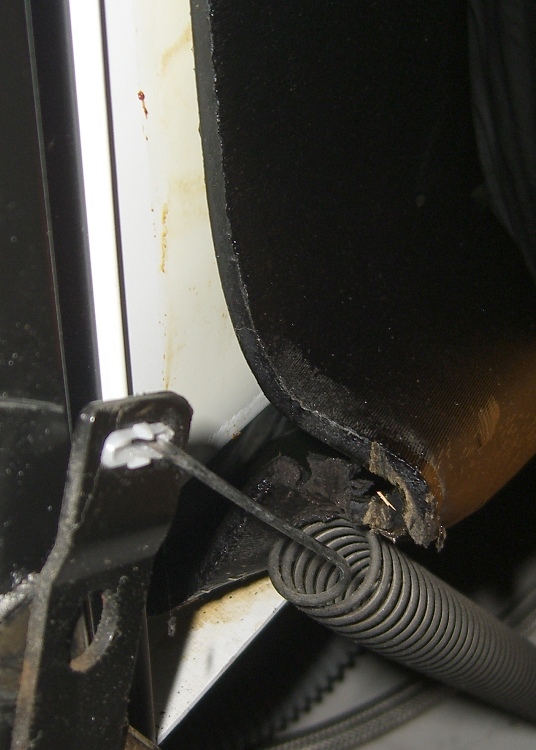
Our dishwasher door started making an odd gronking noise when it was opened or closed. It had done this before, so I knew what was going on: one of the sound deadening sheets inside was creeping down around the enclosure and jamming itself into the spring.
It turns out that a layer of adhesive holds the sheets in position and, in hot weather, the weight of the sheet pulls it right over the edge. They’re made of asphalt or something equally black and sticky and heavy, just what you want to dampen vibrations on those big unsupported enclosure sides.
Oddly, this is the only sheet that’s on the move. The others are pretty much stuck where they started. I don’t know if it’s hotter on this side or what’s going on.
Sound deadening sheet creepage
The situation was much worse the last time; I had to hack off a huge chunk of the sheet that had buckled around the right side of the dishwasher under the fiberglass insulating blanket. The spring was pretty much encased in shredded asphalt. Not a pretty sight.
This time the sheet traveled only a few inches, just enough to hit the spring with the door about half-open. I broke off the offending part, crudely flattened the rest, and moved the entire sheet back up to the top of the enclosure.
A few strips of duct tape should hold the sheet in place until the heat relaxes the bent areas and improves its contact with the enclosure. I hope that, with most of the remaining sheet on top, rather than hanging off the side, it’ll stay in place until the dishwasher goes casters-up for the last time.
While trying to persuade a Windows program to run under Wine, I stumbled across this useful script: winetricks.
Basically, it downloads & installs the myriad runtime libraries / DLLs / programs that Windows programs generally assume are installed. Those are the things you don’t know are missing and generally can’t figure out how to install on your own.
It didn’t actually help get the program in question running. As nearly as I can tell, if at first you can’t get a program installed & running under Wine, just give up…
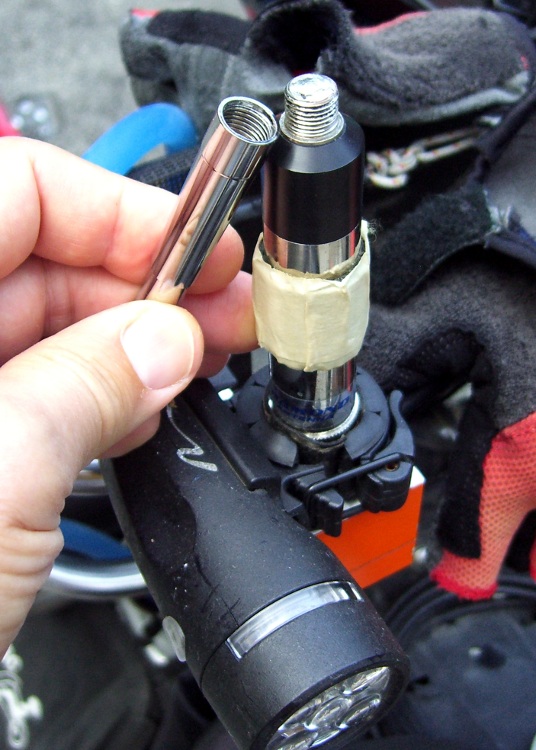
Vibration is a real killer for bike-mounted hardware. The antenna mast on my bike has been unscrewing itself, despite my repeated attempts to tighten it. Fortunately, I’ve managed to notice the rattle before the mast falls off into traffic.
We’ll see if a dab of medium strength (blue) Loctite will do the job.
One thing to worry about: this is an electrical as well as a mechanical joint. I hope there’s still enough metal-to-metal contact to get RF energy to the radiating part of the whip!
[Update: Yup, works just like you’d expect. Problem solved.]
The antennas on the other two bikes have remained tight, so maybe it’s just that my riding style generates more vibration? Hard to imagine; it’s not like I venture off-road.
More details on the homebrew mount are there and how commercial mounts fail are there.
The unsightly masking tape wrap is where I attached a reflector for a (rare) after-dark ride a while ago. Making a set of bushings for the reflector clamps is a low-priority job in the queue right now.



 The Smell of Molten Projects in the Morning