The Smell of Molten Projects in the Morning

Ed Nisley's Blog: Shop notes, electronics, firmware, machinery, 3D printing, laser cuttery, and curiosities. Contents: 100% human thinking, 0% AI slop.

Month: September 2009

  • Credit Card Privacy Choices

    Just got a new credit card, which arrived with the usual “Privacy Policy” flyer describing how they’ll keep our sensitive bits safe & secure. Except, of course, that by default they’ll share those bits with nearly any organization that asks, if there’s even the least bit of money to be made in the process.

    The flyer explains how we can tell them of our privacy choices. Oddly, in this Internet Age, none of the banks have figured out how to put our privacy policy choices on their websites. Maybe that would be entirely too efficient.

    Anyhow, we’re supposed to either:

    • Pick up the phone to deal with their customer service apparat or
    • Pick up a pen, fill out a form, cut it out, and mail it to them

    For our joint accounts, if I forget to say “And this also applies to my wife”, well, then they’re free to share her sensitive bits.

    I’m sure they know that when they make “choosing” difficult enough, nobody will bother.

    Ya think?

    For the record:

    • Chase: press 0 to short-circuit the account info blather and get to a rep
    • Citi: press 6 for that purpose. Why not 0? Huh…

    The Chase folks tell me this may require up to 90 days to take effect. Wow, do they fill out forms and hand-carry the paperwork to Galactic HQ for further transcription?

    Memo to Self: Remember to tell the nice voice…

    • This applies to both account holders
    • Turn off all information sharing options
    • Turn off “convenience checks” (is anybody stupid enough to use those things?)
    • Turn off automatic credit line increases

    This takes about four minutes for each account on a Sunday morning.
  • Digital Caliper Disassembly

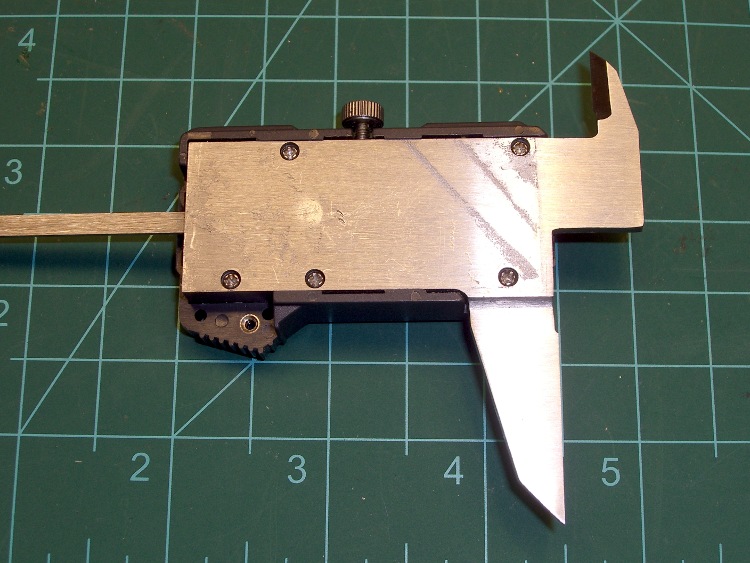
    Caliper Back Side - Label Removed
    Caliper Back Side – Label Removed

    Just in case I spill a sticky liquid on the caliper and must disassemble it again…

    This was a relatively inexpenive, but not dirt cheap, caliper that has worked fine all along, apart from the issue with the thumb roller frame.

    After removing all the obvious screws, taking off all the various doodads, and extracting the sliding jaw, it still doesn’t come apart. The trick, as always, is to peel the label off the back side to reveal the five crucial screws that secure the electronics package to the metal scale.

    These screws don’t have the best heads in the world, but a #2 Phillips driver, solid pressure, and steady torque gets them out. All but one of the screws are pointed; the one in the lower-left corner (as above) is a machine screw that, I think, ensures a good electrical connection between the metal frame and the electronics package.

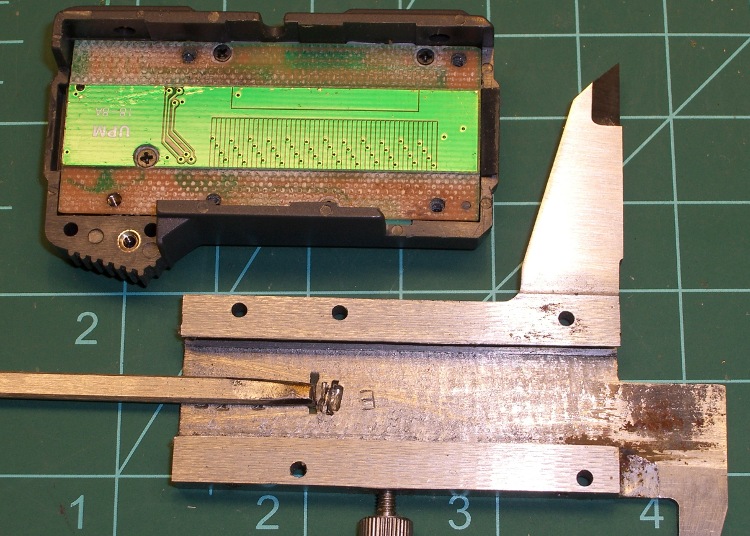
    Caliper Disassembled
    Caliper Disassembled

    With those screws removed, the electronics package pulls off to expose the innards. Note the cough delicate hand-forging that secures the tang to the back plate.

    The schmutz on the far right matched up with a similar patch of rust on the sliding scale. Some TopSaver rust treatment applied with a scrubbing pad reduced the problem to mere discoloration; the rust wasn’t all that deep.

    Reassemble in reverse order, with dabs of lubricant on the obvious wear points along the way. The thumb roller must go on after securing the electronics package, not before.

  • Maxwell 10 F Ultracapacitor: First Charge

    Maxwell PC10 Ultracapacitors
    Maxwell PC10 Ultracapacitors

    My buddy Mark One dropped off a pair of Maxwell PC10 10 farad Ultracapacitors. We both recall our respective professors saying that a farad is an impractical unit, there’d never be such a thing as a 1 F capacitor, and it would be the size of a barn anyway…

    These are 25x30x3 mm.

    The downside, of course, is that they’re rated at 2.5 V DC with an absolute maximum of 2.7 V.

    On the other paw, they have a maximum current of 2.5 A and a whopping 19 A short-circuit current. Serious risk of fire & personal injury there…

    Charged one up from an AA NiMH cell I had lying around on the desk, which took a while, then let it discharge all by itself while taking notes. The results look like this:

    10 uF Ultracap - Self DischargeTime    Voltage – mV
    13:02    1353
    13:08    1350
    13:36    1338
    13:56    1333
    14:09    1329
    14:21    1326
    14:54    1318
    15:13    1314
    15:49    1308
    16:06    1305
    17:42    1291
    18:49    1283
    19:03    1282

    Now, maybe that’s not exactly the extreme top left end of an exponential drop, but it looks close enough:

    V(t) = V0 * exp (-t/τ)

    Pick any two points on the curve to find τ, the time constant:

    V(t1) / V(t2) = exp (-t1/τ) / exp (-t2/τ)

    Take the log of both sides and remember that the log of a ratio is the difference of the logs:

    log V(t1) – log V(t2) = (-t1 + t2) / τ

    Plug in the first and last data points to get:

    0.02341 = 21.6 ks / τ

    Reshuffle and τ = 923 ks. Close enough to a megasecond for my purposes.

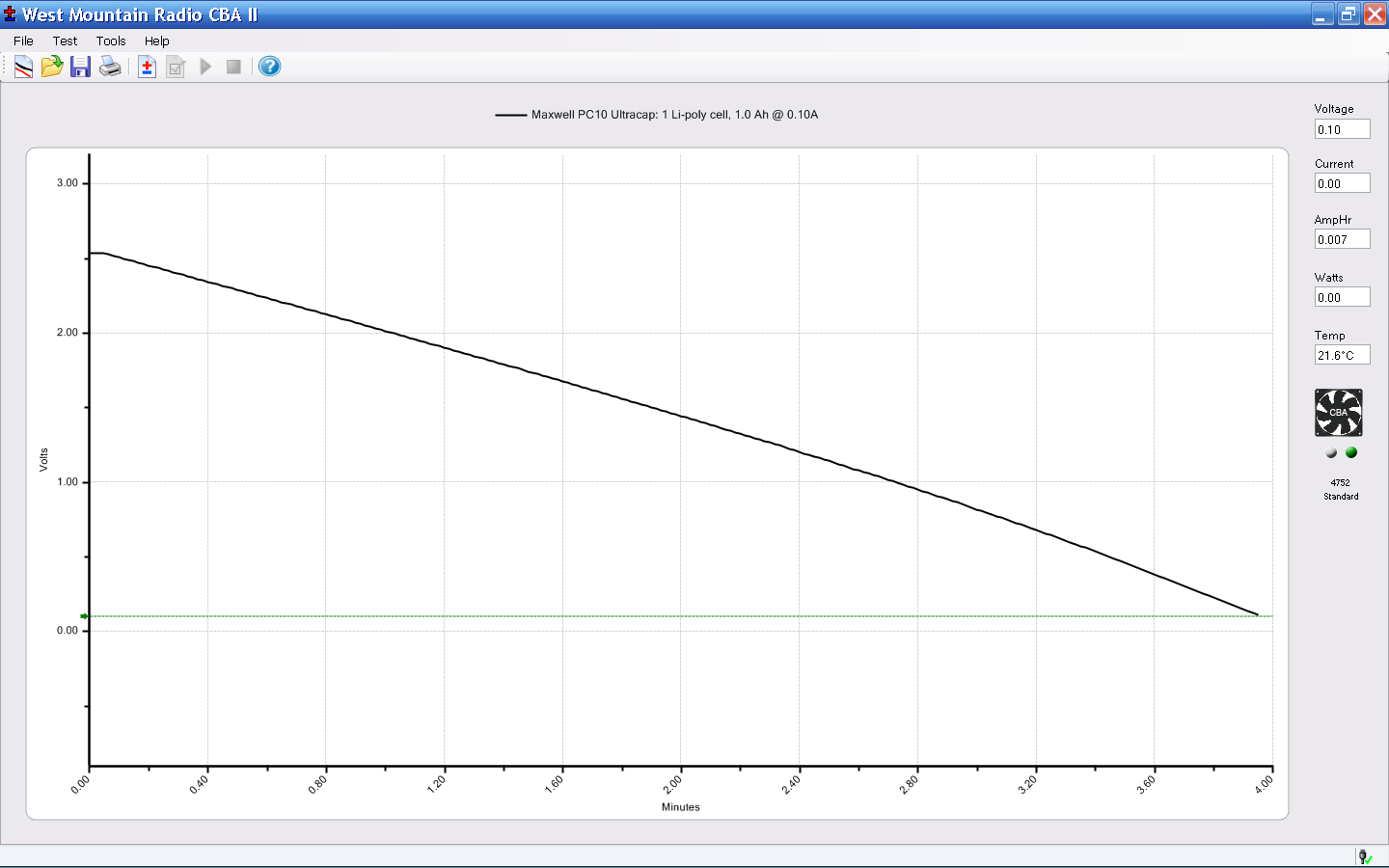
    How to find the capacitance? Charge the cap up fram a pair of NiMH cells, discharge it at a constant current using a battery tester, thusly:

    10 uF Ultracap - 100 mA Load
    10 uF Ultracap – 100 mA Load

    That curve isn’t exactly linear, but it’s close enough that we can use the familiar capacitor equation:

    ΔV/ΔT = I/C

    Reshuffle to get capacitance over there on the left side:

    C = I * ΔT / ΔV

    The lower axis is minutes, not seconds, with truly poor grid values. Eyeballometrically, call it 4 min * 60 = 240 seconds.

    Plug in the appropriate numbers and find that

    C = 0.1 A * 240 s / 2.5 V = 9.6 F.

    Close enough.

    Knowing τ and C, find the self-discharge resistance R = τ/C = 96 kΩ. That seems pretty low, but at 2 V it amounts to 25 µA. The cap’s self-discharge current is rated at 40 µA, so that’s well within spec.

    Now, admittedly, the cap doesn’t hold much energy:

    • NiMH 2 x AA = 1 Ah @ 2.4 V = 2.4 Wh = 8600 Ws = 8600 J
    • Ultracap 10 F @ 2.4 V = 1/2 * C * V^2 = 29 J

    But, heck, it’s pretty slick anyway… it’ll make a dandy backup power source for a clock I’m thinking of making.

    Memo to Self: Datasheet says to add balancing resistors that carry 10x the self-discharge current when stacking in series. That’d be 10 kΩ, more or less, which seems scary-low.

  • NiMH Cells: Finding the Weak Link

    I recently bought two dozen Tenergy Ready-to-Use NiMH cells, rated at 2.3 Ah, with the intent of making up three 8-cell packs (identified as A, B, and C, for lack of anything smarter) for the amateur radio HTs we use on our bikes. However, one of the packs measured a consistently short runtime and I suspected one weak cell.

    So I ran pairs of cells from the weak pack and found these results:

    DSC-H5 Battery - Tenergy RTU NiMH AA Cells
    DSC-H5 Battery – Tenergy RTU NiMH AA Cells

    Observations…

    These are all measured just after charging, so they’re all the best you can expect from the cells. I haven’t done any self-discharge tests yet.

    The overall capacity at 1 A load is roughly 65% of the 2.3 Ah rating.

    The red trace falls far short of the others, so that’s the pair with the weak cell. I charged & tested those two cells individually, which are the lower two traces: cell A4 has 58% of nominal capacity. Admittedly, that’s 90% of the capacity of the rest, but, still …

    I’ll use the other three pairs of cells through the Sony DSC-H5 camera, for reasons described there. Cell A4 is destined for the shelf…

    Now, the question becomes: who should I buy the next batch of cells from?

  • Digital Camera Battery Runtime

    My Sony DSC-H5 uses a pair of AA NiMh cells and, it seems, drains them rather rapidly. I’ve been cycling a motley assortment of paired cells through the thing and figured some measurements were in order.

    Click on the graph to get a bigger image with readable labels:

    DSC-H5 Battery - Old NiMh AA Cells
    DSC-H5 Battery – Old NiMh AA Cells

    Some observations…

    All of the cells, except for the Tenergy RTUs, have been cycled through the camera many times over the last few years. I charged the cells before testing, so these are hot-from-the-charger values without the usual self-discharge that afflicts all NiMh cells.

    I picked a 1 A load for convenience. I think the camera presents a much heavier, although intermittent, load to the cells, as the actual runtime is far less than the 1.5 to 2.3 hours you see on the graph. In round numbers, the camera rejects the weaker cells in about 15 minutes, which means its load is much heavier.

    The topmost blue-gray line is from the original pair of Sony Stamina cells that came with the camera, which still deliver decent runtime. Rated at 2.5 Ah and delivering very nearly that much into a 1-A load.

    The green line is the same pair of cells loaded at 2.5 A, just to see what happens. They still work pretty well; the lower voltage is to be expected. A mere 0.14 Ω of lead resistance will account for that entire difference and I’m not sure how much the cells contribute.

    The red and black lines are from the quartet of 2.2 Ah Energizer cells that came with an Energizer 15-minute (!) charger. They’re rated at “Min 2.05 Ah” and are still well within that spec. However, they deliver a relatively short runtime. I just noticed that the graph legend has the wrong capacity values for the red trace (cells C&D): oops.

    The short purple line that dunks down in the middle of the graph is a new pair of the disappointing Tenergy Ready-to-Use cells, with a nominal capacity of 2.3 Ah and delivering barely 1.5 Ah.

    The blue line is a pair of Tenergy 2.6 Ah cells with a similarly low actual capacity at a much lower voltage. They give a very brief runtime.

    As nearly as I can tell, the only thing that matters for camera runtime is the battery voltage. Large currents cause a correspondingly large voltage drop, so even cells with good open-circuit voltage will fail early.

    Internal cell resistance is probably the determining factor, as that increases with age. Even though the Energizers have plenty of capacity, they deliver it with a terminal voltage that’s too low for the camera.

    The Tenergy RTU cells have a pitifully small capacity compared to their ratings, but they last much longer in the camera than I expected. Their output voltage stays above 2.3 V until fairly late in their discharge, so the camera remains happy.

    I’ll continue using the Sony cells, along with a quartet of the Tenergy RTUs. The rest are destined for flashlights and such…

  • Verizon FiOS: Wheeling and Dealing

    So Verizon seem determined to spend as much money as it takes to bury us in FiOS Triple Play mailings. For the last few months, we’ve been getting at least one mailing a week with exactly the same offer. Perhaps they think we’ll eventually get fed up and buy the damned thing, although rumor has it that the offers keep coming even after you do that.

    Anyhow, I called the number (877-896-3354 this week) to ask:

    • How about selling us FiOS 15/5 Internet and Freedom Essentials (unlimited US residential VOIP) for $60/month for two years with no installation fee?
    • Failing that, put us on the Do Not Solicit list to shut off the junk mail

    Come to find out that:

    • Nope, the nice voice can’t dicker on the monthly price, but…
    • They’re willing to waive the installation fee ($50) without blinking
    • The fact that we don’t have a TV and aren’t interested in the Triple Play is a dealbreaker for them
    • The DNS list is just a checkbox on their display of my account: done!

    At this point we’re spending $50 for Optimum Online cable 13/2 (more or less) internet and nigh onto $30 for a Verizon landline phone without “long distance” calling (which we do by VOIP these days). They can do a bundle for something like $80/month with a brief teaser discount, but no better than that. So we’d wind up paying more for basically the same thing.

    After a pleasant conversation he asked if I would recommend Verizon to my friends & relations. I said “Absolutely not” and he asked if I wanted to talk to a Quality Assurance representative. Figuring it’d be good for a laugh, I said yes… and then went directly to the usual interminable wait-on-hold.

    The QA guy asked why I wouldn’t recommend Verizon, so I gave him a few reasons:

    • Their phone menu system is impenetrable
    • I often get mysteriously disconnected during intra-Verizon handoffs, particularly if I’m asking difficult questions
    • Nobody in their “customer support” phone tree can explain how much the “Other charges, taxes & terms” might add up to on a bundle deal: they can’t tell me what their service will cost!
    • Nobody at Verizon can explain the random charges / credits / debits / adjustments on my buddy Aitch’s wireless + Triple Play bill. He’s a smart guy; if he can’t figure it out, I certainly can’t.
    • Their pricing is not competitive; it’s more than we’re paying now for basically the same thing. Why switch?

    He actually tried to claim that I can’t get FiOS speeds from cable. I pointed out that the difference between 15/5 and 13/2 isn’t “This is FiOS. This is BIG!”, it’s just barely discernible and not guaranteed anyway. Oddly, in the last few months, Verizon has quietly bumped the base FiOS speed from 12/2 to 15/5, which I infer means they found that trying to sell a slower speed to cable customers wasn’t working out that well.

    I also infer this whole FiOS thing still isn’t going as well as they’d like. If it was, the incessant offers would stop.

    The QA guy said he’d call me back if they could do anything about the price; there’s evidently a New & Better Deal coming out in a few weeks. Of course, since we’re on the DNS list, we’ll never know…

    I told him here’s what it would take to get me to switch: paying less than $80/month for internet + phone. I figure $60 (plus the mystery charges) would save me maybe $10/month. I’ll geek for that if they don’t screw me over for installation and suchlike.

    Failing that, we may just shoot the landline in the head and go with the cheap prepaid cellphone deal. Google Voice seems to be a reasonable solution; I got a local number that’s very close to our current landline, so maybe it’s time to print up a stack o’ cards and send out some notices.

  • Water Heater: Flexible Tube Heat Trap

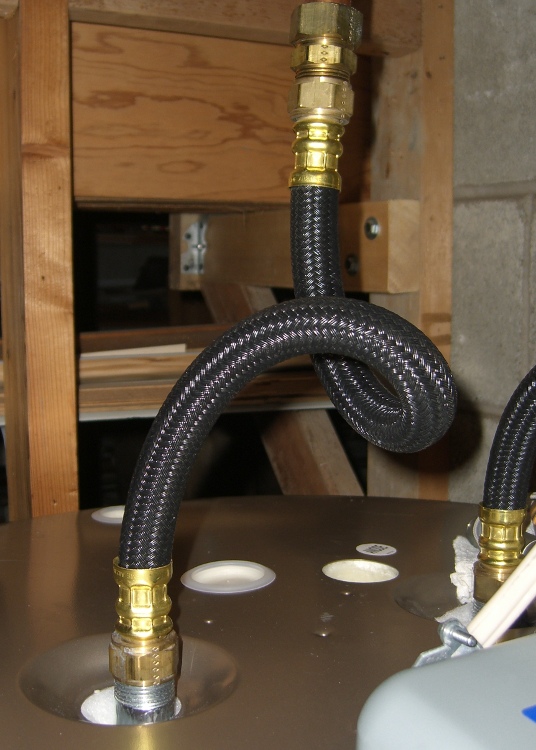
    Flexible tube heat trap loop
    Flexible tube heat trap loop

    The insulation on water heaters is pretty good these days: the exterior shell stays within a few degrees of ambient temperature. However, hot water rises, which shouldn’t come as any surprise, and convection currents can drain a surprising amount of heat out of both the hot & cold water lines on the top of the heater.

    So I added heat trap loops to the inlet & outlet plumbing using flexible tubing. These are 18″ long and I might replace them with 24″ lines to reduce the angle at the water heater. Surprisingly, there’s not much strain in the tubing: it’s happy with that bend.

    The guidelines say you need a foot or so of vertical loop, but even this piddly loop keeps the upper fitting at ambient temperature after a night without drawing any hot water.

    In theory, you can screw heat-trap nipples into the water heater, but this heater came with something that looks like heat traps and heat most certainly still traveled up the cold water pipe. I think that had something to do with conduction from the tank to the metallic shell of the nipples.

    I’ll add all the usual insulation when I’m sure everything is tight.

    As always:

    • This may or may not satisfy your local plumbing code
    • If it leaks, it’s not my problem
    • If it breaks, you get to keep all the pieces
    • Etc, etc, etc.