The Smell of Molten Projects in the Morning

Ed Nisley's Blog: Shop notes, electronics, firmware, machinery, 3D printing, laser cuttery, and curiosities. Contents: 100% human thinking, 0% AI slop.

Month: July 2009

  • Cold & Fractured Solder Joints

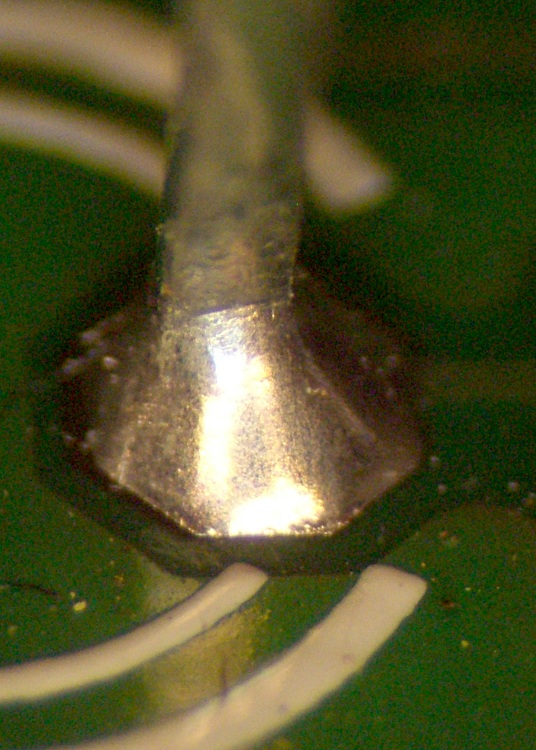
    Joint 1 - solder not bonded to lead
    Joint 1 – solder not bonded to lead

    A friend brought over a broken toy (well, an Argent GPS tracker) with a peculiar problem: everything worked, but after a few minutes the front-panel LEDs would get intermittent. The LEDs are hand-soldered to the board with leads that extend maybe 7 mm from the surface.

    After a bit of poking around, I stuck the gadget under the microscope, at which point the problems became obvious.

    See that distinct line where the solder meniscus ends at the lead? Yup, that’s the teltale sign of a cold solder joint. The lead never got hot enough to bond properly with the solder, so the failure extends all the way down through the board. The only electrical contact is at a random point where the flux layer is thin enough to pass current; as the joint heats up, that point Goes Away.

    Worse, do you see (click on the pix for bigger images) the small discontinuity about 1/3 of the way down the solder cone? My buddy Eks alerted me to that failure: that’s where the solder joint fractures from repeated heat stress.

    Solder Thermal Stress
    Solder Thermal Stress

    Here’s the quick sketch he drew on the canonical back-of-the-envelope. I added the red oval as a replacement for his emphatic gestures; with any luck, you’ll never forget it, either.

    In this case the LED is anchored in a front-panel hole and the lead is mechanically locked to the board. As the lead heats & cools, it expands & contracts (duh) at a slightly different rate than the solder. After a while, the solder cracks; it’s much less ductile than copper.
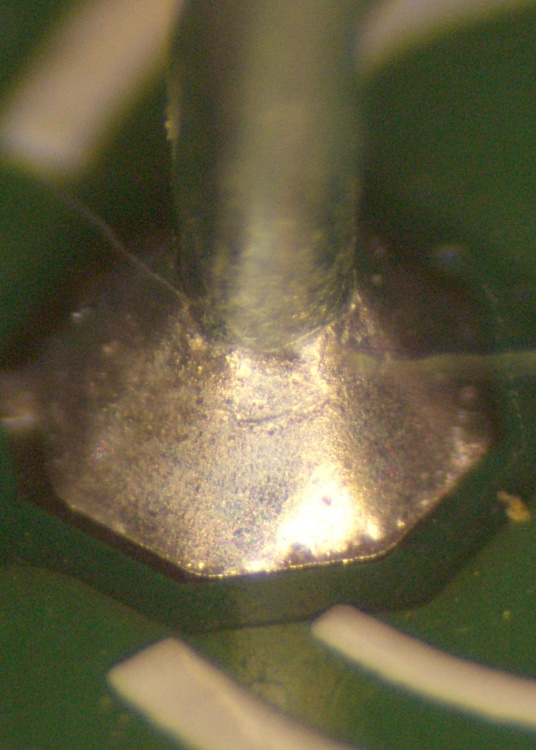
    Joint 2
    Joint 2 – clear fracture

    I’m not convinced that’s what happened here, as the LED leads have a bend in the middle that should relieve the stress, but it’s at exactly the spot where he sketched the failure he’s found in many, many gadgets. Power transistors standing above boards with their backs screwed to heatsinks seem particularly prone to this failure, as they have short leads stressed by the differential expansion between copper and aluminum.

    Here’s another LED lead from the same gadget. A random out-of-focus fiber enters from the right and exits around to the left rear, but you can clearly see the bad joint at the top of the solder cone and the fracture line just below the fiber.

    A touch of the soldering iron generally solves the problem, although you might want to suck the old solder out so the new solder can re-flux the joint.
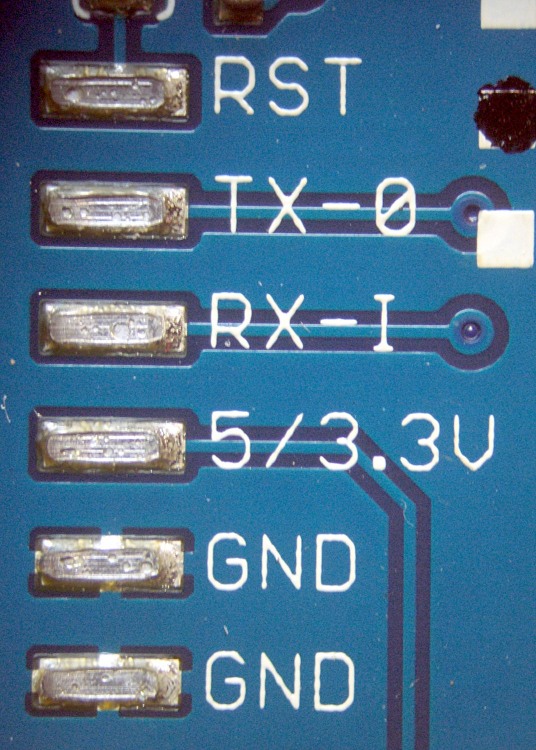
    Arduino Pro USB (cold) Solder Pads
    Arduino Pro USB (cold) Solder Pads

    This doesn’t happen only to hand-soldered joints. The USB header fell right off an Arduino Pro board while I was debugging something else. I had to re-heat the joints and the header separately, add flux, and then solder ’em together. Notice the bubbles in the solder layer? That header just never got up to the proper temperature. The current version of that board uses a through-hole header, which is more rugged than this surface-mount equivalent.

    TinyTrak3 cold-solder joints
    TinyTrak3 cold-solder joints

    And a TinyTrak3+ board had few cold joints, too, where the leads just didn’t bond at all.

    In both of those cases, the vendors did a quick check and didn’t find similar problems with their stock, so the boards I got seem like random failures on the soldering line.

    Now, if I’d never made a cold solder joint in my life, I’d be in a position to get all snooty. That’s just not the case: it happens to everybody, once in a while, and you just learn to live with it.

  • Fancy Scam-by-mail Offering

    Mail Spam
    Mail Spam

    Just got a letter from Canada, allegedly from the Readers Digest Sweepstakes, but with a letterhead address of 1125 Cornell Ave, Atlanta GA 33412. The phone/fax number is 912-480-0353, oddly not a toll-free business number. The letter has medium production values, pixellated Readers Digest logos, surprisingly few typos, and a painfully ersatz signature.

    I’m to believe I’ve won $255,069.00 in a contest I’ve never entered (the way I see constests, while you’ve got to play to win, entering doesn’t improve your chances of winning). The “69” is a nice touch, I’d say.

    Enclosed is an exceedingly valid-looking check for $3892.91 “to help you cover any charges that may be required before you receive your funds.” Check number 1100912681, if you can believe that. It has excellent production values, a genuine artificial watermark on the back, and is nominally drawn on an actual Canadian bank.

    Bogus check
    Bogus check

    Obviously, a fraud. International and postal, no less.

    I’m impressed at the level of effort they went to, but it seems that with an actual telephone number (the address is surely faked), some branch of law enforcement should be able to fly right into their ears. No, I am not going to call that number…

    I gave the FBI a tip, but I’m reasonably sure nothing will come of it.

    [Update: Well, maybe the FBI didn’t do anything, but there’s an absolutely wonderful riff based on this letter. I’ll only quibble about the 57 Chevy… it was really a Studebaker.]

  • Lathe Chuck: Unstuck!

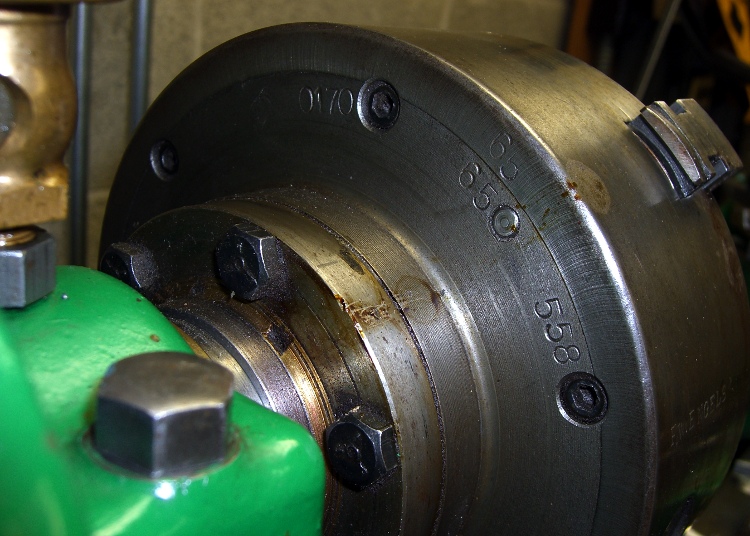
    Witness marks
    Witness marks

    I managed to jam the 3-jaw chuck on my lathe by turning the lathe on without the formality of snugging the chuck against the spindle first; IIRC, there was maybe 1/8″ clearance. The resounding thunk when the irresistible force hit the immovable object was the prelude to about a year of increasingly desperate attempts to remove the chuck, punctuated by long periods of despair.

    The absurd derring-do with clamping the 4-jaw Sherline chuck in the 3-jaw lathe chuck described there finally prompted me to ask my buddy Eks for advice, which is what I should have done in the first place. He suggested removing the chuck body from its backplate, building a lever that bolted to the backplate with the same six bolts as the chuck, blocking the spindle with wedges under the belt pulley, and wailing on the lever with a lead hammer.

    We wondered if a hard hammer would be better than the lead hammer, perhaps because the impact would be less squishy, but that was in the nature of fine tuning.

    The key idea is that removing the chuck body also removes a tremendous amount of rotational inertia, so that wailing on the lever arm actually transfers force / impact directly to the backplate, rather than trying to spin the body. The somewhat risky part is that there’s a pin connecting the spindle with the drive pulley (it’s disengaged when using the back gears), so that it’s entirely possible to break the pin rather than unstick the chuck. But it was still a better idea than any I’d had so far.

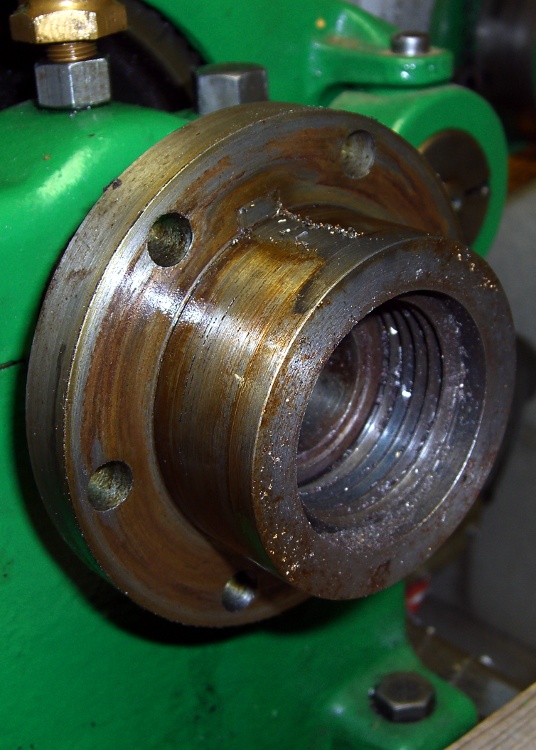
    Stuck backplate
    Stuck backplate

    Making note of the witness marks on the backplate and chuck body, I removed the body. Fortunately, there was just enough clearance between the front bearing journal and the backplate that I could get the bolts out without dismantling anything else.

    That left me with the rather grody and still firmly stuck backplate. The bolt disk was brazed onto the threaded cylinder with a keyway. Although the chuck body had a key slot, it looks like the matching key had been machined off of the cylinder, so the bolts were taking all the cutting torque. Worked OK for both the previous owner and for me, so I suspect it’ll continue to work just fine for the next owner, too.

    Bicycle handlebar stem in spindle
    Bicycle handlebar stem in spindle

    Peering through the spindle reminded me of some recent bike repairs and it occurred to me that maybe, just maybe, a old-skool split-wedge handlebar stem would get enough traction inside the spindle to hold it in place. Some rummaging in the Bike Junk box produced just such a stem and it fit exactly into the spindle bore. Now the spindle is fixed in place by its ID and there’s no risk of breaking the locking pin or (shudder) the back gear.

    Even better, the lumber pile emitted a chunk of 1×4 (actual dimensions!) wood that was precisely the correct length to reach from the floor to the stem. I like it when projects work like that; finding exactly the right stuff in the pile is sort of an omen that things are going well.

    Fundamental rule: always start with a hunk of something that looks a lot like what you want to end up with.

    Corollary: ya gotta have stuff!

    Coordinate-drilling the lever arm
    Coordinate-drilling the lever arm

    Some rummaging in the parts heap turned up several feet of nice “angle iron”, so I bandsawed off a hunk. I should have realized something was wrong when a foot of teeth stripped right off the saw blade, but I ascribed that to, oh, maybe weakening a few teeth when I soldered up the blade.

    I had our daughter run the trig to generate coordinates for the six holes, then lay out the center bore and bolt holes on the plate for practice. Drilling the first hole prompted me to resharpen the drill, but poking the remaining five holes into that plate produced vast clouds of wood smoke from the sacrificial plate underneath, despite boiling copious quantities of cutting fluid off the top.

    I finally admitted defeat when the “angle iron” rubbed the teeth right off a 2-inch hole saw.

    As nearly as I can tell, that plate is un-machinable stainless steel, hand-forged by the Devil himself specifically to taunt me, and is good for nothing. Obviously, I hadn’t used it for anything in the years it had been in my pile and, perhaps as an omen, it didn’t have any other holes in it from anybody else’s efforts. I’ll keep the pieces around just to sneer at them; won’t get fooled again.

    So, at this point, I am out a bandsaw blade, a drill bit, and a hole saw. We won’t discuss the circle cutter or my abortive attempt to lash the damn thing down to the Sherline and perform helix-milling upon it.

    Unstuck backplate with beating bolt
    Unstuck backplate with beating bolt

    While licking my wounds, I wondered if the bolt circle on the backplate would provide enough lever arm to make any difference. I tightened a sacrificial bolt & nut with one face of the bolt aligned along a radius from the spindle center, then deployed a big drift punch and the two-pound ball-peen hammer (a.k.a., The BFH).

    A half-dozen good shots later, the backplate spun free. Notice the very small gap between spindle and backplate… that’s all it takes!

    I added a closed-cell foam washer to fill the gap between the backplate nose and the butt end of the chuck; there was a remarkable amount of crud built up in there.

    I am so happy that it even makes up for the death toll among the tools…

    It’s worth noting that the headstock has two honkin’ big bronze spindle bearings, no delicate balls, and a few mighty thwacks didn’t do them a bit of harm.