The Smell of Molten Projects in the Morning

Ed Nisley's Blog: Shop notes, electronics, firmware, machinery, 3D printing, laser cuttery, and curiosities. Contents: 100% human thinking, 0% AI slop.

Month: December 2008

  • Small Sherline Clamps

    Made six hold-down clamps for the Sherline mill, inspired by this much fancier project:

    http://www.sherline.com/tip5.htm
    Adapted Bookshelf Extrusion and Screws
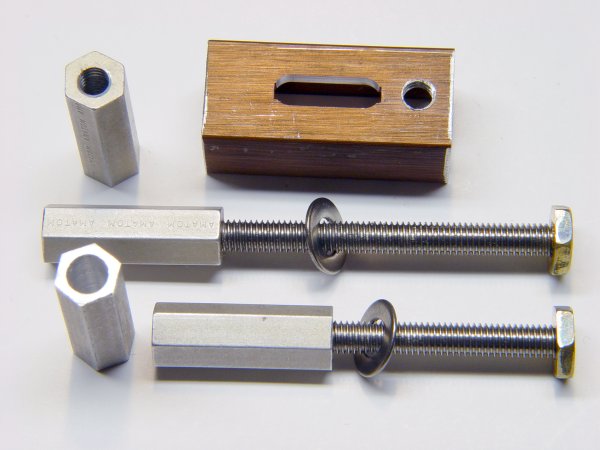
    Adapted Bookshelf Extrusion and Screws

    He used steel clamps, brazed on little brass snippets, and used brass hex rod for the nuts. I hate machining steel, particularly in teeny pieces, and didn’t have any brass hex stock that small: improvisation was in order!

    So I sawed up an old aluminum bookshelf rail, CNC-ed the slot (more practice writing G-code), sawed the heads off some stainless 10-32 screws, and produced something that might work just as well.

    My stash has a lifetime supply of 10-24 brass nuts, so I jammed them on the end of the 10-32 screws in the back to act as pads against the mill table top. No finesse there…

    The T-slots aren’t quite deep enough for the nuts, though, so I milled 15 thou off each side of another six nuts and discovered, once again, that you can’t take an arbitrarily thin cut unless you have an arbitrarily sharp cutter… which, of course, I don’t. Made a plastic spacer to hold the nuts just high enough to nibble off the excess and just low enough to grip ’em in the mill vise. Did the whole thing without leaving embarrassing scars on the vise or ruining the cutter, much to my delight.

    Tapped the slenderized nuts 10-32 (how crude!) and applied green Loctite to the three goobered threads to lock the screws in place. The flats just clear the T-slots and the thickness is just barely OK, so I declared success.
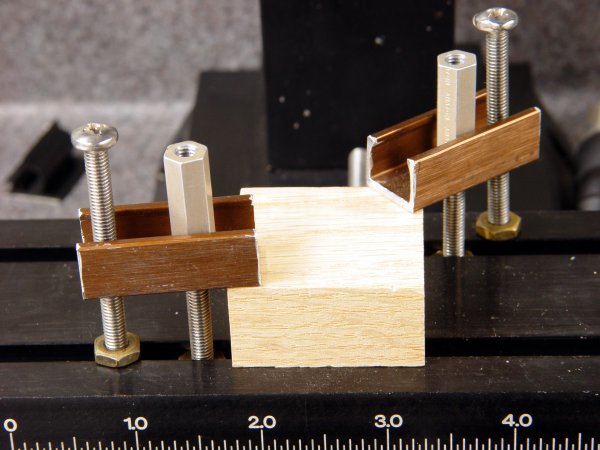
    Clamps In Action
    Clamps In Action

    The Good Idea in the original project lies in the long hex nuts. They’re drilled out about 3/4 of their length to clear the 10-32 screws, so you can just drop them on and spin a few times rather than tediously twisting them all the way down. My stash yielded some 2-inch aluminum standoffs tapped for 4-40 screws on each end; cut ’em in half, drilled out the raw end, drilled-and-tapped the existing holes to 10-32, and there they were.

    And, best of all, my fingers will smell like tapping lube for the rest of the month… ah, shop time!

    Update: You can cut a nice taper on the nose if you don’t like the relentless square aspect of those things or need a bit more clearance. They’re peeking into the sides of the bottom picture there, holding the sacrificial plate in place.
  • Park MTB-7 Rescue Tool Repair

    Too-short Stud
    Too-short Stud
    Goobered Screw Threads
    Goobered Screw Threads

    Once upon a time I deployed the 6 mm hex wrench on my trusty Park MTB-7 Rescue Tool, applied some torque to a handebar stem bolt, and crunch something broke inside the tool.

    [Update: Fixed a dead link; Park evidently reshuffled their website.]

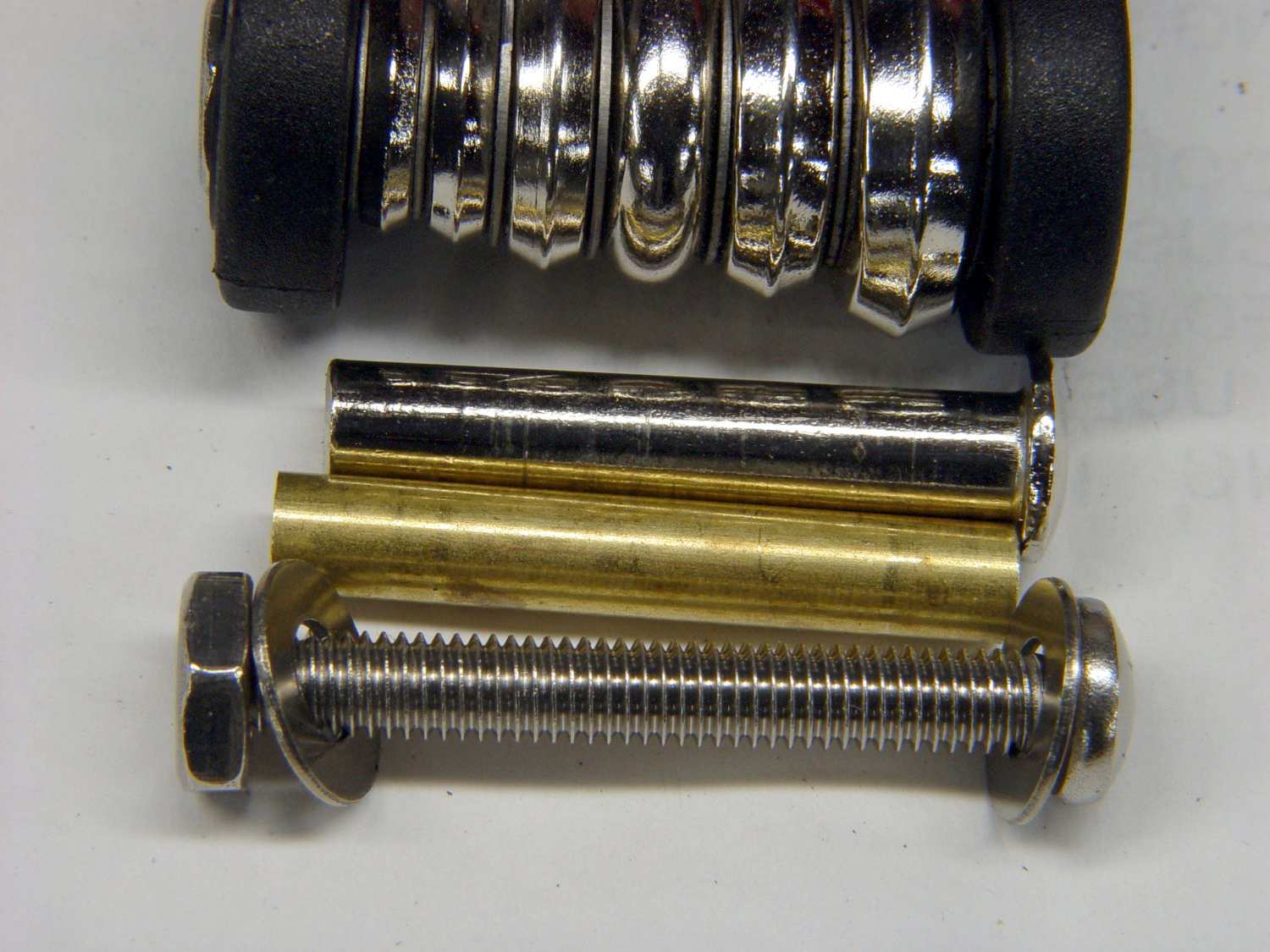
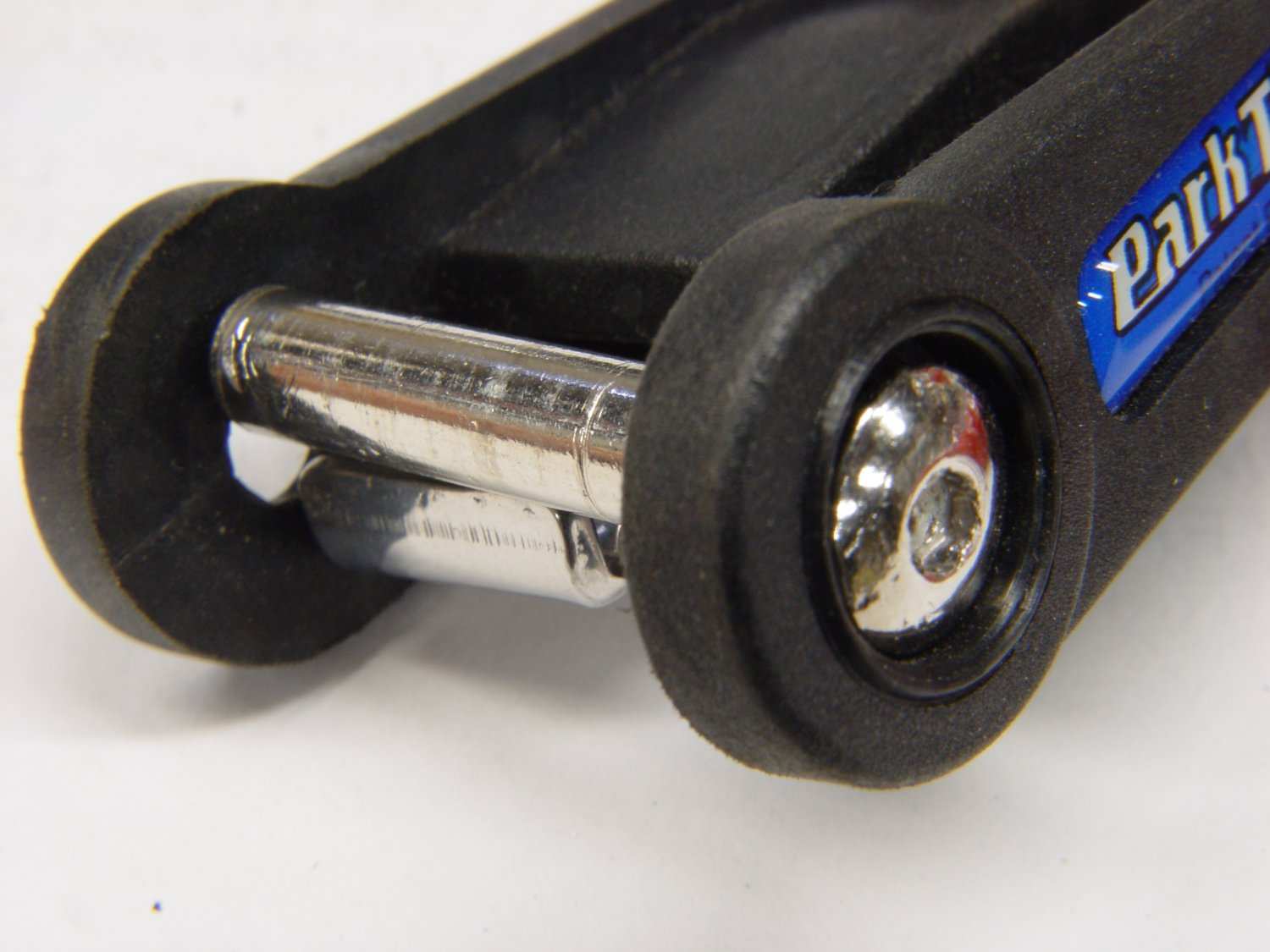
    The essential problem is that the studs holding the tools in place are too short: they don’t seat fully into the plastic housing at the far end, because they’re 2 mm too short. The photo showing the stud at an angle gives an idea of the situation I saw when I took the tool apart.

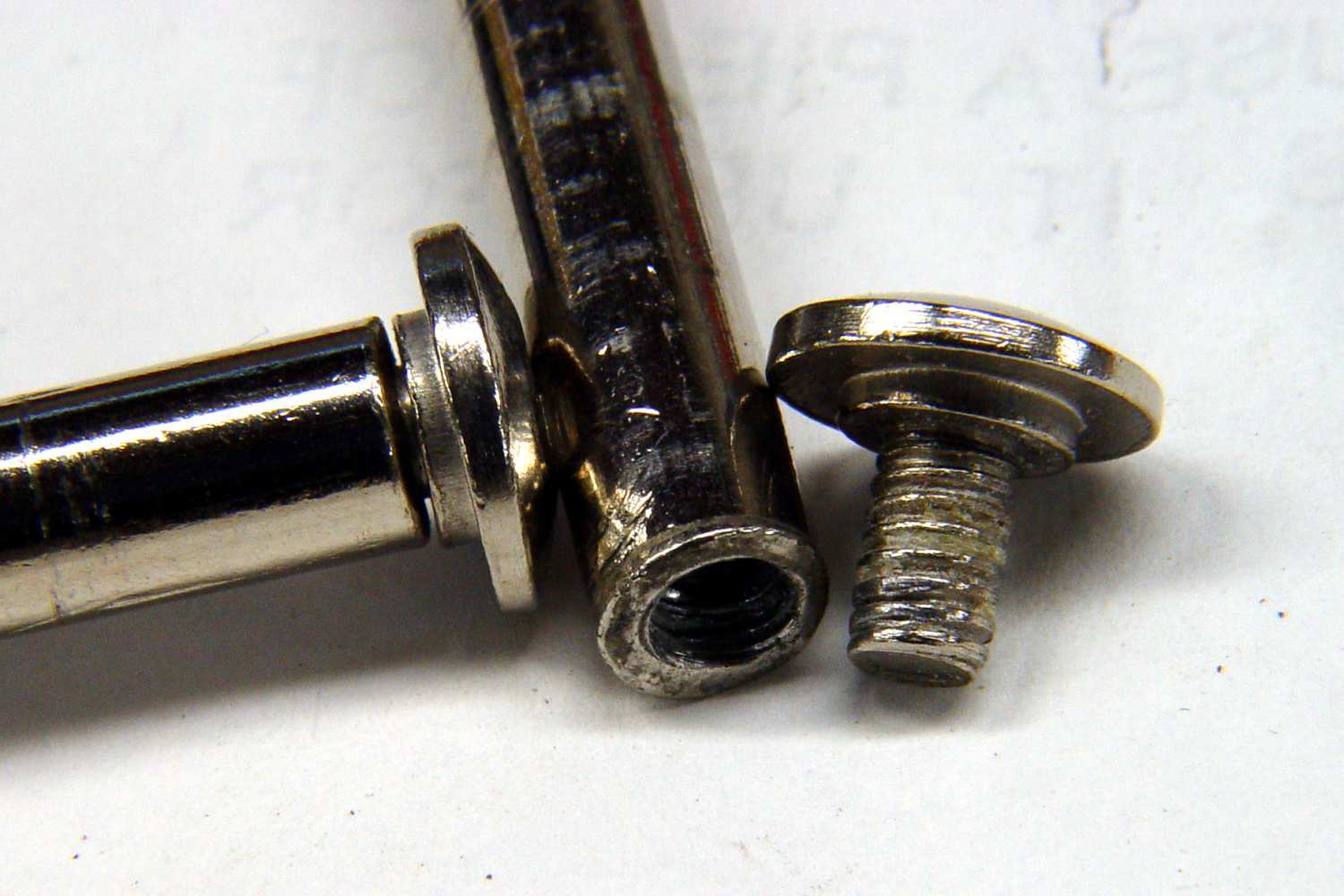
    The crunching sound I heard was the screw tearing out as the stud shifted in the housing. The studs seem to be swaged into shape in one operation, but without quite enough material: the threaded end isn’t flat and the internal threads are crap. The photo showing the studs and screws can’t really show how off-center and feeble the internal threads really are, but you can see the junk lodged in the external screw’s threads where it tore out. Note the poor fit between the other stud’s end and its screw: it’s firmly seated against the stud, so that’s how far off square the end is!

    Better Screw and Sleeve
    Better Screw and Sleeve

    The fix was easy enough. I cut some brass tubing to the proper length, trimmed stainless-steel 10-32 screws to fit, and put everything together with red Loctite. The photo showing the all the parts indicates how much longer my sleeves are than the original studs: basically, that’s the thickness of the plastic housing on one side.

    But, sheesh, you’d expect a Park tool to be better than that. I sent ’em a note with pictures and maybe they’ll smack the factor who shorted ’em on the Quality bullet item upside the head.

    I got to spend some time playing with my toys, so it wasn’t a dead loss.

  • CD Longevity, Lack Thereof

    Remember when they said CDs would last for a hundred years?

    Some years back, a bit o’ PC shuffling around here spat out a 60 GB hard drive and brought the Big Box of CDs up from the fireproof safe at the same time. A little mental math: hey, why not?

    Turns out that all 130+ of my “purchased” CDs, mostly with Windows programs & device drivers, add up to 42 GB of ISO images. Creating ISOs is trivial with Linux:

    dd if=/dev/cdrecorder of=image.iso

    and you’re done. Depending on your system, you’ll get faster transfer with a bigger blocksize: bs=1M is more than enough.

    I used the two upstairs PCs as readers, with the hard drive installed in the milling-machine PC downstairs. It took the better part of a day to think up file names and feed CDs into the slots. Typical speeds were 3 MB/s, dropping dramatically with read retries: a minute or two or three per CD. The average CD is half-full.

    I wrote a trivial script to do the tedious work: loaded the CD, issued the dd command, computed MD5 checksums on the raw CD data and the stored file, and ejected the CD. The checksums always matched except when the disc had read errors, but gave me confidence I wasn’t losing any bits along the way, because the CD got read twice and any marginal sectors that were fixed-in-error would pop out.

    One CD was completely unreadable because of a nasty scratch. Another, never used, turned out to be cracked in the sealed envelope.

    What’s scary is the number of previously good, visibly undamaged, used-once-or-twice CDs that couldn’t be read in at least one drive. I don’t abuse the things and I -know- some of these haven’t seen the light of day more than once or twice.

    Dozens (I lost count) weren’t readable in at least one drive and many weren’t readable in three drives. If you happened to have two of those drives in your one-and-only PC you’d be sunk without a trace.

    I had a visibly undamaged CD that couldn’t be read in any of the four drives, although rubbing it down with toothpaste (got nothing to lose!) persuaded it to play in the CD burner. Perhaps a minute scratch? Dunno, but if that CD was damaged, then you can’t even look at ’em without damaging the things.

    The most reliable drive was a CD-only burner. The DVD-ROM and DVD-burner drives could read most discs, but fell flat on others. There’s no obvious difference between a DVD+(only) burner and the DVD+/- burners.

    Bottom line: maybe a quarter of those spendy pressed commercial CDs on your shelf won’t work when you really need to reinstall those programs. Should you happen to do an installation that doesn’t read the part of the CD with rotten bits, then you’ll never notice. I was copying the entire bit stream off the disc, so every single sector had to pass muster. How lucky do you feel?

    If you think you’ll ever need ’em again, get ’em on a hard drive now. Then you can burn ’em as needed. Oh, yeah, put the serial number right in the file name, too, it’ll come in handy.

    Hundred years, ptui!

    Back then I didn’t know about GNU ddrescue. Now, I do. Life is good. Well, better.

    Update: Nowadays, I keep everything on a 500 GB drive in the file server, which does a daily backup to a 500 GB external drive. Once a month, more or less, I dump the contents of the daily backup drive to a similar drive that lives in the fireproof safe.

    Tip: mounting an ISO is easier than finding & mounting the CD. They’re served up over an NFS share mounted locally at /mnt/diskimages, so it goes a little something like this:

    mount -o loop,ro /mnt/diskimages/ISOs/name-of-CD.iso /mnt/loop/

    and away you go. The ro option keeps you from screwing things up with an inadvertent write.

    That doesn’t work in Windows, more’s the pity, but you can find GUI utilities that more-or-less do the same thing from a SAMBA share. Not that I care all that much.

  • Spoke Wrenching

    I recently rebuilt the back wheel on my bike, which had been breaking the odd spoke and getting more & more out of true.

    Spoke wrenches are so tedious when one’s fingers don’t fit in between the spokes like they should. I figured, hey, if the pros can use power drivers, so can I…

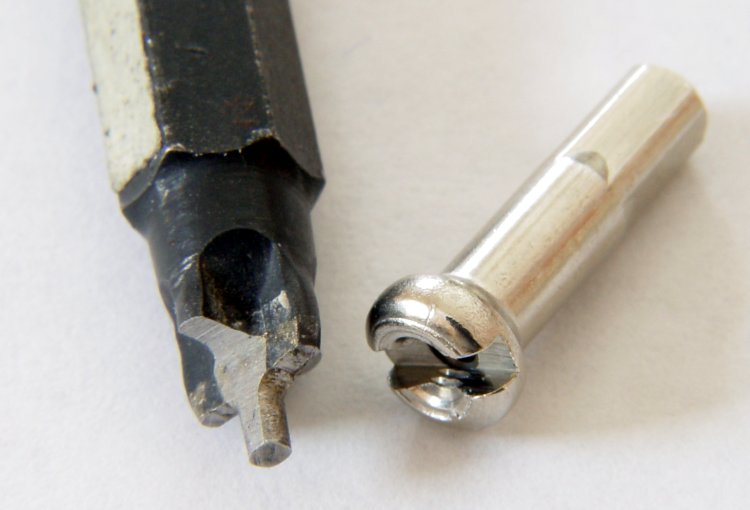
    Dug a goobered #2 Philips bit out of the ziplock baggie labeled “NFG Bits” and applied it to the bench grinder. The strip of tape on one flat makes turn-counting easy enough that I can actually get it right. It’s not hardened, so it probably won’t last for more than a few wheels, but this is the first scratch-built wheel I’ve done in decades and that baggie is nowhere near empty.

    Homebrew Spoke Wrench Bit
    Homebrew Spoke Wrench Bit

    I read through Jobst Brandt’s The Bicycle Wheel to get prepped for the job, removed the old spokes, laced up the new ones, lubed the threads & rim washers, and the wheel trued up almost perfectly just by counting turns.

    Did the spoke aligning & stress-relieving tricks, applied some final tweaking, and it’s perfect!

  • Database Troubles

    So I bought a batch of small carbide bits at Lowe’s: some Dremel burrs and a neat pointed RotoZip engraving bit. Got to the checkout and everything went swimmingly except the RotoZip, which triggered a management override.

    This caused the dreaded price check on Register 6, the only register open at the time. People are four deep behind me and the line is growing.

    Manager shows up, scans his magic power card, types in a small bit of life history, scans the package again. It calls for another management override.

    He re-scans his card, types in a (presumably different) slice of life history, re-scans the package, and the price pops up in bright green for all to see:

    89991 Point Cutting $10,000.00

    “This just isn’t going to happen” sez I. In round numbers, I think it costs 15 bux. Maybe 10, maybe 20.

    The line now extends to the paint counter. I turn to the woman behind me and observe that I don’t think I’ve ever charged a $10,000 item before and that I sure hope it comes with a free yacht.

    The manager laughs, re-scans his card, types in still more life history, re-scans the package, types in yet more life history, and a new price pops up:

    89991 Point Cutting $1.00

    I say “Thank you very much!” He sez “Have a nice day!” The cashier sez “Wow, great deal!” I say “I’m outta here!”

    Hopped on my bike and rode off into the haze.

    I strongly support the “If it doesn’t scan, it’s free” method of price determination, but this is just the second time it’s happened. The first was a clerk who made an on-the-spot decision. This one had management approval!

    I think the price in their database is $10k because of a data entry error, which triggered the first management override.

    Fairly obviously, the database didn’t get fixed today.

    But a good time was had by all!

  • Bicycle Performance

    Back in 2006 I biked to the Main Event Criterium in Po-town to watch real bicycle crazies in action. Despite the name, the course was literally around the blocks near the Poughkeepsie High & Middle Schools on Forbus St & College Ave: about 0.75 miles per lap.

    Now, most places, folks give ‘bent riders a smile and maybe chat ’em up. Not here. Talk about a cold shoulder: the local-resident bystanders were friendly, but the real riders and their main squeezes obviously regarded my pimped-out recumbent as a Hostile Gesture. Barely even a sideways look; it’s as if I didn’t exist.

    I timed a few laps of the Masters 40/50+ race: Olde Fartes like me, but still players. They did 15 laps (maybe a dozen miles) at 16-17 mph. Two guys duked it out for the lead all the way to the finish, with the rest of the pack half a lap behind and fading.

    In my ordinary rides I can cover a dozen or so miles at 15-16 mph, riding with vigor but not an all-out, my-eyeballs-will-explode effort. That’s on open roads with actual hills, traffic signals, and no pace car to clear the way.

    Obviously, I’m nowhere near their well-chiseled physical condition.

    There’s no comparing the bikes, either.

    They’re riding the latest carbon-fiber weight-weenie frames on exotic aero wheels with pitifully few spokes. One guy blew a tire with a bang that sounded like a gunshot.

    I’m riding a steel-frame Tour Easy recumbent bicycle with a fairing, fat Kevlar-belted tires, tire liners, steel spokes (and lots of ’em), a rack, two baggage packs, a water bladder, ham radio, blinky lights, spare batteries, a tool kit, and fenders. Not to mention an aerobelly. Heck, my tool kit probably weighs more than their frame.

    Imagine what they could do on real bikes…

    Somebody mentioned that the TdF guys hit 70+ mph on downhills. I forebore to mention that the human-powered speed record is nearly 80 mph on the flats… I figured that would definitely be regarded as a Hostile Gesture.

    [Update: a friend accused me of riding while carrying more smug than legally permitted, even for Prius drivers. Guilty as charged.

    You’ll find more ‘bent posts by clicking on the “Recumbent Bicycling” category.]

  • STP: The Miracle Lubricant

    Every PC I’ve ever owned with a fan-cooled video card has had a fan failure. It used to take years, now it takes months. The obvious conclusion: cheapnified fans.

    The “business class” Dell I’d been using as a file server started groaning a year ago. I swapped out the video card fan for a similar (used) one from my heap, which failed after half a year. I just replaced the whole box with a newer one that has on-board graphics with no fan…

    A while ago I stuck a pair of nVidia cards in my always-on desktop box so I could get a portrait-mode page display. One of the cards had a bizarre cooler with a fan stuck inside a fingered aluminum cup clamped atop the video chip: definitely not a FRU, at least from my parts heap.

    Months later: groaning & whining. So I used the same trick as I did for the fan in the refrigerator: a drop of STP soaked into the sintered bronze sleeve bearing. Worked like a champ (the freezer fan is still silent) and the PC is now nearly silent once more.

    While I have the STP out, I’m going to blob some on the bathroom fan that’s starting to groan. Certainly cheaper than replacing the fan and, as I found out with the refrigerator, even a new fan can have crappy bearings.

    I now officially loathe fans…

    Yes, I’m perfectly aware that STP is not a real lubricant, but it’s close enough for these bearings. Mostly, it’s slippery and gooey and works perfectly to damp out shaft vibrations and wobbulations.