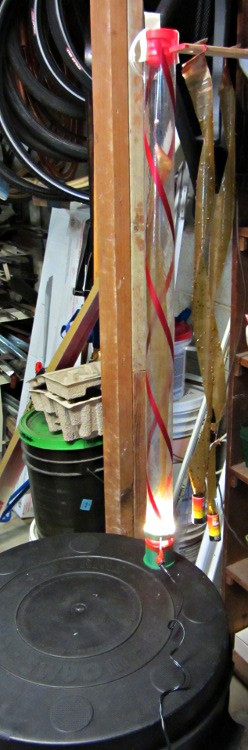
A few months after shaking off the previous fruit fly infestation, the worm compost bin has succumbed to another species of fruit fly that’s probably Drosophila melanogaster: much larger, breeds faster, and seems far more tenacious. Even though they’re completely innocuous, Something Must Be Done, but alas there are no insecticides suitable for a worm bin that produces vegetable garden compost. That reduces the situation to the Siege of Stalingrad: cut off their supplies and let them fight it out.
It seems that fruit flies and their progeny die slightly faster than worms; after three or six weeks without feeding, the flies will should be history and the worms will be eating the dead. Temperatures in the Basement Laboratory Vermiculture Wing will remain in the 60 °F range for the next month or two, so the fly egg-to-adult time will be longer than the usual eight days and this may not work as well as we’d like.
Assuming that succeeds, however, we’ll be freezing all the kitchen scraps that go into the bin to kill off the fruit fly eggs that arrive here from around the world. There seems no way to get fruits without fruit fly eggs, even with non-organic produce. Organic stuff, well, it’s worse than that.
I conjured up a Fruit Fly Escape trap that should I hope will lure flies out of the bin to their death, while keeping the worms inside.This won’t help much with the current extreme infestation, but may help dry the bin’s upper layer and, when we get the population knocked down, should exterminate the more adventurous survivors. Obviously, we’re breeding for stay-at-home fruit flies and, given their rapid-prototyping life cycle, they may evolve into tiny couch potatoes.
Anyhow.
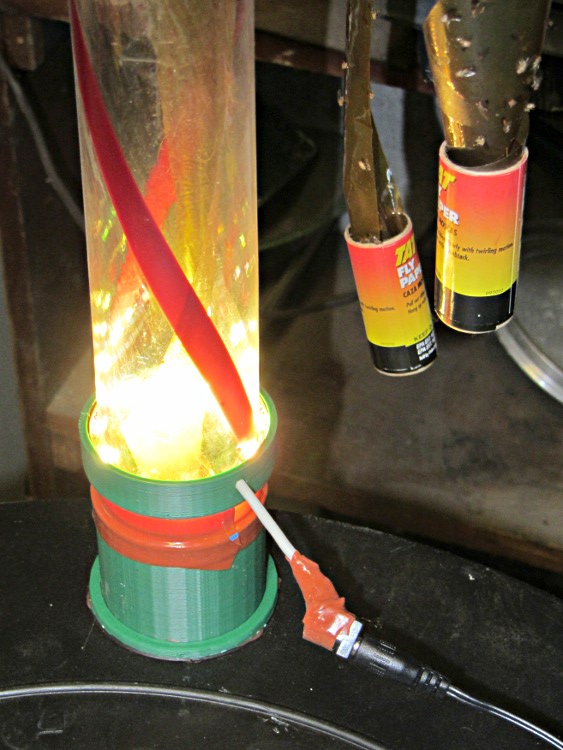
Flies like heat and light, while worms vastly prefer cool and dark, so the general idea is to drill a hole in the bin lid, fit a long tube over it, put an LED ring light at the base, and run a flypaper spiral up the tube to a vent cap near the top. The first picture gives an overview, although it’s tough to see the vertical tube against the clutter: it’s clear with two red spirals, having started life as some weird-ass holiday decoration for the previous owners of our house.
Anyhow, the more interesting plastic bits look like this:
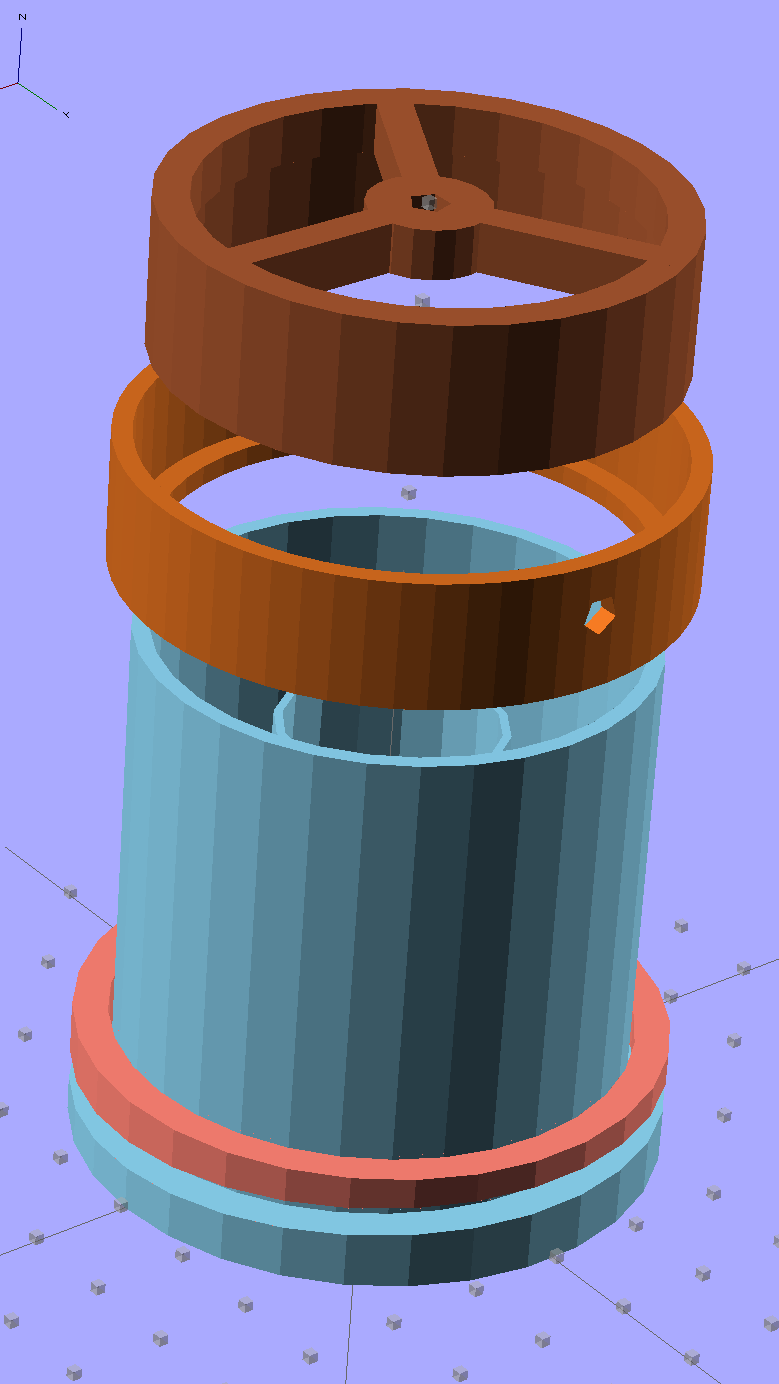
The top ring is the vent cap, with a hole in the middle for a string supporting the sticky tape strip. The middle ring holds three sections of LED strip light that dissipate about 2 W from a 12 V wall wart; that’s enough heat around the tube to produce a slight upward draft. The riser tube at the bottom has an angled rim that compensates for the bin lid angle and holds the long tube vertical. The ring around the riser has a matching angle.
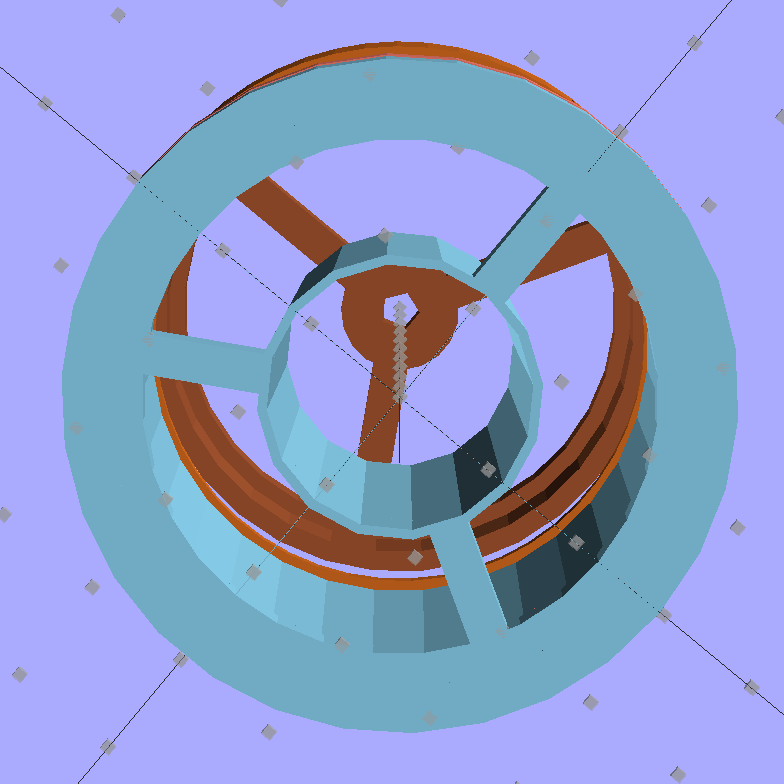
They fit into the lid thusly:

Two beads of hot-melt glue, top and bottom, hold them in place and make an air- / worm- / fly-tight seal.
The inner tube holds the fly paper container and has a slight inward taper toward the top to wedge it in place:
A similar view from inside the actual lid:
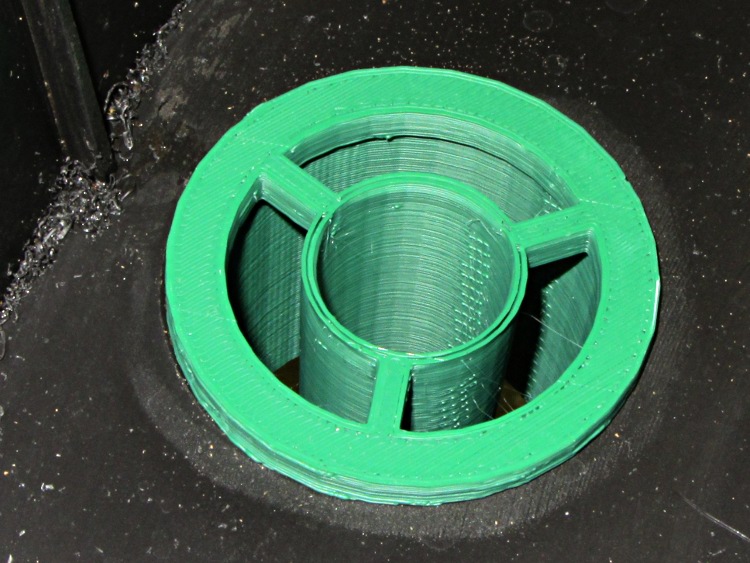
That was the first pass at the dimensions; the tube walls didn’t quite join because I forgot to force the number of polygonal sides to be equal. It’s deliberately thin to make the walls springy, but everything must be Just Right to get both no fill and no space between the two perimeter threads.
The riser and LED ring, combined with festive spiral stripes along the tube and some silicone tape sealing the tubes together, produce a cheery nuclear glow that’s enhanced by the victims mired in the adjacent flypaper strips. A third strip runs up the middle of the tube:
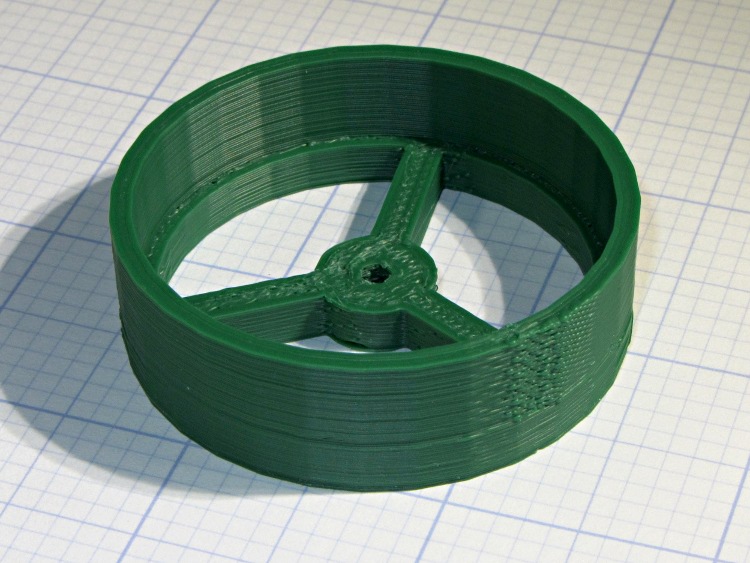
The vent cap on the top of the tube has a small hole in the middle to hold the string supporting the flypaper spiral exactly in the middle of the tube. This view is upside-down from the mounted orientation :
The alert reader will notice a red top plug in place of the vent cap in the first picture. This whole project happened over the course of a frantic afternoon, evening, and morning, with progressive product improvements along the way. For example, it turns out that some flies went pedestrian and walked up the inside of the tube, so there’s now a circle of screening inside that nice vented cap.
Having a 3D printer to hammer out custom plastic widgetry on a short schedule = win.
The OpenSCAD source code:
// Worm bin fly escape
// Ed Nisley KE4ZNU - March 2012

Layout = "Show";						// Build.. Show Riser Ring Cap

//- Extrusion parameters - must match reality!

ThreadThick = 0.25;
ThreadWidth = 2.0 * ThreadThick;

HoleFinagle = 0.3;
HoleFudge = 1.00;

function HoleAdjust(Diameter) = HoleFudge*Diameter + HoleFinagle;

Protrusion = 0.1;						// make holes end cleanly

//-- Dimensions

RiserID = 47.0;							// ID = transparent riser tube OD
RiserOD = 51.0;							// OD = hole in lid (matches hole saw OD)
RiserHeight = 50.0;						// wall height from lid

RiserSides = 4*8;						// for consistency & symmetry

RiserBaseHeight = IntegerMultiple(5.0,ThreadThick);			// stop ring height
RiserBaseID = RiserID - 2*1.0;								// stop ring ID

LipOD = 59.0;							// OD of lip mounted on lid around tube
LipAngle = 3.0;							// angle for lip to make tube vertical
LipMinThick = IntegerMultiple(3.0,ThreadThick);		// min lip thickness
LipAngleThick = LipOD*tan(LipAngle);				// angled section thickness
LipThick = LipMinThick + LipAngleThick;				// total lip thickness

RingClearance = 0.5;								// space between ring and tube

TrapID = 23.0;							// sticky tape container OD
TrapIDTaper = 2.0;						// taper to hold container in place
TrapHeight = 45.0;						//  ... height
TrapWallThickness = 2*ThreadWidth;
TrapSides = 4*4;

TrapFlanges = 3;						// number of support flanges
TrapFlangeThick = IntegerMultiple(3.5,ThreadWidth);

LEDThick = 2.5;							// LED strip thickness
LEDWidth = 11.0;						//  ... width
LEDWireOD = 3.0;						// power cable dia
LightID = RiserID + 2*LEDThick;			// ID of LED collar
LightOD = LightID + 2*4*ThreadWidth;		//  ... OD
LightFlangeThick = IntegerMultiple(2.0,ThreadThick);

CapID = RiserID;
CapRingID = CapID - 2*1.5;
CapOD = CapID + 2*4*ThreadWidth;
CapBaseHeight = RiserBaseHeight;
CapHeight = 10.0 + CapBaseHeight;
CapSides = RiserSides;
CapFlanges = 3;
CapFlangeThick = TrapFlangeThick;
CapGuideID = 3.0;
CapGuideOD = CapGuideID + 6*ThreadWidth;

//-- Sticky tape container holder

module TrapMount() {

  ODBot = TrapID + 2*TrapWallThickness;
  ODTop = TrapID - TrapIDTaper + 2*TrapWallThickness;

  difference() {
	union() {
	  cylinder(r1=ODBot/2,r2=ODTop/2,h=TrapHeight,$fn=TrapSides);
	  for (i=[0:TrapFlanges-1])
		rotate(i*(360/TrapFlanges) + 90)			// align leg with thick side
		  translate([RiserOD/4,0,RiserBaseHeight/2])
			cube([(RiserOD/2 - 4*Protrusion),TrapFlangeThick,RiserBaseHeight],center=true);
	}
	translate([0,0,-Protrusion])
	  cylinder(r1=HoleAdjust(TrapID)/2,
			   r2=HoleAdjust(TrapID - TrapIDTaper)/2,
			   h=(TrapHeight + 2*Protrusion),
			   $fn=TrapSides);
  }

}

//-- Riser tube

module RiserTube() {

  TotalHeight = RiserHeight + RiserBaseHeight;

  difference() {
	cylinder(r=RiserOD/2,h=TotalHeight,$fn=RiserSides);
	translate([0,0,RiserBaseHeight])
	  PolyCyl(RiserID,TotalHeight,RiserSides);
	translate([0,0,-Protrusion])
	  cylinder(r=RiserBaseID/2,h=TotalHeight,$fn=RiserSides);
  }

}

//-- Angled lip around ring
//		aligned with flat side downward at Z=0

module LipRing(Clearance = 0.0) {

  difference() {
	cylinder(r=LipOD/2,h=LipThick);
	translate([0,0,-Protrusion])
	  cylinder(r=(RiserOD/2 + Clearance),
			   h=(LipThick + 2*Protrusion),
			   $fn=RiserSides);
	rotate([LipAngle,0,0])
	  translate([-LipOD,-LipOD,(LipMinThick + LipOD/2*tan(LipAngle))])
		cube([2*LipOD,2*LipOD,LipAngleThick],center=false);
  }
}

//-- Collar to hold LED strip light

module LEDCollar() {

  difference() {
	PolyCyl(LightOD,(LEDWidth + LightFlangeThick));
	translate([0,0,LightFlangeThick])
	  PolyCyl(LightID,(LEDWidth + Protrusion));
	translate([0,0,-Protrusion])
	  PolyCyl(RiserID,(LightFlangeThick + 2*Protrusion));
	translate([0,0,(LightFlangeThick + LEDWidth/2)])
	  rotate([0,90,90])
		PolyCyl(LEDWireOD,LightOD);
  }
}

//-- Cap to hold trap string and vent the tube

module VentCap() {

	union() {
	  difference() {
		cylinder(r=CapOD/2,h=CapHeight,$fn=CapSides);
		translate([0,0,-Protrusion])
		  cylinder(r=CapRingID/2,h=(CapHeight +2*Protrusion),$fn=CapSides);
		translate([0,0,CapBaseHeight])
		  cylinder(r=CapID/2,h=CapHeight,$fn=CapSides);
	  }
	  difference() {
		union() {
		  for (i=[0:TrapFlanges-1])
			rotate(i*(360/CapFlanges))
			  translate([CapOD/4,0,CapBaseHeight/2])
				cube([(CapOD/2 - 4*Protrusion),CapFlangeThick,CapBaseHeight],center=true);
		  cylinder(r=CapGuideOD,h=CapBaseHeight);
		}
		translate([0,0,-Protrusion])
		  PolyCyl(CapGuideID,CapHeight);
	  }
	}

}

//-- Handy routines

function IntegerMultiple(Size,Unit) = Unit * ceil(Size / Unit);

module PolyCyl(Dia,Height,ForceSides=0) {           // based on nophead's polyholes

  Sides = (ForceSides != 0) ? ForceSides : (ceil(Dia) + 2);

  FixDia = Dia / cos(180/Sides);

  cylinder(r=(FixDia + HoleFinagle)/2,h=Height,$fn=Sides);
}

//-- Put peg grid on build surface

module ShowPegGrid(Space = 10.0,Size = 1.0) {

  Range = floor(50 / Space);

	for (x=[-Range:Range])
	  for (y=[-Range:Range])
		translate([x*Space,y*Space,Size/2])
		  %cube(Size,center=true);

	for (z=[1:10])
	  translate([0,0,z*Space])
		  %cube(Size,center=true);
}

//- Build it

ShowPegGrid();

if (Layout == "Ring")
  LipRing();

if (Layout == "Riser")
  RiserTube();

if (Layout == "Cap")
  VentCap();

if (Layout == "Show") {
  color("SkyBlue") {
	TrapMount();
	RiserTube();
	LipRing();
  }
  color("Salmon")
	translate([0,0,2*LipThick])
	  rotate([180,0,0])
		LipRing(RingClearance);
  color("Chocolate")
	translate([0,0,(1.25*RiserHeight)])
	  LEDCollar();
  color("Sienna")
	translate([0,0,2*RiserHeight])
	  rotate([180,0,0])
		VentCap();
}

if (Layout == "Build1") {
  TrapMount();
  RiserTube();
  LipRing();
}

if (Layout == "Build2") {
	LipRing(RingClearance);
}

if (Layout == "Build3") {
	LEDCollar();
}

if (Layout == "Build4") {
	VentCap();
}
 The Smell of Molten Projects in the Morning